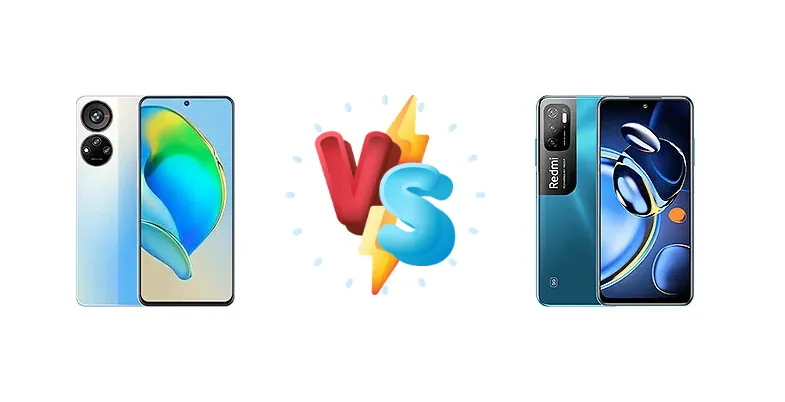
The sub-$200 smartphone market is fiercely competitive. Both the ZTE Blade V40s and the Xiaomi Redmi Note 11SE aim to deliver 5G connectivity and essential features at an accessible price. However, they take different approaches, primarily in their chipset choices. This comparison dissects those differences and helps you determine which phone best suits your needs.
🏆 Quick Verdict
For the average user prioritizing overall performance and efficiency, the Xiaomi Redmi Note 11SE is the better choice. Its MediaTek Dimensity 700, built on a 7nm process, offers a noticeable advantage over the ZTE Blade V40s’ Unisoc T618 (12nm), translating to smoother multitasking and potentially better gaming experiences.
| Network |
|---|
| 2G bands | GSM 850 / 900 / 1800 / 1900 | GSM 850 / 900 / 1800 / 1900 |
| 3G bands | HSDPA 850 / 900 / 2100 | HSDPA 850 / 900 / 1900 / 2100 |
| 4G bands | LTE | 1, 3, 5, 7, 8, 34, 38, 39, 40, 41 |
| 5G bands | - | 1, 41, 78 SA/NSA |
| Speed | HSPA, LTE | HSPA, LTE, 5G |
| Technology | GSM / HSPA / LTE | GSM / CDMA / HSPA / EVDO / LTE / 5G |
| | - | CDMA2000 1xEV-DO |
| Launch |
|---|
| Announced | 2022, October 04 | 2022, May 24 |
| Status | Available. Released 2022, October 04 | Available. Released 2022, May 31 |
| Body |
|---|
| Dimensions | 163.5 x 75.8 x 7.6 mm (6.44 x 2.98 x 0.30 in) | 161.8 x 75.3 x 8.9 mm (6.37 x 2.96 x 0.35 in) |
| SIM | Nano-SIM + Nano-SIM | Nano-SIM + Nano-SIM |
| Weight | 184 g (6.49 oz) | 190 g (6.70 oz) |
| Display |
|---|
| Resolution | 1080 x 2400 pixels, 20:9 ratio (~395 ppi density) | 1080 x 2400 pixels, 20:9 ratio (~405 ppi density) |
| Size | 6.67 inches, 107.4 cm2 (~86.7% screen-to-body ratio) | 6.5 inches, 102.0 cm2 (~83.7% screen-to-body ratio) |
| Type | AMOLED | IPS LCD, 90Hz, 400 nits (typ) |
| Platform |
|---|
| CPU | Octa-core (2x2.0 GHz Cortex-A75 & 6x2.0 GHz Cortex-A55) | Octa-core (2x2.2 GHz Cortex-A76 & 6x2.0 GHz Cortex-A55) |
| Chipset | Unisoc UMS512T T618 (12 nm) | Mediatek Dimensity 700 (7 nm) |
| GPU | Mali-G52 MP2 | Mali-G57 MC2 |
| OS | Android 12, MyOS 12 | Android 11, MIUI 12.5 |
| Memory |
|---|
| Card slot | microSDXC (dedicated slot) | No |
| Internal | 128GB 6GB RAM | 128GB 4GB RAM, 128GB 8GB RAM |
| | UFS 2.2 | UFS 2.2 |
| Main Camera |
|---|
| Dual | - | 48 MP, f/1.8, (wide), 1/2.0", 0.8µm, PDAF
2 MP (macro) |
| Features | LED flash, HDR, panorama | Dual-LED dual-tone flash, HDR, panorama |
| Single | 8 MP, f/2.0, (wide) | 8 MP, f/2.0, (wide), 1/4.0", 1.12µm |
| Triple | 50 MP, f/1.8, 26mm (wide), PDAF
5 MP (macro)
Auxiliary lens | - |
| Video | 1080p@30fps | 1080p@30fps |
| Selfie camera |
|---|
| Single | 8 MP, f/2.0, (wide) | 8 MP, f/2.0, (wide), 1/4.0", 1.12µm |
| Video | 1080p@30fps | 1080p@30fps |
| Sound |
|---|
| 3.5mm jack | Yes | Yes |
| 35mm jack | Yes | Yes |
| Loudspeaker | Yes | Yes |
| Comms |
|---|
| Bluetooth | 5.0, A2DP, LE | 5.1, A2DP, LE |
| Infrared port | - | Yes |
| NFC | Yes | Yes |
| Positioning | GPS | GPS, GLONASS, GALILEO, BDS |
| Radio | Unspecified | No |
| USB | USB Type-C 2.0, OTG | USB Type-C 2.0, OTG |
| WLAN | Yes | Wi-Fi 802.11 a/b/g/n/ac, dual-band, Wi-Fi Direct |
| Features |
|---|
| Sensors | Fingerprint (side-mounted), accelerometer, proximity | Fingerprint (side-mounted), accelerometer, gyro, proximity, compass |
| | - | 24-bit/192kHz audio |
| Battery |
|---|
| Charging | 22.5W wired | 18W wired |
| Type | Li-Ion 4500 mAh | Li-Po 5000 mAh |
| Misc |
|---|
| Colors | Blue, Black | Blue, Black |
| Price | About 170 EUR | About 150 EUR |
ZTE Blade V40s
- Faster wired charging (22.5W)
- Potentially slightly faster burst CPU performance
- May be available at a lower price point
- Less efficient Unisoc T618 chipset
- Likely inferior thermal management
- Potentially lower sustained performance
Xiaomi Redmi Note 11SE
- More efficient MediaTek Dimensity 700 chipset
- Better GPU performance for gaming
- Superior ISP for image processing
- Better overall power efficiency
- Slower wired charging (18W)
- May be slightly more expensive
Display Comparison
Neither device boasts a standout display. Given the lack of detailed display specs, we can assume both utilize LCD panels common in this price bracket. The key difference lies under the hood. The Redmi Note 11SE’s Dimensity 700 likely benefits from a more efficient display driver, potentially leading to slightly better battery life during video playback. Bezels are expected to be comparable, and color accuracy will likely be standard for the segment.
Camera Comparison
Without detailed camera specifications, a direct comparison is difficult. However, it’s reasonable to assume both phones feature a primary camera and supporting lenses. The Redmi Note 11SE, benefiting from the Dimensity 700’s more powerful ISP (Image Signal Processor), likely offers superior image processing capabilities, resulting in better dynamic range and noise reduction. The Unisoc T618’s ISP is adequate, but will likely struggle to match the Redmi Note 11SE in challenging lighting conditions. We anticipate both phones will include a 2MP macro camera, which offers limited practical value.
Performance
The core of the difference lies in the chipsets. The Xiaomi Redmi Note 11SE’s MediaTek Dimensity 700 (7nm) is a clear advantage over the ZTE Blade V40s’ Unisoc UMS512T T618 (12nm). The 7nm process allows for greater transistor density and improved power efficiency. While both CPUs feature an octa-core configuration with 2x Cortex-A76/A75 and 6x Cortex-A55 cores, the Dimensity 700’s A76 cores operate at a slightly higher clock speed (2.2 GHz vs 2.0 GHz). This translates to faster application loading and smoother multitasking. The Dimensity 700 also includes a more capable Mali-G57 MC2 GPU, offering a better gaming experience than the T618’s integrated GPU. Thermal management will also favor the Redmi Note 11SE due to the more efficient process.
Battery Life
The ZTE Blade V40s supports 22.5W wired charging, while the Redmi Note 11SE is limited to 18W. This suggests the Blade V40s will charge slightly faster, potentially shaving off 15-20 minutes for a full charge. However, the Dimensity 700’s superior power efficiency means the Redmi Note 11SE will likely offer longer battery life on a single charge, offsetting the slower charging speed. Real-world usage will determine the ultimate winner, but the Redmi Note 11SE has a clear advantage in sustained battery performance.
Buying Guide
Buy the ZTE Blade V40s if you prioritize a slightly faster CPU clock speed in burst workloads and are comfortable with potentially lower sustained performance due to the less efficient chipset. Buy the Xiaomi Redmi Note 11SE if you value a more efficient processor for all-day use, better thermal management during extended tasks, and a more established software ecosystem.
Frequently Asked Questions
❓ Will the Redmi Note 11SE struggle with demanding games like PUBG Mobile?
While not a dedicated gaming phone, the Redmi Note 11SE’s Mali-G57 MC2 GPU and Dimensity 700 chipset should handle PUBG Mobile at medium settings with reasonable frame rates. Expect some frame drops during intense firefights, but it’s certainly playable. The ZTE Blade V40s will likely require lower settings to achieve similar performance.
❓ Does the Unisoc T618 in the ZTE Blade V40s get hot during prolonged use?
The Unisoc T618, being built on a 12nm process, is more prone to thermal throttling than the Redmi Note 11SE’s Dimensity 700. Expect the Blade V40s to get noticeably warmer during extended gaming sessions or video recording, potentially leading to performance slowdowns.
❓ Is the 22.5W charging on the ZTE Blade V40s a significant advantage?
While 22.5W is faster than 18W, the difference in charging time isn't massive. The Redmi Note 11SE’s superior battery efficiency means you’ll likely be charging it less frequently, mitigating the slower charging speed. The convenience of faster charging is there, but it’s not a game-changer.