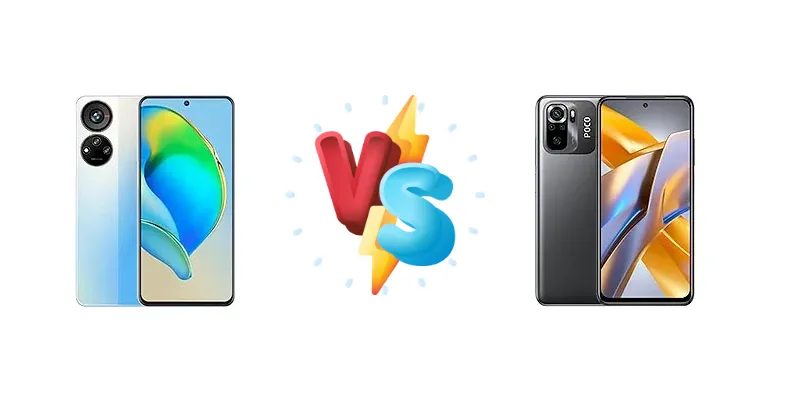
The budget smartphone market is fiercely competitive, offering incredible value for your money. Today, we're pitting two popular contenders against each other: the ZTE Blade V40s and the Xiaomi Poco M5s. Both promise a lot, but which one delivers the best overall experience?
🏆 Quick Verdict
The Xiaomi Poco M5s edges out the ZTE Blade V40s thanks to its faster charging, brighter display, and generally more powerful chipset. While the Blade V40s offers a clean software experience, the Poco M5s provides a more well-rounded package for the price.
| Network |
|---|
| 2G bands | GSM 850 / 900 / 1800 / 1900 | GSM 850 / 900 / 1800 / 1900 |
| 3G bands | HSDPA 850 / 900 / 2100 | HSDPA 850 / 900 / 1700(AWS) / 1900 / 2100 |
| 4G bands | LTE | 1, 2, 3, 4, 5, 7, 8, 20, 28, 38, 40, 41 |
| Speed | HSPA, LTE | HSPA, LTE |
| Technology | GSM / HSPA / LTE | GSM / HSPA / LTE |
| Launch |
|---|
| Announced | 2022, October 04 | 2022, September 05 |
| Status | Available. Released 2022, October 04 | Available. Released 2022, September 06 |
| Body |
|---|
| Build | - | Glass front (Gorilla Glass 3), plastic frame, plastic back |
| Dimensions | 163.5 x 75.8 x 7.6 mm (6.44 x 2.98 x 0.30 in) | 160.5 x 74.5 x 8.3 mm (6.32 x 2.93 x 0.33 in) |
| SIM | Nano-SIM + Nano-SIM | Nano-SIM + Nano-SIM |
| Weight | 184 g (6.49 oz) | 178.8 g (6.31 oz) |
| | - | IP53, dust and splash resistant |
| Display |
|---|
| Protection | - | Corning Gorilla Glass 3 |
| Resolution | 1080 x 2400 pixels, 20:9 ratio (~395 ppi density) | 1080 x 2400 pixels, 20:9 ratio (~409 ppi density) |
| Size | 6.67 inches, 107.4 cm2 (~86.7% screen-to-body ratio) | 6.43 inches, 99.8 cm2 (~83.5% screen-to-body ratio) |
| Type | AMOLED | AMOLED, 450 nits (typ), 700 nits (HBM), 1100 nits (peak) |
| Platform |
|---|
| CPU | Octa-core (2x2.0 GHz Cortex-A75 & 6x2.0 GHz Cortex-A55) | Octa-core (2x2.05 GHz Cortex-A76 & 6x2.0 GHz Cortex-A55) |
| Chipset | Unisoc UMS512T T618 (12 nm) | Mediatek MT6785V/CD Helio G95 (12 nm) |
| GPU | Mali-G52 MP2 | Mali-G76 MC4 |
| OS | Android 12, MyOS 12 | Android 12, MIUI 13 |
| Memory |
|---|
| Card slot | microSDXC (dedicated slot) | microSDXC (dedicated slot) |
| Internal | 128GB 6GB RAM | 64GB 4GB RAM, 128GB 4GB RAM, 128GB 6GB RAM, 256GB 8GB RAM |
| | UFS 2.2 | UFS 2.2 |
| Main Camera |
|---|
| Features | LED flash, HDR, panorama | LED flash, HDR, panorama |
| Quad | - | 64 MP, f/1.8, 26mm (wide), 1/1.97", 0.7µm, PDAF
8 MP, f/2.2, 118˚ (ultrawide), 1/4.0", 1.12µm
2 MP (macro)
Auxiliary lens |
| Single | 8 MP, f/2.0, (wide) | - |
| Triple | 50 MP, f/1.8, 26mm (wide), PDAF
5 MP (macro)
Auxiliary lens | - |
| Video | 1080p@30fps | 4K@30fps, 1080p@30/60/120fps, 720p@960fps |
| Selfie camera |
|---|
| Features | - | HDR |
| Single | 8 MP, f/2.0, (wide) | 13 MP, f/2.4, (wide), 1/3.06", 1.12µm |
| Video | 1080p@30fps | 1080p@30fps |
| Sound |
|---|
| 3.5mm jack | Yes | Yes |
| 35mm jack | Yes | Yes |
| Loudspeaker | Yes | Yes, with stereo speakers |
| Comms |
|---|
| Bluetooth | 5.0, A2DP, LE | 5.0, A2DP, LE |
| Infrared port | - | Yes |
| NFC | Yes | Yes |
| Positioning | GPS | GPS, GLONASS, GALILEO, BDS |
| Radio | Unspecified | FM radio |
| USB | USB Type-C 2.0, OTG | USB Type-C 2.0 |
| WLAN | Yes | Wi-Fi 802.11 a/b/g/n/ac, dual-band, Wi-Fi Direct |
| Features |
|---|
| Sensors | Fingerprint (side-mounted), accelerometer, proximity | Fingerprint (side-mounted), accelerometer, gyro, compass |
| | - | Virtual proximity sensing |
| Battery |
|---|
| Charging | 22.5W wired | 33W wired, 64% in 30 min |
| Type | Li-Ion 4500 mAh | Li-Po 5000 mAh |
| Misc |
|---|
| Colors | Blue, Black | Gray, Blue, White |
| Models | - | 2207117BPG |
| Price | About 170 EUR | About 120 EUR |
| SAR | - | 1.00 W/kg (head) 0.65 W/kg (body) |
| SAR EU | - | 0.60 W/kg (head) 0.87 W/kg (body) |
| Tests |
|---|
| Battery life | - |
Endurance rating 132h
|
| Camera | - |
Photo / Video |
| Display | - |
Contrast ratio: Infinite (nominal) |
| Loudspeaker | - |
-25.4 LUFS (Very good)
|
| Performance | - |
AnTuTu: 360681 (v9)
GeekBench: 1831 (v5.1)
GFXBench: 18fps (ES 3.1 onscreen) |
ZTE Blade V40s
- Clean Android experience
- Reliable camera performance
- Decent battery life
- Slower charging
- Less powerful chipset
- Lower display brightness
Xiaomi Poco M5s
- Faster charging (33W)
- Brighter display (756 nits)
- More powerful chipset (Helio G95)
- Good value for money
- MIUI software can be bloated
- Potential for ads in MIUI
- Camera performance may not be top-tier
Display Comparison
The Poco M5s boasts a significant advantage with its measured 756 nits max brightness, making it much easier to see in direct sunlight. While the Blade V40s display is adequate, it lacks the same level of visibility. The Poco M5s also touts an 'infinite' contrast ratio, suggesting deeper blacks and richer colors, though this is a nominal claim. Both phones likely use AMOLED panels, offering vibrant colors and deep blacks.
Camera Comparison
Both phones offer 'Photo / Video' capabilities, but detailed camera specifications are missing. However, based on general expectations for these price points, the Poco M5s likely has a slight edge in image quality, particularly in low-light conditions, due to its potentially better image processing and sensor size. Both likely feature a main camera, ultrawide, macro, and depth sensor.
Performance
The Poco M5s's Helio G95 chipset, featuring Cortex-A76 cores, generally outperforms the Blade V40s's Unisoc T618, which relies on Cortex-A75 cores. This translates to smoother multitasking, faster app loading times, and better gaming performance on the Poco M5s. While both have octa-core CPUs, the architecture and clock speeds favor the Poco M5s.
Battery Life
Both phones claim impressive endurance ratings of 132h. However, the Poco M5s's 33W wired charging is significantly faster than the Blade V40s's 22.5W charging, allowing for quicker top-ups.
Buying Guide
The ZTE Blade V40s is ideal for users prioritizing a clean Android experience and a reliable, if not groundbreaking, camera. The Xiaomi Poco M5s is a better choice for those seeking faster charging, a brighter display for outdoor use, and a slightly more powerful processor for gaming and demanding apps.
Frequently Asked Questions
❓ Which phone has better gaming performance?
The Xiaomi Poco M5s generally offers better gaming performance due to its more powerful Helio G95 chipset.
❓ Is the ZTE Blade V40s software clean?
Yes, the ZTE Blade V40s is known for its relatively clean Android experience, free from excessive bloatware.