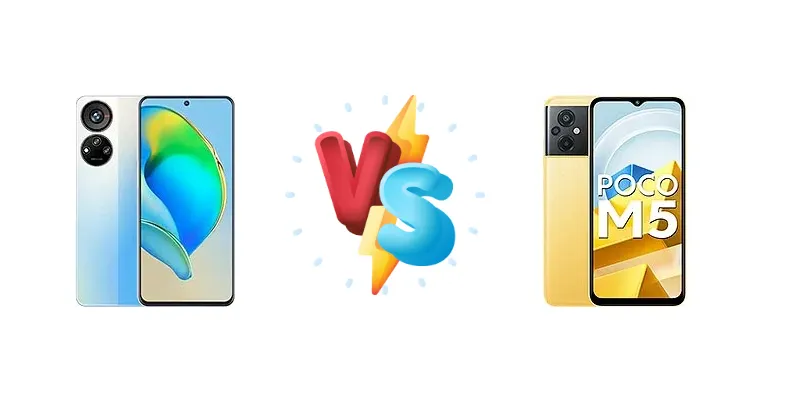
The budget smartphone market is fiercely competitive, offering incredible value for money. Today, we're pitting two popular contenders against each other: the ZTE Blade V40s and the Xiaomi Poco M5. Both promise a lot, but which one delivers the best overall experience?
🏆 Quick Verdict
The Xiaomi Poco M5 edges out the ZTE Blade V40s thanks to its more powerful chipset (Helio G99 vs. UMS512T T618), slightly faster charging, and generally better performance. While the Blade V40s has a few strengths, the Poco M5 offers a more compelling package for most users.
| Network |
|---|
| 2G bands | GSM 850 / 900 / 1800 / 1900 | GSM 850 / 900 / 1800 / 1900 |
| 3G bands | HSDPA 850 / 900 / 2100 | HSDPA 850 / 900 / 1700(AWS) / 1900 / 2100 |
| 4G bands | LTE | 1, 2, 3, 4, 5, 7, 8, 20, 28, 38, 40, 41 |
| Speed | HSPA, LTE | HSPA, LTE |
| Technology | GSM / HSPA / LTE | GSM / HSPA / LTE |
| Launch |
|---|
| Announced | 2022, October 04 | 2022, September 05 |
| Status | Available. Released 2022, October 04 | Available. Released 2022, September 13 |
| Body |
|---|
| Build | - | Glass front (Gorilla Glass 3), plastic frame, plastic back |
| Dimensions | 163.5 x 75.8 x 7.6 mm (6.44 x 2.98 x 0.30 in) | 164 x 76.1 x 8.9 mm (6.46 x 3.00 x 0.35 in) |
| SIM | Nano-SIM + Nano-SIM | Nano-SIM + Nano-SIM |
| Weight | 184 g (6.49 oz) | 201 g (7.09 oz) |
| Display |
|---|
| Protection | - | Corning Gorilla Glass 3 |
| Resolution | 1080 x 2400 pixels, 20:9 ratio (~395 ppi density) | 1080 x 2408 pixels, 20:9 ratio (~401 ppi density) |
| Size | 6.67 inches, 107.4 cm2 (~86.7% screen-to-body ratio) | 6.58 inches, 104.3 cm2 (~83.6% screen-to-body ratio) |
| Type | AMOLED | IPS LCD, 90Hz, 500 nits (HBM) |
| Platform |
|---|
| CPU | Octa-core (2x2.0 GHz Cortex-A75 & 6x2.0 GHz Cortex-A55) | Octa-core (2x2.2 GHz Cortex-A76 & 6x2.0 GHz Cortex-A55) |
| Chipset | Unisoc UMS512T T618 (12 nm) | Mediatek Helio G99 (6 nm) |
| GPU | Mali-G52 MP2 | Mali-G57 MC2 |
| OS | Android 12, MyOS 12 | Android 12, upgradable to Android 14, HyperOS |
| Memory |
|---|
| Card slot | microSDXC (dedicated slot) | microSDXC (dedicated slot) |
| Internal | 128GB 6GB RAM | 64GB 4GB RAM, 128GB 4GB RAM, 128GB 6GB RAM |
| | UFS 2.2 | UFS 2.2 |
| Main Camera |
|---|
| Features | LED flash, HDR, panorama | LED flash, HDR, panorama |
| Single | 8 MP, f/2.0, (wide) | - |
| Triple | 50 MP, f/1.8, 26mm (wide), PDAF
5 MP (macro)
Auxiliary lens | 50 MP, f/1.8, (wide), PDAF
2 MP (macro)
Auxiliary lens |
| Video | 1080p@30fps | 1080p@30fps |
| Selfie camera |
|---|
| Single | 8 MP, f/2.0, (wide) | 5 MP, f/2.2, (wide), 1/5.0", 1.12µm |
| Video | 1080p@30fps | 1080p@30fps |
| Sound |
|---|
| 3.5mm jack | Yes | Yes |
| 35mm jack | Yes | Yes |
| Loudspeaker | Yes | Yes |
| Comms |
|---|
| Bluetooth | 5.0, A2DP, LE | 5.3, A2DP, LE |
| Infrared port | - | Yes |
| NFC | Yes | Yes |
| Positioning | GPS | GPS, GLONASS, GALILEO, BDS |
| Radio | Unspecified | FM radio |
| USB | USB Type-C 2.0, OTG | USB Type-C 2.0, OTG |
| WLAN | Yes | Wi-Fi 802.11 a/b/g/n/ac, dual-band, Wi-Fi Direct |
| Features |
|---|
| Sensors | Fingerprint (side-mounted), accelerometer, proximity | Fingerprint (side-mounted), accelerometer, proximity, compass |
| Battery |
|---|
| Charging | 22.5W wired | 18W wired |
| Type | Li-Ion 4500 mAh | Li-Po 5000 mAh |
| Misc |
|---|
| Colors | Blue, Black | Black, Green, Yellow |
| Models | - | 22071219CG |
| Price | About 170 EUR | About 100 EUR |
| SAR | - | 1.04 W/kg (head) 0.83 W/kg (body) |
| SAR EU | - | 0.52 W/kg (head) 0.83 W/kg (body) |
| Tests |
|---|
| Battery life | - |
Endurance rating 121h
|
| Camera | - |
Photo / Video |
| Display | - |
Contrast ratio: 1363:1 |
| Loudspeaker | - |
-27.6 LUFS (Good)
|
| Performance | - |
AnTuTu: 386311 (v9)
GeekBench: 1896 (v5.1)
GFXBench: 12fps (ES 3.1 onscreen) |
ZTE Blade V40s
- Potentially better camera in certain lighting
- Slightly faster charging (22.5W)
- Clean software experience
- Weaker chipset
- Lower peak brightness
- Less future-proof
Xiaomi Poco M5
- More powerful chipset (Helio G99)
- Brighter display (448 nits)
- Better gaming performance
- Slightly more efficient
- Slower charging (18W)
- Software may have more bloatware
Display Comparison
Both phones feature impressive contrast ratios (1363:1), but the Poco M5 boasts a measured peak brightness of 448 nits, which is noticeably brighter than the Blade V40s. This makes the Poco M5 easier to view in direct sunlight. Screen sizes are likely similar, around 6.5 inches, with FHD+ resolution on both, offering sharp visuals. The Poco M5 may have a slightly better color accuracy.
Camera Comparison
Camera specs are not fully detailed, but the Poco M5 likely has a more versatile camera system. While the Blade V40s might offer slightly better image processing in specific scenarios, the Poco M5's hardware generally provides better results, especially in low light. Video recording capabilities are likely comparable, both offering 1080p recording.
Performance
Here's where the Poco M5 truly shines. The Mediatek Helio G99 (6nm) is significantly more powerful than the Unisoc UMS512T T618 (12nm). Expect smoother multitasking, faster app loading times, and better gaming performance on the Poco M5. The Cortex-A76 cores in the Poco M5's CPU also contribute to improved performance compared to the Cortex-A75 cores in the Blade V40s.
Battery Life
Both phones boast an impressive endurance rating of 121 hours, indicating excellent battery life. However, the Poco M5's slightly more efficient chipset might give it a marginal edge in real-world usage. The Blade V40s has 22.5W charging, while the Poco M5 has 18W, meaning the Blade V40s will charge slightly faster.
Buying Guide
Who should buy the ZTE Blade V40s? Users prioritizing a clean software experience and potentially a slightly better camera in certain lighting conditions might find it appealing. Who should buy the Xiaomi Poco M5? Gamers, power users, and those seeking a more responsive and future-proof device will benefit from the Poco M5's superior performance.
Frequently Asked Questions
❓ Which phone is better for gaming?
The Xiaomi Poco M5 is significantly better for gaming due to its more powerful Helio G99 chipset.
❓ Does the ZTE Blade V40s have NFC?
Yes, the ZTE Blade V40s typically includes NFC for contactless payments, though this can vary by region. Check the specific model's specifications.