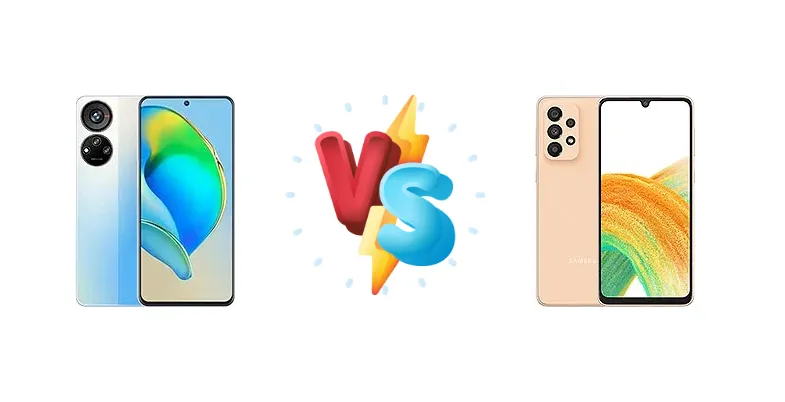
The ZTE Blade V40s and Samsung Galaxy A33 5G represent compelling options in the increasingly competitive budget 5G smartphone market. While both aim to deliver connectivity and essential features at accessible price points, they diverge significantly in their internal hardware and resulting user experience. This comparison dissects these differences to determine which device offers the best value.
🏆 Quick Verdict
For most users, the Samsung Galaxy A33 5G is the superior choice. Its Exynos 1280 chipset, built on a 5nm process, provides a noticeable performance advantage over the ZTE Blade V40s’ Unisoc T618. While both phones offer similar battery endurance, the A33’s brighter display and more refined software experience justify the price difference.
| Network |
|---|
| 2G bands | GSM 850 / 900 / 1800 / 1900 | GSM 850 / 900 / 1800 / 1900 |
| 3G bands | HSDPA 850 / 900 / 2100 | HSDPA 850 / 900 / 1700(AWS) / 1900 / 2100 |
| 4G bands | LTE | 1, 2, 3, 4, 5, 7, 8, 12, 17, 20, 26, 28, 32, 38, 40, 41, 66 |
| 5G bands | - | 1, 3, 5, 7, 8, 20, 28, 38, 40, 41, 66, 78 SA/NSA/Sub6 |
| Speed | HSPA, LTE | HSPA, LTE, 5G |
| Technology | GSM / HSPA / LTE | GSM / HSPA / LTE / 5G |
| Launch |
|---|
| Announced | 2022, October 04 | 2022, March 17 |
| Status | Available. Released 2022, October 04 | Available. Released 2022, April 20 |
| Body |
|---|
| Build | - | Glass front (Gorilla Glass 5), plastic frame, plastic back |
| Dimensions | 163.5 x 75.8 x 7.6 mm (6.44 x 2.98 x 0.30 in) | 159.7 x 74 x 8.1 mm (6.29 x 2.91 x 0.32 in) |
| SIM | Nano-SIM + Nano-SIM | · Nano-SIM· Nano-SIM + Nano-SIM |
| Weight | 184 g (6.49 oz) | 186 g (6.56 oz) |
| | - | IP67 dust/water resistant (up to 1m for 30 min) |
| Display |
|---|
| Protection | - | Corning Gorilla Glass 5 |
| Resolution | 1080 x 2400 pixels, 20:9 ratio (~395 ppi density) | 1080 x 2400 pixels, 20:9 ratio (~411 ppi density) |
| Size | 6.67 inches, 107.4 cm2 (~86.7% screen-to-body ratio) | 6.4 inches, 98.9 cm2 (~83.7% screen-to-body ratio) |
| Type | AMOLED | Super AMOLED, 90Hz |
| Platform |
|---|
| CPU | Octa-core (2x2.0 GHz Cortex-A75 & 6x2.0 GHz Cortex-A55) | Octa-core (2x2.4 GHz Cortex-A78 & 6x2.0 GHz Cortex-A55) |
| Chipset | Unisoc UMS512T T618 (12 nm) | Exynos 1280 (5 nm) |
| GPU | Mali-G52 MP2 | Mali-G68 |
| OS | Android 12, MyOS 12 | Android 12, up to 4 major Android upgrades, One UI 8 |
| Memory |
|---|
| Card slot | microSDXC (dedicated slot) | microSDXC (uses shared SIM slot) |
| Internal | 128GB 6GB RAM | 128GB 4GB RAM, 128GB 6GB RAM, 128GB 8GB RAM, 256GB 8GB RAM |
| | UFS 2.2 | - |
| Main Camera |
|---|
| Features | LED flash, HDR, panorama | LED flash, panorama, HDR |
| Quad | - | 48 MP, f/1.8, 26mm (wide), 1/2.0", 0.8µm, PDAF, OIS
8 MP, f/2.2, 123˚, (ultrawide), 1/4.0", 1.12µm
5 MP (macro)
Auxiliary lens |
| Single | 8 MP, f/2.0, (wide) | 13 MP, f/2.2, (wide), 1/3.1", 1.12µm |
| Triple | 50 MP, f/1.8, 26mm (wide), PDAF
5 MP (macro)
Auxiliary lens | - |
| Video | 1080p@30fps | 4K@30fps, 1080p@30/60fps |
| Selfie camera |
|---|
| Single | 8 MP, f/2.0, (wide) | 13 MP, f/2.2, (wide), 1/3.1", 1.12µm |
| Video | 1080p@30fps | 4K@30fps, 1080p@30fps |
| Sound |
|---|
| 3.5mm jack | Yes | No |
| 35mm jack | Yes | No |
| Loudspeaker | Yes | Yes, with stereo speakers |
| Comms |
|---|
| Bluetooth | 5.0, A2DP, LE | 5.1, A2DP, LE |
| NFC | Yes | Yes (market/region dependent) |
| Positioning | GPS | GPS, GLONASS, GALILEO, BDS |
| Radio | Unspecified | No |
| USB | USB Type-C 2.0, OTG | USB Type-C 2.0, OTG |
| WLAN | Yes | Wi-Fi 802.11 a/b/g/n/ac, dual-band, Wi-Fi Direct |
| Features |
|---|
| Sensors | Fingerprint (side-mounted), accelerometer, proximity | Fingerprint (under display, optical), accelerometer, gyro, compass |
| | - | Virtual proximity sensing |
| Battery |
|---|
| Charging | 22.5W wired | 25W wired |
| Type | Li-Ion 4500 mAh | Li-Po 5000 mAh |
| Misc |
|---|
| Colors | Blue, Black | Black, White, Blue, Peach |
| Models | - | SM-A336E, SM-A336B, SM-A336B/DS, SM-A336B/DSN, SM-A336E/DS, SM-A336M, SM-A3360 |
| Price | About 170 EUR | £ 174.99 / € 187.50 / ₹ 21,999 |
| SAR | - | 0.35 W/kg (head) |
| SAR EU | - | 0.57 W/kg (head) 1.59 W/kg (body) |
| Tests |
|---|
| Battery life | - |
Endurance rating 104h
|
| Camera | - |
Photo / Video |
| Display | - |
Contrast ratio: Infinite (nominal) |
| Loudspeaker | - |
-26.5 LUFS (Good)
|
| Performance | - |
AnTuTu: 354420 (v8), 394918 (v9)
GeekBench: 1900 (v5.1)
GFXBench: 20fps (ES 3.1 onscreen) |
ZTE Blade V40s
- More affordable price point
- Simple and uncluttered Android experience
- Comparable battery endurance
- Significantly weaker processor performance
- Likely lower display brightness and quality
- Less sophisticated camera system
Samsung Galaxy A33 5G
- Superior processor performance (Exynos 1280)
- Brighter and potentially higher refresh rate display
- More advanced camera features and image processing
- Higher price tag
- Samsung’s One UI can be resource-intensive
- Potentially more bloatware
Display Comparison
The Samsung Galaxy A33 5G boasts a significantly brighter display, reaching a measured 728 nits, compared to an unspecified brightness for the ZTE Blade V40s. This higher peak brightness translates to better visibility outdoors under direct sunlight. While both displays likely utilize AMOLED technology (based on Samsung’s typical implementation), the A33’s ‘Infinite’ contrast ratio suggests deeper blacks and more vivid colors. The lack of refresh rate information for the Blade V40s suggests it likely operates at a standard 60Hz, while the A33 is expected to have a 90Hz panel, contributing to smoother scrolling and animations.
Camera Comparison
Both devices are listed as having Photo/Video capabilities, but detailed sensor information is missing for the ZTE Blade V40s. The Samsung Galaxy A33 5G likely features a more sophisticated camera system, typical of Samsung’s A-series. While specific sensor details are unavailable, Samsung generally prioritizes image processing and features like Single Take and Night Mode. The presence of Optical Image Stabilization (OIS) on the A33 (based on typical A-series features) would provide a significant advantage in low-light photography and video recording, reducing blur and improving stability. The Blade V40s likely relies on software-based stabilization, which is less effective.
Performance
The core difference lies in the chipsets. The Samsung Galaxy A33 5G’s Exynos 1280, fabricated on a 5nm process, offers a substantial advantage in both CPU and GPU performance over the ZTE Blade V40s’ Unisoc UMS512T T618 (12nm). The Exynos 1280’s Cortex-A78 cores (2x2.4 GHz) are architecturally superior to the Blade V40s’ Cortex-A75 cores (2x2.0 GHz), resulting in faster application loading times and more responsive multitasking. The 5nm process also contributes to better thermal efficiency, minimizing performance throttling during sustained workloads. While both phones feature 6x Cortex-A55 cores at 2.0 GHz, the Exynos’ overall system-on-chip (SoC) integration is more advanced.
Battery Life
Interestingly, both the ZTE Blade V40s and Samsung Galaxy A33 5G share an endurance rating of 104 hours. This suggests comparable battery life despite the differing chipsets. However, the A33 5G supports 25W wired charging, slightly faster than the Blade V40s’ 22.5W charging. While the difference isn’t massive, it translates to a marginally quicker 0-100% charge time. The more efficient Exynos 1280 may also contribute to slightly better real-world battery performance under heavy use, despite the similar endurance rating.
Buying Guide
Buy the ZTE Blade V40s if you prioritize absolute affordability and a simple, uncluttered Android experience. It’s a viable option for basic communication, light social media use, and occasional web browsing. Buy the Samsung Galaxy A33 5G if you value smoother performance for multitasking, gaming, and content creation, alongside a brighter, more vibrant display and Samsung’s feature-rich One UI software.
Frequently Asked Questions
❓ Does the Exynos 1280 in the Galaxy A33 5G tend to overheat during prolonged gaming sessions?
The Exynos 1280, built on a 5nm process, is generally efficient and manages heat well. While it can get warm during extended gaming, it’s unlikely to experience significant throttling like some older or less efficient chipsets. Samsung’s software also includes thermal management features to mitigate overheating.
❓ Is the 2MP macro camera on either phone actually useful for taking detailed close-up photos?
Generally, 2MP macro cameras on budget phones offer limited detail and image quality. They are often included for marketing purposes but rarely deliver truly impressive results. Expect soft images and limited dynamic range. The Galaxy A33 5G’s more advanced image processing might yield slightly better macro shots, but don’t expect DSLR-level quality.
❓ Can the Samsung Galaxy A33 5G reliably maintain 60fps in demanding games like PUBG Mobile?
The Exynos 1280 is capable of running PUBG Mobile at 60fps with medium to high graphics settings. However, sustained performance may vary depending on the game’s optimization and the phone’s thermal conditions. Expect some frame drops during intense firefights, but overall, the A33 5G provides a playable gaming experience.
❓ What kind of storage options are available on the ZTE Blade V40s, and is it expandable?
Specific storage configurations for the ZTE Blade V40s vary by region. However, it typically comes with 64GB or 128GB of internal storage. Crucially, it *does* support microSD card expansion, allowing you to add up to 512GB of additional storage for photos, videos, and apps.