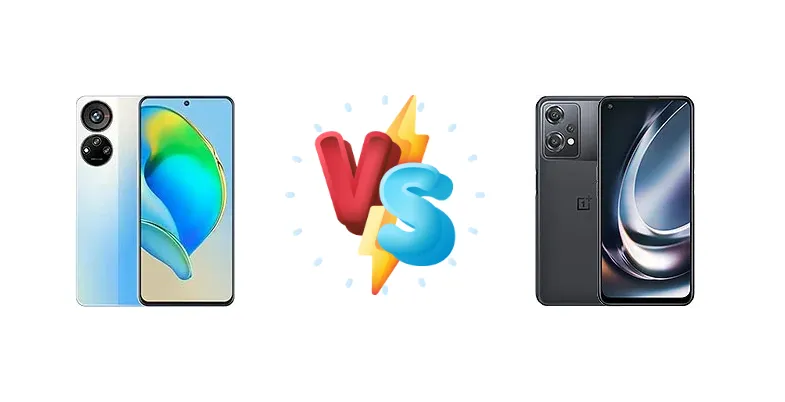
The sub-$250 smartphone market is fiercely competitive. The ZTE Blade V40s and OnePlus Nord CE 2 Lite 5G both aim to deliver 5G connectivity and essential features at an accessible price point. However, they take distinctly different approaches to achieving this, primarily through their chipset choices. This comparison dissects those differences and determines which phone offers the best overall experience.
🏆 Quick Verdict
For the average user prioritizing responsiveness and future-proofing, the OnePlus Nord CE 2 Lite 5G is the better choice. Its Snapdragon 695, built on a more efficient 6nm process, provides a noticeable performance advantage over the ZTE Blade V40s’ Unisoc T618, despite the latter’s slightly higher CPU clock speeds on paper.
| Network |
|---|
| 2G bands | GSM 850 / 900 / 1800 / 1900 | GSM 850 / 900 / 1800 / 1900 |
| 3G bands | HSDPA 850 / 900 / 2100 | HSDPA 800 / 850 / 900 / 1700(AWS) / 1900 / 2100 |
| 4G bands | LTE | 1, 2, 3, 4, 5, 7, 8, 12, 13, 17, 18, 19, 20, 26, 28, 38, 39, 40, 41, 66 - Europe |
| 5G bands | - | 1, 3, 5, 7, 8, 20, 28, 38, 40, 41, 66, 77, 78 SA/NSA - Europe |
| Speed | HSPA, LTE | HSPA, LTE, 5G |
| Technology | GSM / HSPA / LTE | GSM / HSPA / LTE / 5G |
| Launch |
|---|
| Announced | 2022, October 04 | 2022, April 28 |
| Status | Available. Released 2022, October 04 | Available. Released 2022, April 30 |
| Body |
|---|
| Build | - | Glass front, plastic frame, plastic back |
| Dimensions | 163.5 x 75.8 x 7.6 mm (6.44 x 2.98 x 0.30 in) | 164.3 x 75.6 x 8.5 mm (6.47 x 2.98 x 0.33 in) |
| SIM | Nano-SIM + Nano-SIM | Nano-SIM + Nano-SIM |
| Weight | 184 g (6.49 oz) | 195 g (6.88 oz) |
| Display |
|---|
| Resolution | 1080 x 2400 pixels, 20:9 ratio (~395 ppi density) | 1080 x 2412 pixels, 20:9 ratio (~401 ppi density) |
| Size | 6.67 inches, 107.4 cm2 (~86.7% screen-to-body ratio) | 6.59 inches, 104.5 cm2 (~84.1% screen-to-body ratio) |
| Type | AMOLED | IPS LCD, 120Hz |
| Platform |
|---|
| CPU | Octa-core (2x2.0 GHz Cortex-A75 & 6x2.0 GHz Cortex-A55) | Octa-core (2x2.2 GHz Kryo 660 Gold & 6x1.7 GHz Kryo 660 Silver) |
| Chipset | Unisoc UMS512T T618 (12 nm) | Qualcomm SM6375 Snapdragon 695 5G (6 nm) |
| GPU | Mali-G52 MP2 | Adreno 619 |
| OS | Android 12, MyOS 12 | Android 12, upgradable to Android 13, OxygenOS 13 |
| Memory |
|---|
| Card slot | microSDXC (dedicated slot) | microSDXC (uses shared SIM slot) |
| Internal | 128GB 6GB RAM | 128GB 6GB RAM, 128GB 8GB RAM |
| | UFS 2.2 | - |
| Main Camera |
|---|
| Features | LED flash, HDR, panorama | LED flash, HDR, panorama |
| Single | 8 MP, f/2.0, (wide) | - |
| Triple | 50 MP, f/1.8, 26mm (wide), PDAF
5 MP (macro)
Auxiliary lens | 64 MP, f/1.7, 26mm (wide), 0.7µm, PDAF
2 MP (macro)
Auxiliary lens |
| Video | 1080p@30fps | 1080p@30fps |
| Selfie camera |
|---|
| Features | - | HDR |
| Single | 8 MP, f/2.0, (wide) | 16 MP, f/2.0, (wide), 1/3.0", 1.0µm |
| Video | 1080p@30fps | 1080p@30fps |
| Sound |
|---|
| 3.5mm jack | Yes | Yes |
| 35mm jack | Yes | Yes |
| Loudspeaker | Yes | Yes |
| Comms |
|---|
| Bluetooth | 5.0, A2DP, LE | 5.2, A2DP, LE, aptX HD |
| NFC | Yes | Yes (market/region dependent) |
| Positioning | GPS | GPS, GLONASS, GALILEO, BDS, QZSS |
| Radio | Unspecified | Unspecified |
| USB | USB Type-C 2.0, OTG | USB Type-C 2.0, OTG |
| WLAN | Yes | Wi-Fi 802.11 a/b/g/n/ac, dual-band, Wi-Fi Direct |
| Features |
|---|
| Sensors | Fingerprint (side-mounted), accelerometer, proximity | Fingerprint (side-mounted), accelerometer, gyro, proximity, compass |
| Battery |
|---|
| Charging | 22.5W wired | 33W wired |
| Type | Li-Ion 4500 mAh | Li-Po 5000 mAh |
| Misc |
|---|
| Colors | Blue, Black | Black Dusk, Blue Tide |
| Models | - | CPH2381, CPH2409 |
| Price | About 170 EUR | About 220 EUR |
| SAR | - | 1.19 W/kg (head) 0.71 W/kg (body) |
ZTE Blade V40s
- Lower upfront cost
- Acceptable performance for basic tasks
- Functional for everyday use
- Less efficient Unisoc chipset
- Slower charging speed
- Potentially limited software support
OnePlus Nord CE 2 Lite 5G
- More powerful and efficient Snapdragon 695
- Faster 33W charging
- Better image processing capabilities
- Likely better long-term software support
- Slightly higher price
- May not be a significant upgrade for very basic users
- Still a budget device with inherent limitations
Display Comparison
Neither device boasts a standout display. Both likely utilize LCD panels, a common cost-saving measure in this segment. The key difference lies under the hood: the OnePlus benefits from the more efficient Snapdragon 695, potentially allowing for slightly better color calibration and brightness control. While specific nit ratings are unavailable, the 6nm process generally allows for more efficient power delivery to the display, potentially resulting in a marginally brighter image. Bezels are expected to be comparable, typical of budget devices.
Camera Comparison
Without detailed camera specs beyond the chipsets, a direct comparison is limited. However, the Snapdragon 695 typically offers superior image signal processing (ISP) capabilities compared to Unisoc’s offerings. This means the OnePlus Nord CE 2 Lite 5G is likely to produce more detailed and dynamic photos, especially in challenging lighting conditions. The ZTE Blade V40s will likely rely more heavily on software processing to compensate for its less capable ISP. The presence of a dedicated ISP within the Snapdragon 695 also aids in faster image capture and improved video stabilization.
Performance
The performance gap is the most significant differentiator. The OnePlus Nord CE 2 Lite 5G’s Qualcomm Snapdragon 695 (6nm) is architecturally superior to the ZTE Blade V40s’ Unisoc UMS512T T618 (12nm). The Snapdragon 695 utilizes Kryo 660 Gold and Silver cores, offering a more balanced and efficient performance profile. While the ZTE’s Cortex-A75 cores have a slightly higher peak clock speed (2.0 GHz vs 2.2 GHz on the OnePlus), the 6nm fabrication process of the Snapdragon 695 provides a substantial advantage in sustained performance and thermal management. This translates to smoother app switching, faster loading times, and a more responsive overall experience on the OnePlus, particularly during demanding tasks. The 6nm node also means less heat generation, reducing the likelihood of performance throttling.
Battery Life
Both phones offer adequate battery life for typical daily use. The OnePlus Nord CE 2 Lite 5G’s 33W wired charging is a clear advantage over the ZTE Blade V40s’ 22.5W charging. This faster charging speed translates to significantly reduced charging times – potentially shaving off 30-45 minutes to reach a full charge. While battery capacity isn’t specified, the more efficient Snapdragon 695 in the OnePlus will likely result in comparable or even better real-world battery life despite potentially having a similar capacity to the ZTE.
Buying Guide
Buy the ZTE Blade V40s if you prioritize a lower upfront cost and are primarily focused on basic smartphone tasks like calling, texting, and light social media browsing. Buy the OnePlus Nord CE 2 Lite 5G if you value smoother multitasking, a more responsive user experience, and the potential for better long-term software support, even if it means spending a bit more.
Frequently Asked Questions
❓ Will the Unisoc T618 in the ZTE Blade V40s struggle with demanding games like PUBG Mobile?
Yes, the Unisoc T618 is likely to struggle with graphically intensive games like PUBG Mobile, even at medium settings. The Snapdragon 695 in the OnePlus Nord CE 2 Lite 5G offers a significantly better gaming experience due to its more powerful GPU and efficient thermal management.
❓ How much faster is the 33W charging on the OnePlus Nord CE 2 Lite 5G compared to the ZTE Blade V40s’ 22.5W charging?
The 33W charging on the OnePlus Nord CE 2 Lite 5G can reduce charging times by approximately 30-45 minutes for a full 0-100% charge compared to the ZTE Blade V40s. This is a substantial difference for users who frequently need to top up their battery quickly.
❓ Does the Snapdragon 695 in the OnePlus Nord CE 2 Lite 5G offer better 5G connectivity than the Unisoc T618?
Generally, Qualcomm’s Snapdragon modems are known for their more reliable and wider 5G band support compared to Unisoc’s. While both phones support 5G, the OnePlus Nord CE 2 Lite 5G is more likely to achieve stronger and more consistent 5G connections in various regions.