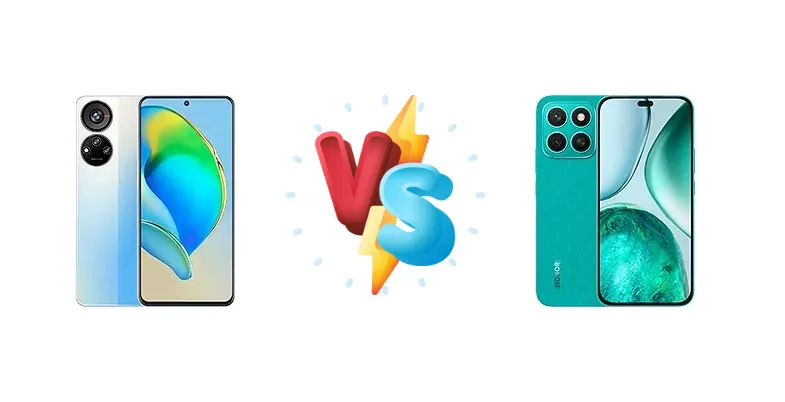
The sub-$200 smartphone market is fiercely competitive. The ZTE Blade V40s and Honor X8c represent compelling options, but cater to slightly different priorities. The Blade V40s leverages a Unisoc chipset, while the X8c opts for Qualcomm's Snapdragon 685. This comparison dissects the key differences to determine which device delivers the best value.
🏆 Quick Verdict
For most users, the Honor X8c emerges as the stronger choice. Its Snapdragon 685, built on a more efficient 6nm process, provides a noticeable performance advantage and better thermal management compared to the ZTE Blade V40s' Unisoc T618. The faster 35W charging is also a significant benefit.
| Network |
|---|
| 2G bands | GSM 850 / 900 / 1800 / 1900 | GSM 850 / 900 / 1800 / 1900 |
| 3G bands | HSDPA 850 / 900 / 2100 | HSDPA 850 / 900 / 1900 / 2100 |
| 4G bands | LTE | LTE |
| Speed | HSPA, LTE | HSPA, LTE |
| Technology | GSM / HSPA / LTE | GSM / HSPA / LTE |
| Launch |
|---|
| Announced | 2022, October 04 | 2025, January 14 |
| Status | Available. Released 2022, October 04 | Available. Released 2025, January 20 |
| Body |
|---|
| Build | - | Glass front, plastic frame, plastic back or silicone polymer back (eco leather) |
| Dimensions | 163.5 x 75.8 x 7.6 mm (6.44 x 2.98 x 0.30 in) | 161.1 x 74.6 x 7.1 mm (6.34 x 2.94 x 0.28 in) |
| SIM | Nano-SIM + Nano-SIM | Nano-SIM + Nano-SIM |
| Weight | 184 g (6.49 oz) | 174 g (6.14 oz) |
| Display |
|---|
| Resolution | 1080 x 2400 pixels, 20:9 ratio (~395 ppi density) | 1080 x 2412 pixels, 20:9 ratio (~394 ppi density) |
| Size | 6.67 inches, 107.4 cm2 (~86.7% screen-to-body ratio) | 6.7 inches, 108.0 cm2 (~89.9% screen-to-body ratio) |
| Type | AMOLED | AMOLED, 120Hz, 1200 nits (HBM), 2800 nits (peak) |
| Platform |
|---|
| CPU | Octa-core (2x2.0 GHz Cortex-A75 & 6x2.0 GHz Cortex-A55) | Octa-core (4x2.8 GHz Cortex-A73 & 4x1.9 GHz Cortex-A53) |
| Chipset | Unisoc UMS512T T618 (12 nm) | Qualcomm SM6225 Snapdragon 685 (6 nm) |
| GPU | Mali-G52 MP2 | Adreno 610 |
| OS | Android 12, MyOS 12 | Android 15, MagicOS 9 |
| Memory |
|---|
| Card slot | microSDXC (dedicated slot) | No |
| Internal | 128GB 6GB RAM | 128GB 6GB RAM, 128GB 8GB RAM, 256GB 8GB RAM, 512GB 8GB RAM |
| | UFS 2.2 | - |
| Main Camera |
|---|
| Dual | - | 108 MP, f/1.8, 24mm (wide), 1/1.67", PDAF, OIS
5 MP, f/2.2, (ultrawide) |
| Features | LED flash, HDR, panorama | LED flash, HDR, panorama |
| Single | 8 MP, f/2.0, (wide) | - |
| Triple | 50 MP, f/1.8, 26mm (wide), PDAF
5 MP (macro)
Auxiliary lens | - |
| Video | 1080p@30fps | 1080p@30fps, gyro-EIS |
| Selfie camera |
|---|
| Single | 8 MP, f/2.0, (wide) | 50 MP, f/2.1, (wide) |
| Video | 1080p@30fps | 1080p@30fps |
| Sound |
|---|
| 3.5mm jack | Yes | - |
| 35mm jack | Yes | No |
| Loudspeaker | Yes | Yes |
| Comms |
|---|
| Bluetooth | 5.0, A2DP, LE | 5.0/5.1, A2DP, LE |
| NFC | Yes | Yes (market/region dependent) |
| Positioning | GPS | GPS, GLONASS, GALILEO, BDS |
| Radio | Unspecified | No |
| USB | USB Type-C 2.0, OTG | USB Type-C 2.0, OTG |
| WLAN | Yes | Wi-Fi 802.11 a/b/g/n/ac, dual-band, Wi-Fi Direct |
| Features |
|---|
| Sensors | Fingerprint (side-mounted), accelerometer, proximity | Fingerprint (under display, optical), accelerometer, gyro, compass, proximity (ultrasonic) |
| Battery |
|---|
| Charging | 22.5W wired | 35W wired |
| Type | Li-Ion 4500 mAh | Li-Po 5000 mAh |
| Misc |
|---|
| Colors | Blue, Black | Marrs Green, Midnight Black, Moonlight White, Cloud Purple |
| Models | - | ABR-LX1, ABR-LX2, ABR-LX3 |
| Price | About 170 EUR | € 190.78 / $ 213.42 / £ 159.00 |
ZTE Blade V40s
- Potentially lower price point
- Unisoc chipset offers adequate performance for basic tasks
- Likely similar battery capacity to the X8c
- Less efficient 12nm Unisoc chipset
- Slower 22.5W charging
- Potentially lower performance in demanding applications
Honor X8c
- More efficient 6nm Snapdragon 685 chipset
- Faster 35W wired charging
- Superior CPU performance with Cortex-A73 cores
- May be slightly more expensive than the Blade V40s
- Likely similar display quality to the Blade V40s
- Camera performance relies heavily on software optimization
Display Comparison
Neither device boasts a standout display. Specifications are unavailable for panel type or brightness, but given the price bracket, expect 60Hz LCD panels. The focus here is on efficiency rather than visual fidelity. Bezels are likely comparable, and color accuracy will be standard for this segment. The lack of high refresh rates or advanced panel technology means display quality won't be a deciding factor.
Camera Comparison
Without detailed camera specifications, a direct comparison is difficult. However, it’s safe to assume both phones feature a primary camera and supporting lenses. The absence of Optical Image Stabilization (OIS) is likely on both. Image processing will be a key differentiator, with Qualcomm’s Snapdragon ISP generally offering superior noise reduction and dynamic range. The ZTE Blade V40s may rely more heavily on software processing to compensate for a potentially less capable sensor. The presence of a 2MP macro lens on either device is largely a marketing tactic and offers limited real-world benefit.
Performance
The core difference lies in the chipsets. The Honor X8c’s Qualcomm Snapdragon 685 (6nm) offers a significant architectural advantage over the ZTE Blade V40s’ Unisoc UMS512T T618 (12nm). While both are octa-core CPUs, the Snapdragon 685 utilizes four Cortex-A73 cores clocked at 2.8 GHz, providing a substantial performance boost over the Blade V40s’ 2.0 GHz Cortex-A75 cores. The 6nm process also translates to improved power efficiency and reduced thermal throttling during sustained workloads. This means the X8c will handle multitasking and gaming more smoothly. The Cortex-A53 cores in the X8c are also more efficient than the A55 cores in the Blade V40s.
Battery Life
Battery capacity is not specified for either device, but both likely fall in the 5000mAh range, typical for this price point. The Honor X8c’s 35W wired charging is a clear advantage over the ZTE Blade V40s’ 22.5W charging. This translates to significantly faster charging times – potentially reducing a full charge from over 2 hours on the Blade V40s to around 90 minutes on the X8c. While battery life will depend on usage patterns, the Snapdragon 685’s efficiency could contribute to slightly longer runtimes on the Honor X8c.
Buying Guide
Buy the ZTE Blade V40s if you prioritize a potentially lower price point and are primarily focused on basic smartphone tasks like calling, texting, and light social media use. Buy the Honor X8c if you value smoother multitasking, more responsive gaming, and faster charging, even if it means spending slightly more upfront. The X8c is the better option for users who want a phone that feels more future-proof.
Frequently Asked Questions
❓ Will the Honor X8c handle demanding games like PUBG Mobile smoothly?
The Snapdragon 685 in the Honor X8c is capable of running PUBG Mobile, but you'll likely need to lower the graphics settings to medium or low for a consistently smooth experience. The Unisoc T618 in the ZTE Blade V40s will struggle more with higher settings and may exhibit more noticeable frame drops.
❓ How long will it take to fully charge each phone from 0%?
With its 35W charging, the Honor X8c should fully charge in approximately 90-100 minutes. The ZTE Blade V40s, with its 22.5W charging, will likely take over 2 hours to reach 100%.
❓ Is the difference in CPU architecture (Cortex-A73 vs A75) noticeable in everyday use?
Yes, the Cortex-A73 cores in the Snapdragon 685 offer a performance advantage over the Cortex-A75 cores in the Unisoc T618. This translates to snappier app launches, smoother multitasking, and a more responsive user experience, especially when switching between applications.
❓ Does either phone support NFC for contactless payments?
Specifications are not available for either device. However, NFC support is becoming increasingly common in this price range, so it's worth checking the product listing or specifications for your region before purchasing.