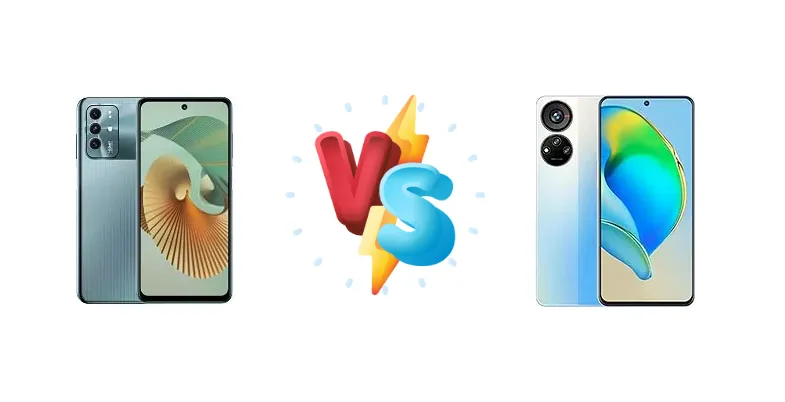
The ZTE Blade series consistently delivers affordable smartphones, and the V40 and V40s are no exception. But with subtle differences, choosing between them can be tricky. This comprehensive comparison will dissect their features, performance, and value to help you make the right decision.
🏆 Quick Verdict
The ZTE Blade V40 generally edges out the V40s thanks to its superior Mediatek Dimensity 700 chipset, offering noticeably better performance. While the V40s might have slight design variations, the V40's processing power makes it the more compelling choice for most users.
| Network |
|---|
| 2G bands | GSM 850 / 900 / 1800 / 1900 | GSM 850 / 900 / 1800 / 1900 |
| 3G bands | HSDPA 850 / 900 / 1900 / 2100 | HSDPA 850 / 900 / 2100 |
| 4G bands | LTE | LTE |
| 5G bands | SA/NSA | - |
| Speed | HSPA, LTE, 5G | HSPA, LTE |
| Technology | GSM / HSPA / LTE / 5G | GSM / HSPA / LTE |
| Launch |
|---|
| Announced | 2022, February 28 | 2022, October 04 |
| Status | Available. Released 2023, January | Available. Released 2022, October 04 |
| Body |
|---|
| Dimensions | - | 163.5 x 75.8 x 7.6 mm (6.44 x 2.98 x 0.30 in) |
| SIM | Nano-SIM + Nano-SIM | Nano-SIM + Nano-SIM |
| Weight | - | 184 g (6.49 oz) |
| Display |
|---|
| Resolution | 1080 x 2400 pixels, 20:9 ratio (~395 ppi density) | 1080 x 2400 pixels, 20:9 ratio (~395 ppi density) |
| Size | 6.67 inches, 107.4 cm2 | 6.67 inches, 107.4 cm2 (~86.7% screen-to-body ratio) |
| Type | IPS LCD | AMOLED |
| Platform |
|---|
| CPU | Octa-core (2x2.2 GHz Cortex-A76 & 6x2.0 GHz Cortex-A55) | Octa-core (2x2.0 GHz Cortex-A75 & 6x2.0 GHz Cortex-A55) |
| Chipset | Mediatek Dimensity 700 (7 nm) | Unisoc UMS512T T618 (12 nm) |
| GPU | Mali-G57 MC2 | Mali-G52 MP2 |
| OS | Android 12 | Android 12, MyOS 12 |
| Memory |
|---|
| Card slot | microSDXC | microSDXC (dedicated slot) |
| Internal | 128GB 6GB RAM | 128GB 6GB RAM |
| | - | UFS 2.2 |
| Main Camera |
|---|
| Features | Dual-LED dual-tone flash, HDR, panorama | LED flash, HDR, panorama |
| Single | 8 MP, f/2.0, (wide) | 8 MP, f/2.0, (wide) |
| Triple | 48 MP, f/1.8, (wide), PDAF
2 MP (macro)
Auxiliary lens | 50 MP, f/1.8, 26mm (wide), PDAF
5 MP (macro)
Auxiliary lens |
| Video | 1080p@30fps | 1080p@30fps |
| Selfie camera |
|---|
| Single | 8 MP, f/2.0, (wide) | 8 MP, f/2.0, (wide) |
| Video | 1080p@30fps | 1080p@30fps |
| Sound |
|---|
| 3.5mm jack | Yes | Yes |
| 35mm jack | Yes | Yes |
| Loudspeaker | Yes | Yes |
| Comms |
|---|
| Bluetooth | Yes | 5.0, A2DP, LE |
| NFC | Yes (market/region dependent) | Yes |
| Positioning | GPS | GPS |
| Radio | Unspecified | Unspecified |
| USB | USB Type-C 2.0 | USB Type-C 2.0, OTG |
| WLAN | Yes | Yes |
| Features |
|---|
| Sensors | Fingerprint (side-mounted), accelerometer, proximity | Fingerprint (side-mounted), accelerometer, proximity |
| Battery |
|---|
| Charging | 22.5W wired | 22.5W wired |
| Type | Li-Po 6000 mAh | Li-Ion 4500 mAh |
| Misc |
|---|
| Colors | Black, Blue | Blue, Black |
| Price | - | About 170 EUR |
ZTE Blade V40
- Better Performance (Dimensity 700)
- Slightly more efficient chipset (7nm)
- Generally smoother user experience
- Design might be less refined than V40s
- Potentially slightly higher price
ZTE Blade V40s
- Potentially more attractive design
- May be available at a lower price
- Weaker Performance (Unisoc T618)
- Less efficient chipset (12nm)
- Slower app loading and gaming
Display Comparison
Both phones feature a 6.67-inch FHD+ display, likely with similar color accuracy and brightness. Expect a comfortable viewing experience for everyday use, though neither excels in this area. The V40s might have a slightly different panel or coating, but this is difficult to confirm without detailed testing.
Camera Comparison
Both phones likely feature a similar main camera setup (typically a 64MP primary sensor, plus ultrawide and macro lenses). Image quality will likely be comparable in good lighting conditions. Low-light performance might vary slightly depending on software processing, but neither is expected to be exceptional.
Performance
This is where the biggest difference lies. The V40's Mediatek Dimensity 700 (7nm) is significantly more powerful than the V40s' Unisoc UMS512T T618 (12nm). Expect smoother app loading, better gaming performance, and overall snappier responsiveness on the V40. The V40s will handle basic tasks adequately, but may struggle with demanding applications.
Battery Life
Both devices are expected to have a 5000mAh battery, providing all-day battery life for moderate users. Charging speeds are identical at 22.5W wired, so expect similar charging times.
Buying Guide
The ZTE Blade V40 is ideal for users prioritizing performance and smoother multitasking, even on a budget. The ZTE Blade V40s is a good option if design nuances are a higher priority and you're less concerned about raw processing power, or if it's significantly cheaper.
Frequently Asked Questions
❓ Is the ZTE Blade V40s worth buying if it's cheaper?
If the price difference is significant and you primarily use your phone for basic tasks like calls, texts, and social media, the V40s might be acceptable. However, the V40's superior performance is generally worth the extra cost.
❓ Can I play demanding games on the ZTE Blade V40s?
While you can technically play some games, the Unisoc T618 in the V40s will struggle with demanding titles. The V40 offers a much better gaming experience.