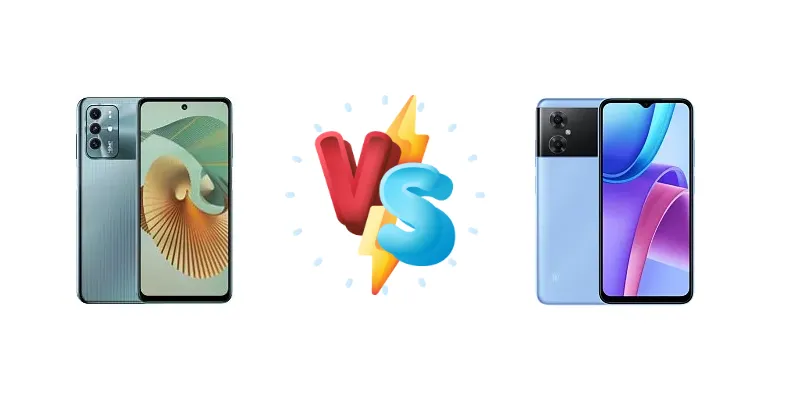
The ZTE Blade V40 and Xiaomi Redmi Note 11R represent a competitive segment of the smartphone market – affordable 5G devices. Both leverage the Mediatek Dimensity 700 chipset, making performance similarities likely. However, key differences in charging capabilities and potentially other areas dictate which phone is the better choice for specific users.
🏆 Quick Verdict
For the average user prioritizing faster charging and potentially a slightly more refined software experience, the ZTE Blade V40 emerges as the winner. Its 22.5W charging significantly outperforms the Redmi Note 11R’s 18W, reducing downtime. While performance is nearly identical, this charging advantage is a tangible benefit.
| Network |
|---|
| 2G bands | GSM 850 / 900 / 1800 / 1900 | GSM 850 / 900 / 1800 / 1900 |
| 3G bands | HSDPA 850 / 900 / 1900 / 2100 | HSDPA 850 / 900 / 1900 / 2100 |
| 4G bands | LTE | 1, 3, 5, 7, 8, 34, 38, 39, 40, 41 |
| 5G bands | SA/NSA | 1, 5, 8, 28, 41, 78 |
| Speed | HSPA, LTE, 5G | HSPA, LTE, 5G |
| Technology | GSM / HSPA / LTE / 5G | GSM / CDMA / HSPA / LTE / 5G |
| | - | CDMA 800 |
| Launch |
|---|
| Announced | 2022, February 28 | 2022, September 30 |
| Status | Available. Released 2023, January | Available. Released 2022, September 30 |
| Body |
|---|
| Build | - | Glass front, plastic frame, plastic back |
| Dimensions | - | 164 x 76.1 x 8.9 mm (6.46 x 3.00 x 0.35 in) |
| SIM | Nano-SIM + Nano-SIM | Nano-SIM + Nano-SIM |
| Weight | - | 201 g (7.09 oz) |
| Display |
|---|
| Resolution | 1080 x 2400 pixels, 20:9 ratio (~395 ppi density) | 1080 x 2408 pixels, 20:9 ratio (~401 ppi density) |
| Size | 6.67 inches, 107.4 cm2 | 6.58 inches, 104.3 cm2 (~83.6% screen-to-body ratio) |
| Type | IPS LCD | IPS LCD, 90Hz, 400 nits (typ) |
| Platform |
|---|
| CPU | Octa-core (2x2.2 GHz Cortex-A76 & 6x2.0 GHz Cortex-A55) | Octa-core (2x2.2 GHz Cortex-A76 & 6x2.0 GHz Cortex-A55) |
| Chipset | Mediatek Dimensity 700 (7 nm) | Mediatek Dimensity 700 (7 nm) |
| GPU | Mali-G57 MC2 | Mali-G57 MC2 |
| OS | Android 12 | Android 12, MIUI 13 |
| Memory |
|---|
| Card slot | microSDXC | microSDXC (dedicated slot) |
| Internal | 128GB 6GB RAM | 128GB 4GB RAM, 128GB 6GB RAM, 128GB 8GB RAM |
| | - | UFS 2.2 |
| Main Camera |
|---|
| Dual | - | 13 MP, f/2.2, (wide), PDAF
Auxiliary lens |
| Features | Dual-LED dual-tone flash, HDR, panorama | LED flash, HDR, panorama |
| Single | 8 MP, f/2.0, (wide) | - |
| Triple | 48 MP, f/1.8, (wide), PDAF
2 MP (macro)
Auxiliary lens | - |
| Video | 1080p@30fps | 1080p@30fps |
| Selfie camera |
|---|
| Features | - | HDR |
| Single | 8 MP, f/2.0, (wide) | 5 MP, f/2.2, (wide) |
| Video | 1080p@30fps | 1080p@30fps |
| Sound |
|---|
| 3.5mm jack | Yes | Yes |
| 35mm jack | Yes | Yes |
| Loudspeaker | Yes | Yes |
| | - | 24-bit/192kHz audio |
| Comms |
|---|
| Bluetooth | Yes | 5.1, A2DP, LE |
| Infrared port | - | Yes |
| NFC | Yes (market/region dependent) | No |
| Positioning | GPS | GPS, GLONASS, GALILEO, BDS |
| Radio | Unspecified | No |
| USB | USB Type-C 2.0 | USB Type-C 2.0, OTG |
| WLAN | Yes | Wi-Fi 802.11 a/b/g/n/ac, dual-band, Wi-Fi Direct |
| Features |
|---|
| Sensors | Fingerprint (side-mounted), accelerometer, proximity | Fingerprint (side-mounted), accelerometer, proximity, compass |
| Battery |
|---|
| Charging | 22.5W wired | 18W wired |
| Type | Li-Po 6000 mAh | Li-Po 5000 mAh |
| Misc |
|---|
| Colors | Black, Blue | Black, Blue, Gray |
| Models | - | 22095RA98C |
| Price | - | About 160 EUR |
ZTE Blade V40
- Faster 22.5W charging
- Potentially cleaner software experience
- Competitive price point
- Brand recognition may be lower than Xiaomi
- Camera performance is unknown without further specs
Xiaomi Redmi Note 11R
- Strong brand reputation (Xiaomi)
- MIUI software features and customization
- Established user community
- Slower 18W charging
- MIUI can be resource-intensive
- Potential for bloatware
Display Comparison
Both devices are expected to feature LCD panels, typical for this price bracket. Without specific display specs like resolution or peak brightness, it’s difficult to definitively declare a winner. However, the Redmi Note 11R, based on Xiaomi’s typical implementation, may offer slightly better color calibration. The absence of high refresh rates on either device suggests a focus on power efficiency rather than visual fluidity.
Camera Comparison
Without detailed camera specifications beyond the presence of cameras, a direct comparison is challenging. It’s safe to assume both phones will feature a multi-camera setup, likely with a primary sensor, an ultrawide, and potentially a macro lens. Given the price point, image processing will be crucial. Xiaomi’s image processing algorithms are generally more aggressive, aiming for vibrant, shareable photos, while ZTE tends towards a more natural look. The absence of OIS on either device suggests low-light performance will be limited.
Performance
The core of both phones is the Mediatek Dimensity 700 (7nm). This chipset features an octa-core configuration with 2x2.2 GHz Cortex-A76 and 6x2.0 GHz Cortex-A55 cores, guaranteeing similar CPU performance. The identical chipset and likely similar RAM configurations (though not specified) mean that day-to-day tasks and light gaming will perform almost identically on both devices. Thermal management will likely be adequate for the chipset's power draw, but sustained heavy loads could lead to throttling, a common trait in this segment.
Battery Life
The key differentiator here is charging speed. The ZTE Blade V40 supports 22.5W wired charging, while the Xiaomi Redmi Note 11R is limited to 18W. This translates to a noticeably faster charging time for the ZTE, potentially shaving off 30-60 minutes for a full charge. While battery capacity isn’t specified, the faster charging of the Blade V40 is a significant advantage for users who prioritize minimizing downtime. The Dimensity 700’s efficiency should provide all-day battery life for moderate usage on both devices.
Buying Guide
Buy the ZTE Blade V40 if you frequently find yourself needing to top up your phone quickly and value a faster charging experience. This is ideal for users who are constantly on the go. Buy the Xiaomi Redmi Note 11R if you prioritize brand loyalty within the Xiaomi ecosystem and are less concerned with charging speed, potentially benefiting from Xiaomi’s MIUI software features and established user base.
Frequently Asked Questions
❓ How much faster is the ZTE Blade V40's charging compared to the Redmi Note 11R in real-world use?
The 22.5W charging on the ZTE Blade V40 will likely result in a 30-60 minute faster full charge compared to the Redmi Note 11R's 18W charging. This difference is most noticeable when quickly topping up the battery.
❓ Will I notice a performance difference between the ZTE Blade V40 and Redmi Note 11R when playing demanding games like PUBG Mobile?
Given both phones utilize the same Mediatek Dimensity 700 chipset, performance in games like PUBG Mobile will be nearly identical. Frame rates and stability will be comparable, though thermal throttling could slightly impact sustained performance on both devices.
❓ Does either phone support expandable storage via microSD card?
This information is not provided in the specifications. However, given the target market of these devices, it is highly probable that both the ZTE Blade V40 and Xiaomi Redmi Note 11R support microSD card expansion for increased storage capacity.
❓ Which phone is likely to receive more software updates and security patches?
Xiaomi generally provides more consistent software updates and security patches for its devices compared to ZTE. While both companies offer updates, Xiaomi’s larger development team and established update schedule give it an advantage in this area.