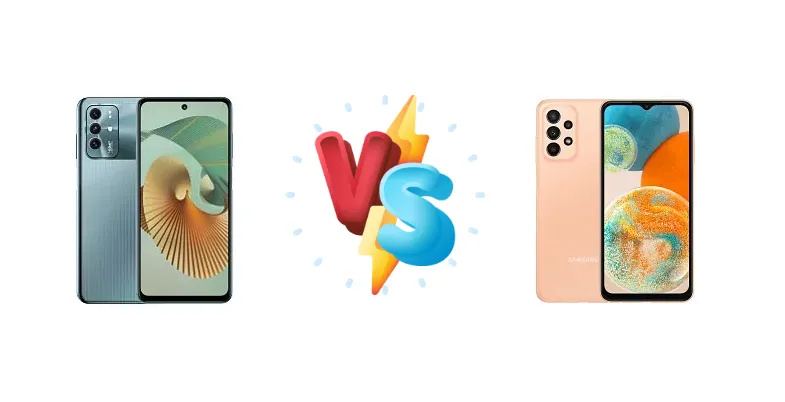
The ZTE Blade V40 and Samsung Galaxy A23 5G represent compelling options in the increasingly competitive sub-$250 5G smartphone market. Both aim to deliver 5G connectivity and essential smartphone features without breaking the bank, but they achieve this with different chipsets and design philosophies. This comparison dives deep into their specifications to determine which device offers the best value.
🏆 Quick Verdict
For the average user prioritizing consistent performance and a slightly brighter display, the Samsung Galaxy A23 5G emerges as the better choice. While the ZTE Blade V40 offers a competitive price, the Snapdragon 695's 6nm process and optimized CPU architecture in the A23 5G provide a smoother overall experience.
| Network |
|---|
| 2G bands | GSM 850 / 900 / 1800 / 1900 | GSM 850 / 900 / 1800 / 1900 |
| 3G bands | HSDPA 850 / 900 / 1900 / 2100 | HSDPA 850 / 900 / 1700(AWS) / 1900 / 2100 |
| 4G bands | LTE | 1, 2, 3, 4, 5, 7, 8, 12, 17, 20, 26, 28, 32, 38, 40, 41, 66 - International |
| 5G bands | SA/NSA | 1, 3, 7, 8, 20, 28, 38, 40, 41, 77, 78 SA/NSA/Sub6 - International |
| Speed | HSPA, LTE, 5G | HSPA, LTE, 5G |
| Technology | GSM / HSPA / LTE / 5G | GSM / HSPA / LTE / 5G |
| | - | 2, 5, 30, 66, 77 SA/NSA/Sub6/mmWave - USA |
| Launch |
|---|
| Announced | 2022, February 28 | 2022, August 05 |
| Status | Available. Released 2023, January | Available. Released 2022, September 02 |
| Body |
|---|
| Build | - | Glass front (Gorilla Glass 5), plastic frame, plastic back |
| Dimensions | - | 165.4 x 76.9 x 8.4 mm (6.51 x 3.03 x 0.33 in) |
| SIM | Nano-SIM + Nano-SIM | · Nano-SIM· Nano-SIM + Nano-SIM |
| Weight | - | 197 g (6.95 oz) |
| Display |
|---|
| Protection | - | Corning Gorilla Glass 5 |
| Resolution | 1080 x 2400 pixels, 20:9 ratio (~395 ppi density) | 1080 x 2408 pixels, 20:9 ratio (~400 ppi density) |
| Size | 6.67 inches, 107.4 cm2 | 6.6 inches, 104.9 cm2 (~82.5% screen-to-body ratio) |
| Type | IPS LCD | PLS LCD, 120Hz |
| Platform |
|---|
| CPU | Octa-core (2x2.2 GHz Cortex-A76 & 6x2.0 GHz Cortex-A55) | Octa-core (2x2.2 GHz Kryo 660 Gold & 6x1.7 GHz Kryo 660 Silver) |
| Chipset | Mediatek Dimensity 700 (7 nm) | Qualcomm SM6375 Snapdragon 695 5G (6 nm) |
| GPU | Mali-G57 MC2 | Adreno 619 |
| OS | Android 12 | Android 12, upgradable to Android 14, One UI 6 |
| Memory |
|---|
| Card slot | microSDXC | microSDXC (dedicated slot) |
| Internal | 128GB 6GB RAM | 64GB 4GB RAM, 64GB 6GB RAM, 128GB 4GB RAM, 128GB 6GB RAM, 128GB 8GB RAM |
| Main Camera |
|---|
| Features | Dual-LED dual-tone flash, HDR, panorama | LED flash, panorama, HDR |
| Quad | - | 50 MP, f/1.8, 26mm (wide), 1/2.76", 0.64µm, PDAF, OIS
5 MP, f/2.2, 13mm, 123˚ (ultrawide), 1/5.0", 1.12µm
2 MP (macro)
Auxiliary lens |
| Single | 8 MP, f/2.0, (wide) | - |
| Triple | 48 MP, f/1.8, (wide), PDAF
2 MP (macro)
Auxiliary lens | - |
| Video | 1080p@30fps | 1080p@30fps |
| Selfie camera |
|---|
| Single | 8 MP, f/2.0, (wide) | 8 MP, f/2.0, 25mm (wide), 1/4.0", 1.12µm - USA
8 MP, f/2.2, 25mm (wide), 1/4.0", 1.12µm - International |
| Video | 1080p@30fps | 1080p@30fps |
| Sound |
|---|
| 3.5mm jack | Yes | Yes |
| 35mm jack | Yes | Yes |
| Loudspeaker | Yes | Yes |
| Comms |
|---|
| Bluetooth | Yes | 5.1, A2DP, LE |
| NFC | Yes (market/region dependent) | Yes |
| Positioning | GPS | GPS, GLONASS, GALILEO, BDS |
| Radio | Unspecified | FM radio (market/region dependent) |
| USB | USB Type-C 2.0 | USB Type-C 2.0 |
| WLAN | Yes | Wi-Fi 802.11 a/b/g/n/ac, dual-band, Wi-Fi Direct |
| Features |
|---|
| Sensors | Fingerprint (side-mounted), accelerometer, proximity | Fingerprint (side-mounted), accelerometer, gyro, compass, barometer (USA only) |
| | - | Virtual proximity sensing |
| Battery |
|---|
| Charging | 22.5W wired | 25W wired |
| Type | Li-Po 6000 mAh | Li-Po 5000 mAh |
| Misc |
|---|
| Colors | Black, Blue | Black, White, Peach, Blue |
| Models | - | SM-A236U, SM-A236U1, SM-A236B, SM-A236B/DS, SM-A236B/DSN, SM-A236E, SM-S236DL |
| Price | - | $ 84.44 / £ 129.00 / € 125.28 / ₹ 21,000 |
| SAR | - | 0.68 W/kg (head) 0.57 W/kg (body) |
| SAR EU | - | 1.49 W/kg (head) 1.25 W/kg (body) |
| Tests |
|---|
| Battery life | - |
Endurance rating 138h
|
| Camera | - |
Photo / Video |
| Display | - |
Contrast ratio: 1328:1 (nominal) |
| Loudspeaker | - |
-25.9 LUFS (Very good)
|
| Performance | - |
AnTuTu: 318821 (v9)
GeekBench: 1940 (v5.1)
GFXBench: 16fps (ES 3.1 onscreen) |
ZTE Blade V40
- Potentially lower price point
- 5G connectivity
- Acceptable battery life
- Less efficient Dimensity 700 chipset
- Display specifications are unknown
- Likely less refined software experience
Samsung Galaxy A23 5G
- More efficient Snapdragon 695 chipset
- Brighter display (508 nits)
- Faster 25W charging
- Potentially higher price
- Similar battery life rating to the ZTE
- Samsung's software can be bloated
Display Comparison
The Samsung Galaxy A23 5G boasts a display capable of reaching 508 nits of peak brightness, a significant advantage for outdoor visibility compared to the ZTE Blade V40 (brightness data unavailable). Both displays share a 1328:1 contrast ratio, suggesting similar black levels and color depth. However, the lack of information regarding the Blade V40’s panel technology (LCD vs. AMOLED) and refresh rate leaves the A23 5G with a clear edge in display quality, assuming a standard 60Hz LCD on the ZTE.
Camera Comparison
Both devices are listed as having Photo/Video capabilities, but detailed camera specifications are absent. Without sensor size, aperture, or image processing details, a direct comparison is difficult. However, Samsung generally employs more sophisticated image processing algorithms, potentially resulting in more pleasing photos, especially in challenging lighting conditions. The absence of any mention of OIS on either device suggests reliance on software stabilization. The usefulness of any included macro cameras (likely 2MP on both) is questionable given their limited resolution and image quality.
Performance
The core difference lies in the chipsets: the ZTE Blade V40 utilizes the Mediatek Dimensity 700 (7nm), while the Samsung Galaxy A23 5G features the Qualcomm Snapdragon 695 5G (6nm). The Snapdragon 695’s smaller 6nm node generally translates to improved power efficiency and thermal management. While both CPUs feature a 2x2.2 GHz core configuration, the Snapdragon 695’s Kryo 660 Gold cores are architecturally more efficient than the Cortex-A76 cores in the Dimensity 700, potentially leading to better sustained performance during demanding tasks. The A23 5G is likely to exhibit less throttling under prolonged load.
Battery Life
Both the ZTE Blade V40 and Samsung Galaxy A23 5G achieve an endurance rating of 138 hours, indicating similar overall battery life. However, the Samsung Galaxy A23 5G supports 25W wired charging, slightly faster than the ZTE Blade V40’s 22.5W charging. This translates to a quicker top-up time, even if the actual battery capacity isn't specified for either device. The more efficient Snapdragon 695 in the A23 5G may also contribute to slightly better real-world battery performance.
Buying Guide
Buy the ZTE Blade V40 if you need a very affordable 5G phone and are willing to accept some performance trade-offs for the lowest possible price. Buy the Samsung Galaxy A23 5G if you prioritize a more responsive user experience, a slightly brighter and more visible display in sunlight, and the established Samsung ecosystem.
Frequently Asked Questions
❓ Will the Snapdragon 695 in the Galaxy A23 5G handle demanding games like PUBG Mobile?
The Snapdragon 695 is capable of running PUBG Mobile, but you'll likely need to stick to medium graphics settings for a consistently smooth experience. The Dimensity 700 in the Blade V40 will likely struggle more with sustained performance in graphically intensive games.
❓ How significant is the difference in charging speed between 22.5W and 25W?
While the difference of 2.5W doesn't sound substantial, it can translate to a 10-15 minute faster full charge for the Samsung Galaxy A23 5G, especially when starting from a low battery percentage. This can be a convenient benefit for users who frequently need to quickly top up their phone.
❓ Is the camera on either phone good enough for casual social media use?
Both phones should be adequate for casual social media photography in good lighting conditions. However, don't expect exceptional image quality, especially in low light. The Samsung Galaxy A23 5G is likely to produce more consistently pleasing results due to Samsung's image processing.