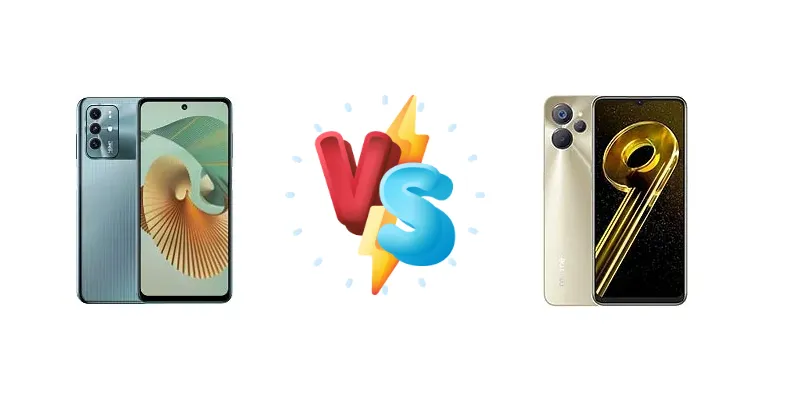
The sub-$200 5G smartphone market is heating up, and the ZTE Blade V40 and Realme 9i 5G are two strong contenders. Both aim to deliver 5G connectivity without breaking the bank, but they take different approaches to achieving that goal. This comparison dissects their key specifications to determine which device offers the best overall experience.
🏆 Quick Verdict
For most users, the Realme 9i 5G emerges as the better choice. Its Dimensity 810 chipset, built on a more efficient 6nm process, provides a noticeable performance edge over the ZTE Blade V40’s Dimensity 700. While the Blade V40 offers slightly faster wired charging, the 9i 5G’s superior processing power makes it the more capable all-rounder.
| Network |
|---|
| 2G bands | GSM 850 / 900 / 1800 / 1900 | GSM 850 / 900 / 1800 / 1900 |
| 3G bands | HSDPA 850 / 900 / 1900 / 2100 | HSDPA 850 / 900 / 1700(AWS) / 1900 / 2100 |
| 4G bands | LTE | 1, 2, 3, 4, 5, 7, 8, 19, 20, 28, 34, 38, 39, 40, 41 |
| 5G bands | SA/NSA | 1, 5, 7, 8, 28, 41, 77, 78 SA/NSA |
| Speed | HSPA, LTE, 5G | HSPA, LTE, 5G |
| Technology | GSM / HSPA / LTE / 5G | GSM / HSPA / LTE / 5G |
| Launch |
|---|
| Announced | 2022, February 28 | 2022, August 18 |
| Status | Available. Released 2023, January | Available. Released 2022, August 24 |
| Body |
|---|
| Dimensions | - | 164.4 x 75.1 x 8.1 mm (6.47 x 2.96 x 0.32 in) |
| SIM | Nano-SIM + Nano-SIM | Nano-SIM + Nano-SIM |
| Weight | - | 187 g (6.60 oz) |
| Display |
|---|
| Protection | - | Panda Glass |
| Resolution | 1080 x 2400 pixels, 20:9 ratio (~395 ppi density) | 1080 x 2408 pixels, 20:9 ratio (~400 ppi density) |
| Size | 6.67 inches, 107.4 cm2 | 6.6 inches, 104.9 cm2 (~85.0% screen-to-body ratio) |
| Type | IPS LCD | IPS LCD, 90Hz, 400 nits (typ) |
| Platform |
|---|
| CPU | Octa-core (2x2.2 GHz Cortex-A76 & 6x2.0 GHz Cortex-A55) | Octa-core (2x2.4 GHz Cortex-A76 & 6x2.0 GHz Cortex-A55) |
| Chipset | Mediatek Dimensity 700 (7 nm) | Mediatek Dimensity 810 (6 nm) |
| GPU | Mali-G57 MC2 | Mali-G57 MC2 |
| OS | Android 12 | Android 12, upgradable to Android 13, Realme UI 4.0 |
| Memory |
|---|
| Card slot | microSDXC | microSDXC (dedicated slot) |
| Internal | 128GB 6GB RAM | 64GB 4GB RAM, 128GB 4GB RAM, 128GB 6GB RAM |
| | - | UFS 2.2 |
| Main Camera |
|---|
| Features | Dual-LED dual-tone flash, HDR, panorama | LED flash, HDR, panorama |
| Single | 8 MP, f/2.0, (wide) | 8 MP, f/2.0, 27mm (wide) |
| Triple | 48 MP, f/1.8, (wide), PDAF
2 MP (macro)
Auxiliary lens | 50 MP, f/1.8, 26mm (wide), 1/2.76", 0.64µm, PDAF
Unspecified MP, 46mm (telephoto)
2 MP (macro) |
| Video | 1080p@30fps | 1080p@30fps |
| Selfie camera |
|---|
| Features | - | HDR, panorama |
| Single | 8 MP, f/2.0, (wide) | 8 MP, f/2.0, 27mm (wide) |
| Video | 1080p@30fps | 1080p@30fps |
| Sound |
|---|
| 3.5mm jack | Yes | Yes |
| 35mm jack | Yes | Yes |
| Loudspeaker | Yes | Yes |
| Comms |
|---|
| Bluetooth | Yes | 5.2, A2DP, LE |
| NFC | Yes (market/region dependent) | No |
| Positioning | GPS | GPS, GLONASS, GALILEO, BDS |
| Radio | Unspecified | No |
| USB | USB Type-C 2.0 | USB Type-C 2.0, OTG |
| WLAN | Yes | Wi-Fi 802.11 a/b/g/n/ac, dual-band |
| Features |
|---|
| Sensors | Fingerprint (side-mounted), accelerometer, proximity | Fingerprint (side-mounted), accelerometer, proximity, compass |
| Battery |
|---|
| Charging | 22.5W wired | 18W wired |
| Type | Li-Po 6000 mAh | 5000 mAh |
| Misc |
|---|
| Colors | Black, Blue | Soulful Blue, Rocking Black, Gold |
| Models | - | RMX3612 |
| Price | - | About 180 EUR |
ZTE Blade V40
- Faster 22.5W wired charging
- Potentially lower price point
- Acceptable performance for basic tasks
- Less efficient Dimensity 700 chipset
- Likely lower sustained performance
- May exhibit more thermal throttling
Realme 9i 5G
- More efficient Dimensity 810 chipset (6nm)
- Higher CPU clock speeds for better responsiveness
- Potentially better long-term software support
- Slower 18W wired charging
- May be slightly more expensive
- Camera performance likely similar to Blade V40
Display Comparison
Neither device boasts a standout display. Both likely utilize LCD panels, a common cost-saving measure in this segment. The Realme 9i 5G’s display specifications are not provided, but given its market positioning, it’s reasonable to assume a similar resolution and refresh rate to the Blade V40. The focus here isn’t on visual fidelity, but on basic usability. Bezels are likely comparable, and color accuracy will be standard for budget LCDs.
Camera Comparison
Camera performance is likely to be similar, with both phones relying on budget sensors and image processing. Without specific sensor details, it’s difficult to make a definitive judgment. However, the Realme brand generally emphasizes camera features more heavily in its marketing, suggesting a potentially more refined software experience. Expect acceptable results in good lighting conditions, but limitations in low-light scenarios. The inclusion of a 2MP macro camera on both devices is largely a marketing tactic, offering minimal practical benefit.
Performance
The core difference lies in the chipsets. The Realme 9i 5G’s Mediatek Dimensity 810 (6nm) has a clear advantage over the ZTE Blade V40’s Dimensity 700 (7nm). The 6nm process allows for greater transistor density and improved power efficiency, translating to better sustained performance and potentially less thermal throttling. While both CPUs feature the same Cortex-A76 and A55 core configuration, the 810’s higher clock speeds (2.4 GHz vs 2.2 GHz) contribute to a more responsive experience. This difference will be most noticeable when multitasking, gaming, or running demanding applications.
Battery Life
Battery life will depend heavily on usage patterns. While the ZTE Blade V40 offers 22.5W wired charging, potentially allowing for faster top-ups, the Realme 9i 5G’s more efficient Dimensity 810 chipset could offset the slower 18W charging rate through reduced power consumption. The 6nm process of the Dimensity 810 will contribute to longer battery life during typical use, potentially negating the charging speed advantage of the Blade V40.
Buying Guide
Buy the ZTE Blade V40 if you prioritize slightly faster 22.5W charging and are on an extremely tight budget, willing to trade performance for a lower upfront cost. Buy the Realme 9i 5G if you value a smoother user experience, better app responsiveness, and a more future-proof chipset for handling demanding applications and potential software updates. The 9i 5G is ideal for users who stream video, play casual games, or multitask frequently.
Frequently Asked Questions
❓ Will the Realme 9i 5G handle graphically intensive games like PUBG Mobile smoothly?
The Dimensity 810 in the Realme 9i 5G is capable of running PUBG Mobile, but you’ll likely need to stick to medium graphics settings for a consistently smooth experience. The 6nm process and higher clock speeds provide a performance advantage over the Blade V40, but it’s still a budget chipset.
❓ Does the ZTE Blade V40’s faster charging significantly reduce charging time compared to the Realme 9i 5G?
While 22.5W is faster than 18W, the difference in 0-100% charging time won’t be dramatic. Expect roughly 2-2.5 hours for a full charge on the Blade V40, and potentially 2.5-3 hours on the 9i 5G. The 9i 5G’s more efficient chipset may partially offset the slower charging speed in real-world usage.
❓ How will software updates be handled on each device?
Realme generally provides more consistent software updates and a longer support lifecycle compared to ZTE. While neither phone is guaranteed years of updates, the Realme 9i 5G is more likely to receive security patches and potentially even a major Android version upgrade.