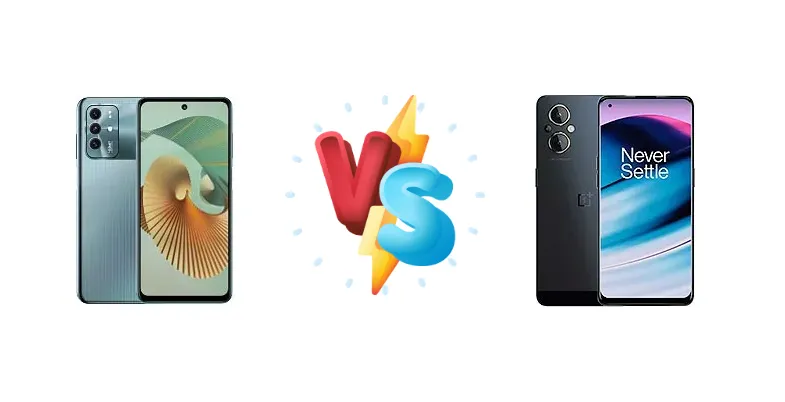
The ZTE Blade V40 and OnePlus Nord N20 5G represent compelling options in the increasingly competitive sub-$300 5G smartphone market. Both aim to deliver 5G connectivity and a modern smartphone experience without breaking the bank, but they achieve this through different approaches to chipset selection and feature prioritization. This comparison dives deep into the specifics to determine which device offers the best value.
🏆 Quick Verdict
For the average user prioritizing a slightly brighter display and faster charging, the OnePlus Nord N20 5G emerges as the better choice. However, the ZTE Blade V40 offers a competitive package, and its Dimensity 700 chipset may provide a slight edge in sustained multi-core workloads.
| Network |
|---|
| 2G bands | GSM 850 / 900 / 1800 / 1900 | GSM 850 / 900 / 1800 / 1900 |
| 3G bands | HSDPA 850 / 900 / 1900 / 2100 | HSDPA 850 / 900 / 1700(AWS) / 1900 / 2100 |
| 4G bands | LTE | 1, 2, 3, 4, 5, 7, 8, 12, 13, 17, 20, 25, 26, 28, 38, 39, 40, 41, 66, 71 |
| 5G bands | SA/NSA | 2, 25, 41, 66, 71 SA/NSA |
| Speed | HSPA, LTE, 5G | HSPA 42.2/5.76 Mbps, LTE Cat15 800/200 Mbps, 5G |
| Technology | GSM / HSPA / LTE / 5G | GSM / HSPA / LTE / 5G |
| Launch |
|---|
| Announced | 2022, February 28 | 2022, April 28 |
| Status | Available. Released 2023, January | Available. Released 2022, April 28 |
| Body |
|---|
| Build | - | Glass front (Schott Xensation Up), plastic frame, plastic back |
| Dimensions | - | 159.9 x 73.2 x 7.5 mm (6.30 x 2.88 x 0.30 in) |
| SIM | Nano-SIM + Nano-SIM | Nano-SIM |
| Weight | - | 173 g (6.10 oz) |
| Display |
|---|
| Protection | - | Schott Xensation Up |
| Resolution | 1080 x 2400 pixels, 20:9 ratio (~395 ppi density) | 1080 x 2400 pixels, 20:9 ratio (~409 ppi density) |
| Size | 6.67 inches, 107.4 cm2 | 6.43 inches, 99.8 cm2 (~85.3% screen-to-body ratio) |
| Type | IPS LCD | AMOLED |
| | - | Always-on display |
| Platform |
|---|
| CPU | Octa-core (2x2.2 GHz Cortex-A76 & 6x2.0 GHz Cortex-A55) | Octa-core (2x2.2 GHz Kryo 660 Gold & 6x1.7 GHz Kryo 660 Silver) |
| Chipset | Mediatek Dimensity 700 (7 nm) | Qualcomm SM6375 Snapdragon 695 5G (6 nm) |
| GPU | Mali-G57 MC2 | Adreno 619 |
| OS | Android 12 | Android 11, OxygenOS 11 |
| Memory |
|---|
| Card slot | microSDXC | microSDXC (dedicated slot) |
| Internal | 128GB 6GB RAM | 128GB 6GB RAM |
| | - | UFS 2.2 |
| Main Camera |
|---|
| Features | Dual-LED dual-tone flash, HDR, panorama | LED flash, HDR, panorama |
| Single | 8 MP, f/2.0, (wide) | 16 MP, f/2.4, (wide) |
| Triple | 48 MP, f/1.8, (wide), PDAF
2 MP (macro)
Auxiliary lens | 64 MP, f/1.8, (wide), PDAF
2 MP (macro)
Auxiliary lens |
| Video | 1080p@30fps | 1080p@30fps |
| Selfie camera |
|---|
| Features | - | HDR |
| Single | 8 MP, f/2.0, (wide) | 16 MP, f/2.4, (wide) |
| Video | 1080p@30fps | 1080p@30fps |
| Sound |
|---|
| 3.5mm jack | Yes | Yes |
| 35mm jack | Yes | Yes |
| Loudspeaker | Yes | Yes |
| Comms |
|---|
| Bluetooth | Yes | 5.1, A2DP, LE |
| NFC | Yes (market/region dependent) | Yes |
| Positioning | GPS | GPS (L1+L5), GLONASS, GALILEO, BDS |
| Radio | Unspecified | No |
| USB | USB Type-C 2.0 | USB Type-C 2.0, OTG |
| WLAN | Yes | Wi-Fi 802.11 a/b/g/n/ac, dual-band, Wi-Fi Direct |
| Features |
|---|
| Sensors | Fingerprint (side-mounted), accelerometer, proximity | Fingerprint (under display, optical), accelerometer, gyro, proximity, compass, barometer |
| Battery |
|---|
| Charging | 22.5W wired | 33W wired |
| Type | Li-Po 6000 mAh | Li-Po 4500 mAh |
| Misc |
|---|
| Colors | Black, Blue | Blue |
| Models | - | GN2200, CPH2459 |
| Price | - | About 120 EUR |
| Tests |
|---|
| Battery life | - |
Endurance rating 129h
|
| Display | - |
Contrast ratio: Infinite (nominal) |
| Performance | - |
AnTuTu: 316974 (v8), 380672 (v9)
GeekBench: 1945 (v5.1)
GFXBench: 16fps (ES 3.1 onscreen) |
ZTE Blade V40
- Potentially better sustained multi-core performance
- Competitive price point
- 5G connectivity
- Slower charging speed (22.5W)
- Likely lower display brightness
- Less efficient chipset (7nm)
OnePlus Nord N20 5G
- Brighter display (647 nits)
- Faster charging (33W)
- More efficient chipset (6nm)
- Potentially lower sustained multi-core performance
- May be slightly more expensive
- Relies heavily on software for camera processing
Display Comparison
The OnePlus Nord N20 5G boasts a significant advantage in display quality, achieving a measured peak brightness of 647 nits. This is crucial for outdoor visibility, a common pain point for budget phones. While the ZTE Blade V40’s display specifications are not provided, it’s reasonable to assume it falls short of this figure. The Nord N20 5G’s 'Infinite' contrast ratio (nominal) suggests a typical IPS panel, but the higher brightness makes a tangible difference. Neither phone is expected to feature high refresh rate panels, focusing instead on maximizing battery life.
Camera Comparison
Without detailed camera specifications for the ZTE Blade V40, a direct comparison is limited. However, the market segment suggests both phones will rely on primary sensors in the 48MP-64MP range. The OnePlus Nord N20 5G likely benefits from Qualcomm’s image signal processor (ISP), which generally delivers good color accuracy and dynamic range. The absence of optical image stabilization (OIS) on either device suggests reliance on software processing for low-light performance. The inclusion of a 2MP macro camera on both devices is largely a marketing tactic, offering minimal practical benefit due to the small sensor size and lack of detail.
Performance
The core of the performance difference lies in the chipsets. The OnePlus Nord N20 5G utilizes the Qualcomm Snapdragon 695 5G (6nm), built on a more efficient node than the ZTE Blade V40’s MediaTek Dimensity 700 (7nm). While both CPUs feature an octa-core configuration with similar high-performance core clock speeds (2.2 GHz), the Snapdragon 695’s Kryo 660 Gold cores are architecturally more advanced than the Cortex-A76 cores in the Dimensity 700. This translates to better single-core performance on the OnePlus. The Dimensity 700, however, may hold a slight edge in sustained multi-core workloads due to its core count and potentially more aggressive thermal design. Neither chipset is a gaming powerhouse, but both are capable of handling casual titles.
Battery Life
Both the ZTE Blade V40 and OnePlus Nord N20 5G share an endurance rating of 129 hours, indicating similar overall battery life. However, the OnePlus Nord N20 5G’s 33W wired charging significantly outperforms the ZTE Blade V40’s 22.5W charging. This translates to a faster 0-100% charge time, reducing downtime. While battery capacity isn’t specified, the faster charging speed on the Nord N20 5G provides a tangible convenience advantage.
Buying Guide
Buy the ZTE Blade V40 if you frequently engage in tasks that benefit from consistent multi-core performance, such as video editing or running multiple apps simultaneously, and are less concerned with peak display brightness. Buy the OnePlus Nord N20 5G if you prioritize a more visually vibrant display experience, faster charging speeds, and a generally smoother user experience for everyday tasks like browsing and social media.
Frequently Asked Questions
❓ Will the Snapdragon 695 in the OnePlus Nord N20 5G struggle with graphically demanding games?
The Snapdragon 695 is an entry-level 5G chipset. While it can handle casual games, you'll likely need to lower graphics settings and resolution for more demanding titles like PUBG Mobile or Call of Duty Mobile to maintain a playable frame rate. Expect frame drops during intense scenes.
❓ Is the 22.5W charging on the ZTE Blade V40 noticeably slower than the 33W charging on the OnePlus Nord N20 5G?
Yes, the difference is significant. 33W charging will typically add a much larger percentage of battery life in the same amount of time. Expect the OnePlus Nord N20 5G to charge from 0-100% considerably faster than the ZTE Blade V40, potentially shaving off 30-60 minutes.
❓ How does the Dimensity 700 handle multitasking compared to the Snapdragon 695?
The Dimensity 700's octa-core configuration might offer a slight advantage in sustained multi-core tasks like video editing or running multiple apps simultaneously. However, the Snapdragon 695's more efficient architecture generally provides a smoother experience for everyday multitasking.