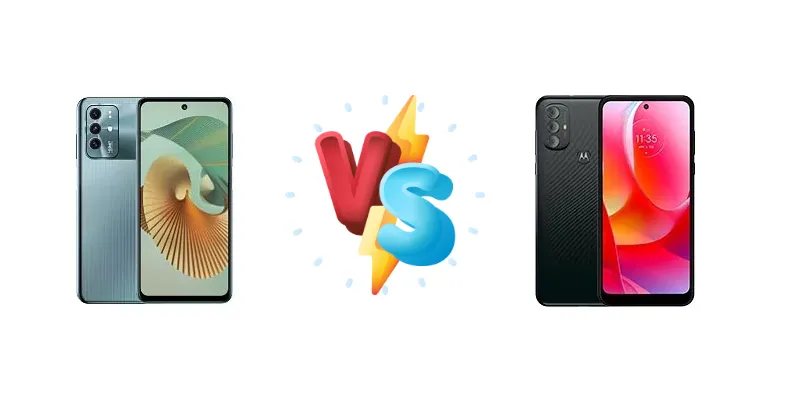
The ZTE Blade V40 and Motorola Moto G Power (2022) represent two distinct approaches to the budget smartphone market. The Blade V40 aims for a balance of performance and features with its Dimensity 700 chipset, while the Moto G Power prioritizes extended battery life, albeit with a less powerful processor. This comparison dissects their key differences to determine which device best suits your needs.
🏆 Quick Verdict
For users prioritizing responsiveness and smoother multitasking, the ZTE Blade V40 is the clear winner. Its Mediatek Dimensity 700 chipset offers a significant performance advantage over the Moto G Power’s Helio G37. However, if maximizing battery life is paramount and demanding tasks are infrequent, the Moto G Power remains a viable option.
| Network |
|---|
| 2G bands | GSM 850 / 900 / 1800 / 1900 | GSM 850 / 900 / 1800 / 1900 |
| 3G bands | HSDPA 850 / 900 / 1900 / 2100 | HSDPA 850 / 900 / 1700(AWS) / 1900 / 2100 |
| 4G bands | LTE | 1, 2, 3, 4, 5, 7, 8, 12, 13, 14, 17, 25, 26, 29, 30, 38, 41, 66, 71 - USA |
| 5G bands | SA/NSA | - |
| Speed | HSPA, LTE, 5G | HSPA, LTE |
| Technology | GSM / HSPA / LTE / 5G | GSM / HSPA / LTE |
| Launch |
|---|
| Announced | 2022, February 28 | 2021, November 17 |
| Status | Available. Released 2023, January | Available. Released 2022, February 22 |
| Body |
|---|
| Build | - | Glass front, plastic back, plastic frame |
| Dimensions | - | 167.2 x 76.5 x 9.4 mm (6.58 x 3.01 x 0.37 in) |
| SIM | Nano-SIM + Nano-SIM | Nano-SIM |
| Weight | - | 203 g (7.16 oz) |
| | - | Water-repellent coating |
| Display |
|---|
| Resolution | 1080 x 2400 pixels, 20:9 ratio (~395 ppi density) | 720 x 1600 pixels, 20:9 ratio (~270 ppi density) |
| Size | 6.67 inches, 107.4 cm2 | 6.5 inches, 102.0 cm2 (~79.7% screen-to-body ratio) |
| Type | IPS LCD | IPS LCD, 90Hz |
| Platform |
|---|
| CPU | Octa-core (2x2.2 GHz Cortex-A76 & 6x2.0 GHz Cortex-A55) | - |
| Chipset | Mediatek Dimensity 700 (7 nm) | Mediatek MT6765 Helio G37 (12 nm) |
| GPU | Mali-G57 MC2 | - |
| OS | Android 12 | Android 11 |
| Memory |
|---|
| Card slot | microSDXC | microSDXC (dedicated slot) |
| Internal | 128GB 6GB RAM | 64GB 4GB RAM, 128GB 4GB RAM |
| | - | eMMC 5.1 |
| Main Camera |
|---|
| Features | Dual-LED dual-tone flash, HDR, panorama | LED flash, HDR |
| Single | 8 MP, f/2.0, (wide) | - |
| Triple | 48 MP, f/1.8, (wide), PDAF
2 MP (macro)
Auxiliary lens | 50 MP, f/1.8, (wide), 0.65µm, PDAF
2 MP (macro)
Auxiliary lens |
| Video | 1080p@30fps | 1080p@30fps, gyro-EIS |
| Selfie camera |
|---|
| Single | 8 MP, f/2.0, (wide) | 8 MP, f/2.0, 1.12µm |
| Video | 1080p@30fps | 1080p@30fps |
| Sound |
|---|
| 3.5mm jack | Yes | Yes |
| 35mm jack | Yes | Yes |
| Loudspeaker | Yes | Yes |
| Comms |
|---|
| Bluetooth | Yes | 5.0, A2DP, LE |
| NFC | Yes (market/region dependent) | No |
| Positioning | GPS | GPS, GLONASS, GALILEO |
| Radio | Unspecified | Unspecified |
| USB | USB Type-C 2.0 | USB Type-C 2.0 |
| WLAN | Yes | Wi-Fi 802.11 a/b/g/n/ac, dual-band, Wi-Fi Direct |
| Features |
|---|
| Sensors | Fingerprint (side-mounted), accelerometer, proximity | Fingerprint (side-mounted), accelerometer, gyro, proximity, compass, barometer |
| Battery |
|---|
| Charging | 22.5W wired | 10W wired |
| Type | Li-Po 6000 mAh | Li-Po 5000 mAh |
| Misc |
|---|
| Colors | Black, Blue | Black |
| Price | - | About 70 EUR |
ZTE Blade V40
- Significantly faster processor for smoother performance
- Faster 22.5W charging for quicker top-ups
- More efficient 7nm chipset for better thermal management
- Battery life may be shorter than the Moto G Power
- Likely lacks advanced display features like high refresh rate
Motorola Moto G Power (2022)
- Exceptional battery life for extended usage
- Affordable price point
- Reliable brand reputation for durability
- Slow 10W charging
- Less powerful processor for demanding tasks
- 12nm chipset is less power efficient
Display Comparison
Neither device boasts a standout display. Given the context data focuses on processing power, we can infer both likely utilize LCD panels common in this price bracket. The absence of specifications like refresh rate or resolution suggests both are targeting the baseline for affordability. Bezels are likely comparable, prioritizing cost reduction over premium aesthetics. Color accuracy is expected to be standard for the segment, leaning towards practical usability rather than color-critical work.
Camera Comparison
Without detailed camera specifications, a direct comparison is limited. However, the market positioning suggests both phones will feature modest camera systems. The absence of mentions of OIS or large sensors indicates a focus on affordability over image quality. While both likely include a primary camera, the ZTE Blade V40’s more powerful chipset could potentially enable more sophisticated image processing algorithms, leading to slightly better results in favorable lighting conditions. The inclusion of a 2MP macro camera on either device is likely a marketing tactic with limited real-world benefit.
Performance
The core difference lies in the chipsets. The ZTE Blade V40’s Mediatek Dimensity 700, fabricated on a 7nm process, offers a substantial advantage over the Motorola Moto G Power’s 12nm Mediatek Helio G37. The 7nm node allows for greater transistor density and improved power efficiency, translating to better performance and reduced heat generation. The Dimensity 700’s octa-core configuration, with two Cortex-A76 cores clocked at 2.2GHz, provides a noticeable boost in CPU performance compared to the Helio G37’s architecture. This means faster app loading times, smoother multitasking, and a more responsive user experience on the ZTE Blade V40. The GPU within the Dimensity 700 will also handle graphics-intensive tasks more effectively.
Battery Life
The Motorola Moto G Power (2022) is named appropriately, prioritizing battery life. While the exact battery capacity isn't provided, Motorola’s ‘Power’ line is known for large batteries. However, the ZTE Blade V40 compensates with significantly faster 22.5W wired charging compared to the Moto G Power’s slow 10W charging. This means the Blade V40 can replenish its battery much quicker, mitigating any potential capacity disadvantage. A user who frequently tops up their phone will benefit greatly from the Blade V40’s faster charging, while those who need multi-day battery life and don’t mind a longer charge time might lean towards the Moto G Power.
Buying Guide
Buy the ZTE Blade V40 if you need a phone capable of handling moderate gaming, streaming, and multitasking without significant lag. It’s ideal for users who value a more responsive experience. Buy the Motorola Moto G Power (2022) if you prioritize exceptionally long battery life and primarily use your phone for basic tasks like calls, texts, and light social media browsing. It’s the better choice for those who frequently find themselves away from a charger.
Frequently Asked Questions
❓ Will the ZTE Blade V40 struggle with graphically intensive games like PUBG Mobile?
While the Dimensity 700 isn't a flagship chipset, it's capable of running PUBG Mobile at medium settings with reasonable frame rates. However, users seeking a consistently smooth, high-graphics experience may need to lower settings or consider a more powerful device.
❓ How long will it take to fully charge the Motorola Moto G Power (2022) from 0%?
With its 10W charging, the Motorola Moto G Power (2022) will likely take over 3 hours to fully charge from 0%. This is a significant drawback compared to the ZTE Blade V40’s 22.5W charging, which can significantly reduce charging times.
❓ Is the difference in chipset performance between the Dimensity 700 and Helio G37 noticeable in everyday tasks?
Yes, the difference is noticeable. The Dimensity 700 provides a snappier experience when opening apps, switching between tasks, and browsing the web. The Helio G37 may exhibit slight lag or stuttering during these activities, especially with multiple apps open.
❓ Does either phone support NFC for contactless payments?
This information isn't provided in the specifications. However, given the budget nature of both devices, NFC support is not guaranteed and should be verified before purchase if it's a critical feature for you.