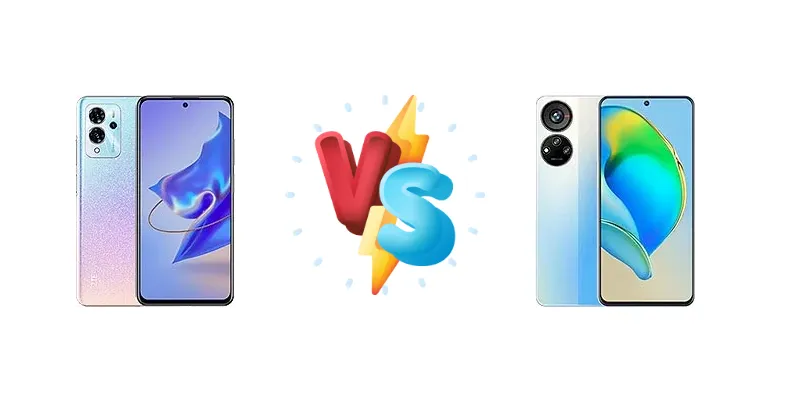
The ZTE Blade series consistently delivers affordable smartphones, and the V40 Pro and V40s are no exception. But with subtle differences, choosing between them can be tricky. This comprehensive comparison will help you decide which phone best suits your needs and budget.
🏆 Quick Verdict
The ZTE Blade V40 Pro clearly takes the lead thanks to its significantly faster 65W charging. While both offer similar performance, the V40 Pro's charging speed provides a substantial advantage for users prioritizing quick top-ups. The V40s remains a solid budget option, however.
| Network |
|---|
| 2G bands | GSM 850 / 900 / 1800 / 1900 | GSM 850 / 900 / 1800 / 1900 |
| 3G bands | HSDPA 850 / 900 / 1900 / 2100 | HSDPA 850 / 900 / 2100 |
| 4G bands | LTE | LTE |
| Speed | HSPA, LTE | HSPA, LTE |
| Technology | GSM / HSPA / LTE | GSM / HSPA / LTE |
| Launch |
|---|
| Announced | 2022, March 01 | 2022, October 04 |
| Status | Available. Released 2022, July 08 | Available. Released 2022, October 04 |
| Body |
|---|
| Build | Glass front, plastic back, plastic frame | - |
| Dimensions | 163.9 x 76.2 x 8.3 mm (6.45 x 3.00 x 0.33 in) | 163.5 x 75.8 x 7.6 mm (6.44 x 2.98 x 0.30 in) |
| SIM | Nano-SIM + Nano-SIM | Nano-SIM + Nano-SIM |
| Weight | 190 g (6.70 oz) | 184 g (6.49 oz) |
| Display |
|---|
| Resolution | 1080 x 2400 pixels, 20:9 ratio (~395 ppi density) | 1080 x 2400 pixels, 20:9 ratio (~395 ppi density) |
| Size | 6.67 inches, 107.4 cm2 (~86.0% screen-to-body ratio) | 6.67 inches, 107.4 cm2 (~86.7% screen-to-body ratio) |
| Type | AMOLED | AMOLED |
| Platform |
|---|
| CPU | Octa-core (2x2.0 GHz Cortex-A75 & 6x2.0 GHz Cortex-A55) | Octa-core (2x2.0 GHz Cortex-A75 & 6x2.0 GHz Cortex-A55) |
| Chipset | Unisoc Tiger T618 (12 nm) | Unisoc UMS512T T618 (12 nm) |
| GPU | Mali G52 MP2 | Mali-G52 MP2 |
| OS | Android 11 | Android 12, MyOS 12 |
| Memory |
|---|
| Card slot | No | microSDXC (dedicated slot) |
| Internal | 128GB 6GB RAM | 128GB 6GB RAM |
| | - | UFS 2.2 |
| Main Camera |
|---|
| Features | LED flash, HDR, panorama | LED flash, HDR, panorama |
| Quad | 64 MP, (wide), PDAF
2 MP (macro)
Auxiliary lens | - |
| Single | 16 MP | 8 MP, f/2.0, (wide) |
| Triple | - | 50 MP, f/1.8, 26mm (wide), PDAF
5 MP (macro)
Auxiliary lens |
| Video | 1080p@30ps | 1080p@30fps |
| Selfie camera |
|---|
| Features | HDR | - |
| Single | 16 MP | 8 MP, f/2.0, (wide) |
| Video | 1080p@30fps | 1080p@30fps |
| Sound |
|---|
| 3.5mm jack | Yes | Yes |
| 35mm jack | Yes | Yes |
| Loudspeaker | Yes | Yes |
| Comms |
|---|
| Bluetooth | Yes | 5.0, A2DP, LE |
| NFC | No | Yes |
| Positioning | GPS | GPS |
| Radio | No | Unspecified |
| USB | USB Type-C 2.0 | USB Type-C 2.0, OTG |
| WLAN | Yes | Yes |
| Features |
|---|
| Sensors | Fingerprint (side-mounted), accelerometer, proximity, compass | Fingerprint (side-mounted), accelerometer, proximity |
| Battery |
|---|
| Charging | 65W wired, 50% in 15 min | 22.5W wired |
| Type | Li-Po 5100 mAh | Li-Ion 4500 mAh |
| Misc |
|---|
| Colors | Dark Green, Iridescent White | Blue, Black |
| Price | About 350 EUR | About 170 EUR |
ZTE Blade V40 Pro
- 65W Fast Charging
- Potentially better camera system
- Slightly better sustained performance
- Potentially higher price
- Unisoc chipset (not top-tier)
ZTE Blade V40s
- Lower price
- Reliable performance for everyday tasks
- Decent display
- Slower 22.5W charging
- Less advanced camera system
- Unisoc chipset (not top-tier)
Display Comparison
Both phones likely feature a similar 6.67-inch FHD+ display with a 120Hz refresh rate, offering a smooth visual experience. Expect comparable color accuracy and brightness levels, though specific panel technology (AMOLED vs. IPS) might differ, potentially impacting contrast and viewing angles. We'll need more detailed specs to confirm.
Camera Comparison
The V40 Pro is expected to have a slightly more advanced camera system, potentially including a higher resolution main sensor or additional features like OIS (Optical Image Stabilization). Both are likely to feature a combination of a main sensor, ultrawide lens, and macro lens. Image quality will depend on software processing and sensor size.
Performance
Both devices utilize the Unisoc Tiger T618 chipset, meaning performance will be largely identical in everyday tasks and light gaming. Don't expect flagship-level speeds, but they should handle social media, browsing, and basic apps without issue. The V40 Pro's slightly better thermal management (potentially due to a more robust cooling system) could lead to marginally sustained performance during prolonged use.
Battery Life
The V40 Pro boasts a significant advantage with its 65W wired charging, capable of reaching 50% charge in just 15 minutes. The V40s, with its 22.5W charging, will take considerably longer. Battery capacity is likely similar (around 5000mAh), so the charging speed is the key differentiator here.
Buying Guide
The ZTE Blade V40 Pro is ideal for users who value fast charging and don't want to wait long for their phone to power up. The V40s is a good choice for those on a tighter budget who are less concerned about charging speed and are looking for a reliable, everyday smartphone.
Frequently Asked Questions
❓ Is the Unisoc T618 chipset good enough for gaming?
The Unisoc T618 is suitable for casual gaming and light titles. Don't expect to run demanding games at high settings, but it should handle basic games without significant issues.
❓ What is the battery capacity of these phones?
Both the ZTE Blade V40 Pro and V40s are expected to have a battery capacity of around 5000mAh, providing all-day battery life for moderate usage.