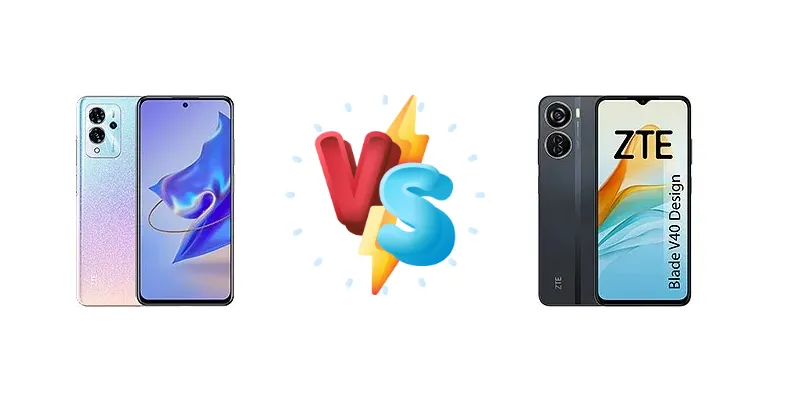
The ZTE Blade series consistently delivers affordable smartphones with decent features. Two recent contenders, the Blade V40 Pro and the Blade V40 Design, offer compelling options, but cater to slightly different needs. This comprehensive comparison will break down their strengths and weaknesses to help you decide which one is the best fit.
🏆 Quick Verdict
The ZTE Blade V40 Pro is the clear winner thanks to its significantly faster chipset, 65W charging, and overall improved performance. While the Design offers a more streamlined aesthetic, the Pro's power and charging speed justify its likely higher price point for most users.
| Network |
|---|
| 2G bands | GSM 850 / 900 / 1800 / 1900 | GSM 850 / 900 / 1800 / 1900 |
| 3G bands | HSDPA 850 / 900 / 1900 / 2100 | HSDPA 850 / 900 / 1900 / 2100 |
| 4G bands | LTE | LTE |
| Speed | HSPA, LTE | HSPA, LTE |
| Technology | GSM / HSPA / LTE | GSM / HSPA / LTE |
| Launch |
|---|
| Announced | 2022, March 01 | 2022, December 21 |
| Status | Available. Released 2022, July 08 | Available. Released 2023, January 10 |
| Body |
|---|
| Build | Glass front, plastic back, plastic frame | - |
| Dimensions | 163.9 x 76.2 x 8.3 mm (6.45 x 3.00 x 0.33 in) | 163 x 74 x 8 mm (6.42 x 2.91 x 0.31 in) |
| SIM | Nano-SIM + Nano-SIM | Nano-SIM + Nano-SIM |
| Weight | 190 g (6.70 oz) | 183.4 g (6.46 oz) |
| Display |
|---|
| Resolution | 1080 x 2400 pixels, 20:9 ratio (~395 ppi density) | 1080 x 2408 pixels, 20:9 ratio (~400 ppi density) |
| Size | 6.67 inches, 107.4 cm2 (~86.0% screen-to-body ratio) | 6.6 inches, 104.9 cm2 (~87.0% screen-to-body ratio) |
| Type | AMOLED | IPS LCD |
| Platform |
|---|
| CPU | Octa-core (2x2.0 GHz Cortex-A75 & 6x2.0 GHz Cortex-A55) | Octa-core (2x2.0 GHz Cortex-A75 & 6x1.8 GHz Cortex-A55) |
| Chipset | Unisoc Tiger T618 (12 nm) | Unisoc Tiger T616 (12 nm) |
| GPU | Mali G52 MP2 | Mali-G57 MP1 |
| OS | Android 11 | Android 12, MyOS 12 |
| Memory |
|---|
| Card slot | No | microSDXC (dedicated slot) |
| Internal | 128GB 6GB RAM | 128GB 4GB RAM, 128GB 6GB RAM |
| | - | UFS 2.2 |
| Main Camera |
|---|
| Features | LED flash, HDR, panorama | LED flash, HDR, panorama |
| Quad | 64 MP, (wide), PDAF
2 MP (macro)
Auxiliary lens | - |
| Single | 16 MP | 8 MP, (wide) |
| Triple | - | 50 MP, f/1.8, (wide), PDAF
2 MP (macro)
Auxiliary lens |
| Video | 1080p@30ps | 1080p@30fps |
| Selfie camera |
|---|
| Features | HDR | - |
| Single | 16 MP | 8 MP, (wide) |
| Video | 1080p@30fps | 1080p@30fps |
| Sound |
|---|
| 3.5mm jack | Yes | Yes |
| 35mm jack | Yes | Yes |
| Loudspeaker | Yes | Yes |
| Comms |
|---|
| Bluetooth | Yes | Yes |
| NFC | No | Yes |
| Positioning | GPS | GPS |
| Radio | No | Unspecified |
| USB | USB Type-C 2.0 | USB Type-C 2.0 |
| WLAN | Yes | Yes |
| Features |
|---|
| Sensors | Fingerprint (side-mounted), accelerometer, proximity, compass | Fingerprint (side-mounted), accelerometer, proximity |
| Battery |
|---|
| Charging | 65W wired, 50% in 15 min | 22.5W wired |
| Type | Li-Po 5100 mAh | Li-Po 4500 mAh |
| Misc |
|---|
| Colors | Dark Green, Iridescent White | Sky Blue, Starry Black |
| Models | - | 8046 |
| Price | About 350 EUR | About 200 EUR |
ZTE Blade V40 Pro
- Faster Chipset (Unisoc T618)
- 65W Fast Charging
- Potentially better image processing
- Likely smoother performance
- Potentially higher price
- Design might be less refined than the Design model
ZTE Blade V40 Design
- More streamlined design
- Likely more affordable
- Decent battery life
- Slower Chipset (Unisoc T616)
- 22.5W Charging (slower)
- Less powerful overall
Display Comparison
Both phones likely feature similar display technology (likely an IPS LCD) and resolution (likely FHD+). However, the Pro might have slightly better color accuracy or brightness due to potentially higher-tier components. We'll need to confirm specific display specs for a definitive comparison.
Camera Comparison
Both phones likely feature a similar main camera setup (likely a 64MP primary sensor). Image quality will depend on software processing and sensor size. The Pro might have slightly better image processing capabilities due to its more powerful chipset, resulting in marginally better photos in challenging lighting conditions.
Performance
This is where the biggest difference lies. The V40 Pro's Unisoc Tiger T618 boasts a more powerful CPU and likely better GPU performance compared to the V40 Design's T616. Expect smoother app loading, better multitasking, and improved gaming performance on the Pro.
Battery Life
While both phones likely have a similar battery capacity (around 5000mAh), the V40 Pro's 65W charging is a game-changer. It can charge from 0% to 50% in just 15 minutes, while the V40 Design's 22.5W charging will take considerably longer.
Buying Guide
The ZTE Blade V40 Pro is ideal for users who prioritize performance, fast charging, and a smoother user experience. It's a good choice for light gaming and multitasking. The ZTE Blade V40 Design is better suited for users who value a clean design and don't heavily rely on demanding applications, and are on a tighter budget.
Frequently Asked Questions
❓ What is the difference between the Unisoc Tiger T618 and T616 chipsets?
The T618 is a more powerful chipset with higher clock speeds and a more efficient architecture, resulting in better overall performance compared to the T616.
❓ Is the ZTE Blade V40 Pro worth the extra cost?
If performance and fast charging are important to you, then yes. The V40 Pro offers a significant upgrade in these areas. If you're on a tight budget and don't need the extra power, the V40 Design is a viable alternative.