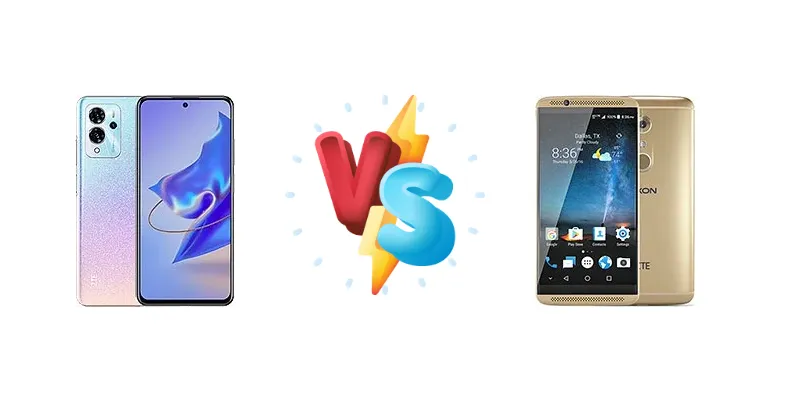
ZTE has a history of offering compelling smartphones at competitive prices. Today, we're pitting two of their devices against each other: the newer ZTE Blade V40 Pro and the older, but still noteworthy, ZTE Axon 7. Which phone offers the best blend of features and performance?
🏆 Quick Verdict
The ZTE Axon 7 boasts a Snapdragon 820 and exceptional battery life, making it surprisingly competitive even today. However, the Blade V40 Pro's 65W charging and newer chipset offer a faster experience. Ultimately, the Axon 7 wins for longevity and value, while the V40 Pro provides modern conveniences.
| Network |
|---|
| 2G bands | GSM 850 / 900 / 1800 / 1900 | GSM 850 / 900 / 1800 / 1900 - SIM 1 & SIM 2 |
| 3G bands | HSDPA 850 / 900 / 1900 / 2100 | HSDPA 850 / 900 / 1700(AWS) / 1900 / 2100 - A2017G, USA |
| 4G bands | LTE | 1, 2, 3, 4, 5, 7, 8, 19, 20, 28, 38, 40, 41 - A2017G |
| Speed | HSPA, LTE | HSPA 42.2/5.76 Mbps, LTE Cat6 300/50 Mbps |
| Technology | GSM / HSPA / LTE | GSM / CDMA / HSPA / LTE |
| | - | 1, 2, 3, 4, 5, 7, 12, 13, 17, 20, 25, 26, 29, 30, 41 - USA |
| Launch |
|---|
| Announced | 2022, March 01 | 2016, May. Released 2016, June |
| Status | Available. Released 2022, July 08 | Discontinued |
| Body |
|---|
| Build | Glass front, plastic back, plastic frame | Glass front (Gorilla Glass 4), aluminum back, aluminum frame |
| Dimensions | 163.9 x 76.2 x 8.3 mm (6.45 x 3.00 x 0.33 in) | 151.7 x 75 x 7.9 mm (5.97 x 2.95 x 0.31 in) |
| SIM | Nano-SIM + Nano-SIM | Nano-SIM + Nano-SIM |
| Weight | 190 g (6.70 oz) | 175 g (6.17 oz) |
| Display |
|---|
| Protection | - | Corning Gorilla Glass 4 |
| Resolution | 1080 x 2400 pixels, 20:9 ratio (~395 ppi density) | 1440 x 2560 pixels, 16:9 ratio (~538 ppi density) |
| Size | 6.67 inches, 107.4 cm2 (~86.0% screen-to-body ratio) | 5.5 inches, 82.2 cm2 (~72.2% screen-to-body ratio) |
| Type | AMOLED | AMOLED |
| Platform |
|---|
| CPU | Octa-core (2x2.0 GHz Cortex-A75 & 6x2.0 GHz Cortex-A55) | Quad-core (2x2.15 GHz Kryo & 2x1.6 GHz Kryo) |
| Chipset | Unisoc Tiger T618 (12 nm) | Qualcomm MSM8996 Snapdragon 820 (14 nm) |
| GPU | Mali G52 MP2 | Adreno 530 |
| OS | Android 11 | Android 6.0.1 (Marshmallow), upgradable to Android 8.0 (Oreo), MiFavor 5.2 |
| Memory |
|---|
| Card slot | No | microSDXC (uses shared SIM slot) |
| Internal | 128GB 6GB RAM | 64GB 4GB RAM |
| Main Camera |
|---|
| Features | LED flash, HDR, panorama | Dual-LED dual-tone flash, HDR, panorama |
| Quad | 64 MP, (wide), PDAF
2 MP (macro)
Auxiliary lens | - |
| Single | 16 MP | 20 MP, f/1.8, 1/2.6", 1.1µm, PDAF, OIS |
| Video | 1080p@30ps | 4K@30fps, 1080p@30/60fps, 720p@240fps |
| Selfie camera |
|---|
| Features | HDR | - |
| Single | 16 MP | 8 MP, f/2.2, 1/4.0", 1.12µm |
| Video | 1080p@30fps | 1080p@30fps |
| Sound |
|---|
| 3.5mm jack | Yes | Yes |
| 35mm jack | Yes | Yes |
| Loudspeaker | Yes | Yes, with Dolby Atmos stereo speakers (2 dedicated amplifiers) |
| | - | 32-bit/192kHz audio |
| Comms |
|---|
| Bluetooth | Yes | 4.2, A2DP |
| NFC | No | Yes |
| Positioning | GPS | GPS, GLONASS/ BDS (region dependent) |
| Radio | No | No |
| USB | USB Type-C 2.0 | USB Type-C 3.0 |
| WLAN | Yes | Wi-Fi 802.11 b/g/n/ac, dual-band, Wi-Fi Direct |
| Features |
|---|
| Sensors | Fingerprint (side-mounted), accelerometer, proximity, compass | Fingerprint (rear-mounted), accelerometer, gyro, proximity, compass |
| Battery |
|---|
| Charging | 65W wired, 50% in 15 min | 18W wired, QC3 |
| Stand-by | - | Up to 360 h (3G) |
| Talk time | - | Up to 16 h (3G) |
| Type | Li-Po 5100 mAh | Li-Ion 3250 mAh, non-removable |
| Misc |
|---|
| Colors | Dark Green, Iridescent White | Ion Gold, Quartz Grey, Chromium Silver |
| Models | - | A2017G, A2017U, A2017, A2017X |
| Price | About 350 EUR | About 240 EUR |
| Tests |
|---|
| Battery life | - |
Endurance rating 70h
|
| Camera | - |
Photo / Video |
| Loudspeaker | - |
Voice 66dB / Noise 72dB / Ring 84dB
|
| Performance | - |
Basemark OS II 2.0: 2346Basemark X: 32243 |
ZTE Blade V40 Pro
- 65W Fast Charging
- More Modern Chipset
- Likely Better Camera
- Modern Design
- Mid-Range Performance
- Battery Life May Be Shorter
- Unisoc Chipset Reputation
ZTE Axon 7
- Exceptional Battery Life
- Surprisingly Powerful Snapdragon 820
- Good Value for Money
- Compact Design
- Older Technology
- Slower Charging
- LCD Display
- Outdated Software
Display Comparison
The Blade V40 Pro likely features a more modern display technology (e.g., AMOLED) with potentially higher resolution and brightness compared to the Axon 7's LCD. Color accuracy and viewing angles are likely improved on the V40 Pro. However, the Axon 7's display was respectable for its time.
Camera Comparison
While both phones offer 'Photo / Video' capabilities, the Blade V40 Pro likely has a more advanced camera system with better image processing and potentially higher resolution sensors. Expect improved low-light performance and more features on the V40 Pro. The Axon 7's camera was good for its era.
Performance
The Snapdragon 820 in the Axon 7 remains surprisingly capable, handling most tasks smoothly. The Blade V40 Pro's Unisoc T618 is a mid-range chipset, offering decent performance but not as much raw power as the 820. Gaming performance will be noticeably better on the Axon 7.
Battery Life
The Axon 7's endurance rating of 70h is remarkable, suggesting exceptional battery life. The Blade V40 Pro, while offering 65W fast charging, likely has a smaller battery capacity and may not match the Axon 7's longevity.
Buying Guide
The ZTE Blade V40 Pro is ideal for users prioritizing fast charging and a more modern, albeit mid-range, experience. The ZTE Axon 7 is a great choice for budget-conscious buyers seeking long battery life and a surprisingly capable processor for everyday tasks and light gaming.
Frequently Asked Questions
❓ Is the ZTE Axon 7 still worth buying in 2024?
Yes, the Axon 7 offers incredible value for its price, especially if battery life is a priority. However, be aware of its age and potential software limitations.
❓ How does the Blade V40 Pro's charging speed compare to other phones?
The 65W charging is very fast, allowing you to charge the phone from 0% to 50% in just 15 minutes, which is competitive with many modern smartphones.