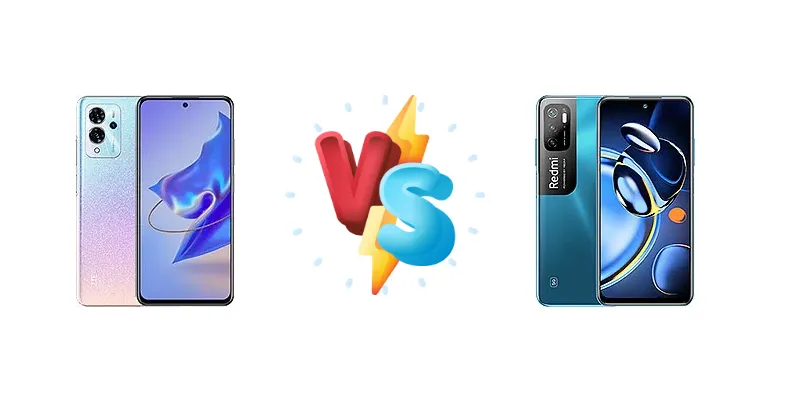
The budget smartphone market is fiercely competitive, offering incredible value for your money. Today, we're pitting two contenders against each other: the ZTE Blade V40 Pro and the Xiaomi Redmi Note 11SE. Both promise compelling features, but which one truly delivers?
🏆 Quick Verdict
The Xiaomi Redmi Note 11SE takes the crown thanks to its significantly faster Dimensity 700 chipset and more efficient 7nm process. While the ZTE Blade V40 Pro boasts impressive 65W charging, the Redmi Note 11SE's overall performance and modern chipset make it the better choice.
| Network |
|---|
| 2G bands | GSM 850 / 900 / 1800 / 1900 | GSM 850 / 900 / 1800 / 1900 |
| 3G bands | HSDPA 850 / 900 / 1900 / 2100 | HSDPA 850 / 900 / 1900 / 2100 |
| 4G bands | LTE | 1, 3, 5, 7, 8, 34, 38, 39, 40, 41 |
| 5G bands | - | 1, 41, 78 SA/NSA |
| Speed | HSPA, LTE | HSPA, LTE, 5G |
| Technology | GSM / HSPA / LTE | GSM / CDMA / HSPA / EVDO / LTE / 5G |
| | - | CDMA2000 1xEV-DO |
| Launch |
|---|
| Announced | 2022, March 01 | 2022, May 24 |
| Status | Available. Released 2022, July 08 | Available. Released 2022, May 31 |
| Body |
|---|
| Build | Glass front, plastic back, plastic frame | - |
| Dimensions | 163.9 x 76.2 x 8.3 mm (6.45 x 3.00 x 0.33 in) | 161.8 x 75.3 x 8.9 mm (6.37 x 2.96 x 0.35 in) |
| SIM | Nano-SIM + Nano-SIM | Nano-SIM + Nano-SIM |
| Weight | 190 g (6.70 oz) | 190 g (6.70 oz) |
| Display |
|---|
| Resolution | 1080 x 2400 pixels, 20:9 ratio (~395 ppi density) | 1080 x 2400 pixels, 20:9 ratio (~405 ppi density) |
| Size | 6.67 inches, 107.4 cm2 (~86.0% screen-to-body ratio) | 6.5 inches, 102.0 cm2 (~83.7% screen-to-body ratio) |
| Type | AMOLED | IPS LCD, 90Hz, 400 nits (typ) |
| Platform |
|---|
| CPU | Octa-core (2x2.0 GHz Cortex-A75 & 6x2.0 GHz Cortex-A55) | Octa-core (2x2.2 GHz Cortex-A76 & 6x2.0 GHz Cortex-A55) |
| Chipset | Unisoc Tiger T618 (12 nm) | Mediatek Dimensity 700 (7 nm) |
| GPU | Mali G52 MP2 | Mali-G57 MC2 |
| OS | Android 11 | Android 11, MIUI 12.5 |
| Memory |
|---|
| Card slot | No | No |
| Internal | 128GB 6GB RAM | 128GB 4GB RAM, 128GB 8GB RAM |
| | - | UFS 2.2 |
| Main Camera |
|---|
| Dual | - | 48 MP, f/1.8, (wide), 1/2.0", 0.8µm, PDAF
2 MP (macro) |
| Features | LED flash, HDR, panorama | Dual-LED dual-tone flash, HDR, panorama |
| Quad | 64 MP, (wide), PDAF
2 MP (macro)
Auxiliary lens | - |
| Single | 16 MP | 8 MP, f/2.0, (wide), 1/4.0", 1.12µm |
| Video | 1080p@30ps | 1080p@30fps |
| Selfie camera |
|---|
| Features | HDR | - |
| Single | 16 MP | 8 MP, f/2.0, (wide), 1/4.0", 1.12µm |
| Video | 1080p@30fps | 1080p@30fps |
| Sound |
|---|
| 3.5mm jack | Yes | Yes |
| 35mm jack | Yes | Yes |
| Loudspeaker | Yes | Yes |
| Comms |
|---|
| Bluetooth | Yes | 5.1, A2DP, LE |
| Infrared port | - | Yes |
| NFC | No | Yes |
| Positioning | GPS | GPS, GLONASS, GALILEO, BDS |
| Radio | No | No |
| USB | USB Type-C 2.0 | USB Type-C 2.0, OTG |
| WLAN | Yes | Wi-Fi 802.11 a/b/g/n/ac, dual-band, Wi-Fi Direct |
| Features |
|---|
| Sensors | Fingerprint (side-mounted), accelerometer, proximity, compass | Fingerprint (side-mounted), accelerometer, gyro, proximity, compass |
| | - | 24-bit/192kHz audio |
| Battery |
|---|
| Charging | 65W wired, 50% in 15 min | 18W wired |
| Type | Li-Po 5100 mAh | Li-Po 5000 mAh |
| Misc |
|---|
| Colors | Dark Green, Iridescent White | Blue, Black |
| Price | About 350 EUR | About 150 EUR |
ZTE Blade V40 Pro
- 65W Fast Charging
- Large Display (likely AMOLED)
- Competitive Price
- Less Powerful Chipset
- Older Chipset Architecture
- Potentially Less Efficient Battery
Xiaomi Redmi Note 11SE
- Faster Chipset (Dimensity 700)
- More Efficient Chipset (7nm)
- Smoother Performance
- Slower Charging (18W)
- Likely IPS LCD Display
- Potentially Higher Price
Display Comparison
Both phones feature large displays, likely around 6.6-6.7 inches. The ZTE Blade V40 Pro likely has an AMOLED display, offering vibrant colors and deep blacks, while the Redmi Note 11SE probably uses an IPS LCD panel. Expect similar resolutions (likely FHD+), but the ZTE's AMOLED should provide a superior viewing experience.
Camera Comparison
Camera specs are likely comparable, with both phones featuring a multi-camera setup including a main sensor (likely 64MP or higher), ultrawide, and macro lenses. Image quality will depend on software processing, but the Redmi Note 11SE's more powerful chipset might allow for slightly better image processing.
Performance
This is where the Redmi Note 11SE shines. The Dimensity 700's 7nm process and Cortex-A76 cores offer a noticeable performance advantage over the Unisoc Tiger T618's 12nm process and Cortex-A75 cores. Expect smoother multitasking, faster app loading, and better gaming performance on the Redmi Note 11SE.
Battery Life
The ZTE Blade V40 Pro's 65W charging is a major selling point, allowing for incredibly fast top-ups. However, the Redmi Note 11SE's Dimensity 700 chipset is more power-efficient, potentially leading to similar or even slightly better battery life despite the slower charging speed.
Buying Guide
The ZTE Blade V40 Pro is ideal for users prioritizing fast charging and a large display on a tight budget. The Xiaomi Redmi Note 11SE is a better fit for those who value performance, a smoother user experience, and a more modern chipset, even with slower charging.
Frequently Asked Questions
❓ Is the ZTE Blade V40 Pro good for gaming?
While it can handle basic games, the ZTE Blade V40 Pro's chipset isn't ideal for demanding titles. The Redmi Note 11SE offers a significantly better gaming experience.
❓ Which phone has better battery life?
Despite the ZTE Blade V40 Pro's faster charging, the Redmi Note 11SE's more efficient chipset could result in comparable or slightly better battery life.