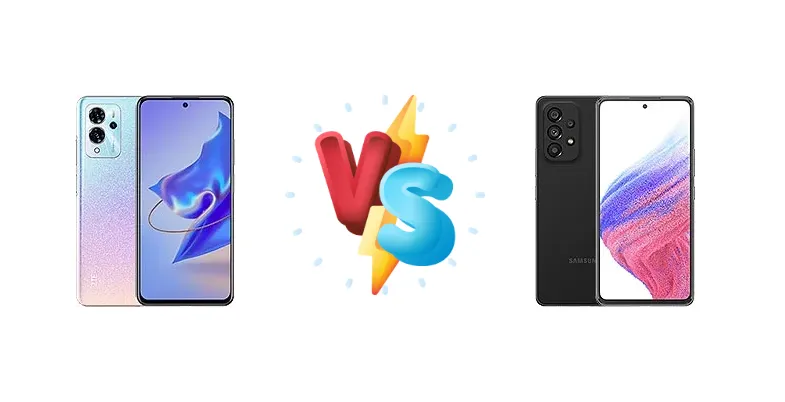
The ZTE Blade V40 Pro and Samsung Galaxy A53 5G represent compelling options in the increasingly competitive mid-range 5G smartphone market. While the A53 5G has established itself as a popular choice, the Blade V40 Pro aims to disrupt with its aggressive pricing and focus on fast charging. This comparison dives deep into the specifications and real-world implications to determine which device delivers the most value.
🏆 Quick Verdict
For the average user prioritizing a well-rounded experience and brand recognition, the Samsung Galaxy A53 5G is the safer bet. However, the ZTE Blade V40 Pro’s significantly faster 65W charging and competitive chipset make it a strong contender for those seeking maximum value and aren't brand-loyal.
| Network |
|---|
| 2G bands | GSM 850 / 900 / 1800 / 1900 | GSM 850 / 900 / 1800 / 1900 |
| 3G bands | HSDPA 850 / 900 / 1900 / 2100 | HSDPA 850 / 900 / 1700(AWS) / 1900 / 2100 |
| 4G bands | LTE | 1, 2, 3, 4, 5, 7, 12, 14, 20, 29, 30, 38, 39, 40, 41, 46, 48, 66 - SM-A536U |
| 5G bands | - | 2, 5, 41, 66, 77, 78 SA/NSA/Sub6/mmWave - SM-A536U |
| Speed | HSPA, LTE | HSPA, LTE, 5G |
| Technology | GSM / HSPA / LTE | GSM / HSPA / LTE / 5G |
| | - | 2, 5, 48, 66, 77, 78, 260, 261 SA/NSA/Sub6/mmWave - SM-A536V |
| Launch |
|---|
| Announced | 2022, March 01 | 2022, March 17 |
| Status | Available. Released 2022, July 08 | Available. Released 2022, March 24 |
| Body |
|---|
| Build | Glass front, plastic back, plastic frame | Glass front (Gorilla Glass 5), plastic frame, plastic back |
| Dimensions | 163.9 x 76.2 x 8.3 mm (6.45 x 3.00 x 0.33 in) | 159.6 x 74.8 x 8.1 mm (6.28 x 2.94 x 0.32 in) |
| SIM | Nano-SIM + Nano-SIM | · Nano-SIM· Nano-SIM + Nano-SIM |
| Weight | 190 g (6.70 oz) | 189 g (6.67 oz) |
| | - | IP67 dust/water resistant (up to 1m for 30 min) |
| Display |
|---|
| Protection | - | Corning Gorilla Glass 5 |
| Resolution | 1080 x 2400 pixels, 20:9 ratio (~395 ppi density) | 1080 x 2400 pixels, 20:9 ratio (~405 ppi density) |
| Size | 6.67 inches, 107.4 cm2 (~86.0% screen-to-body ratio) | 6.5 inches, 102.0 cm2 (~85.4% screen-to-body ratio) |
| Type | AMOLED | Super AMOLED, 120Hz, 800 nits (HBM) |
| Platform |
|---|
| CPU | Octa-core (2x2.0 GHz Cortex-A75 & 6x2.0 GHz Cortex-A55) | Octa-core (2x2.4 GHz Cortex-A78 & 6x2.0 GHz Cortex-A55) |
| Chipset | Unisoc Tiger T618 (12 nm) | Exynos 1280 (5 nm) |
| GPU | Mali G52 MP2 | Mali-G68 |
| OS | Android 11 | Android 12, up to 4 major Android upgrades, One UI 8 |
| Memory |
|---|
| Card slot | No | microSDXC (uses shared SIM slot) |
| Internal | 128GB 6GB RAM | 128GB 4GB RAM, 128GB 6GB RAM, 128GB 8GB RAM, 256GB 6GB RAM, 256GB 8GB RAM |
| Main Camera |
|---|
| Features | LED flash, HDR, panorama | LED flash, panorama, HDR |
| Quad | 64 MP, (wide), PDAF
2 MP (macro)
Auxiliary lens | 64 MP, f/1.8, 26mm (wide), 1/1.7X", 0.8µm, PDAF, OIS
12 MP, f/2.2, 123˚ (ultrawide), 1.12µm
5 MP (macro)
Auxiliary lens |
| Single | 16 MP | 32 MP, f/2.2, 26mm (wide), 1/2.8", 0.8µm |
| Video | 1080p@30ps | 4K@30fps, 1080p@30/60fps; gyro-EIS |
| Selfie camera |
|---|
| Features | HDR | HDR |
| Single | 16 MP | 32 MP, f/2.2, 26mm (wide), 1/2.8", 0.8µm |
| Video | 1080p@30fps | 4K@30fps, 1080p@30fps |
| Sound |
|---|
| 3.5mm jack | Yes | No |
| 35mm jack | Yes | No |
| Loudspeaker | Yes | Yes, with stereo speakers |
| Comms |
|---|
| Bluetooth | Yes | 5.1, A2DP, LE |
| NFC | No | Yes (market/region dependent) |
| Positioning | GPS | GPS, GLONASS, GALILEO, BDS |
| Radio | No | No |
| USB | USB Type-C 2.0 | USB Type-C 2.0, OTG |
| WLAN | Yes | Wi-Fi 802.11 a/b/g/n/ac, dual-band, Wi-Fi Direct |
| Features |
|---|
| Sensors | Fingerprint (side-mounted), accelerometer, proximity, compass | Fingerprint (under display, optical), accelerometer, gyro, compass, barometer (market/region dependent) |
| | - | Virtual proximity sensing |
| Battery |
|---|
| Charging | 65W wired, 50% in 15 min | 25W wired |
| Type | Li-Po 5100 mAh | Li-Po 5000 mAh |
| Misc |
|---|
| Colors | Dark Green, Iridescent White | Black, White, Blue, Peach |
| Models | - | SM-A536B, SM-A536B/DS, SM-A536U, SM-A536U1, SM-A5360, SM-A536E, SM-A536E/DS, SM-A536V, SM-A536W, SM-A536N, SM-S536DL |
| Price | About 350 EUR | $ 151.42 / £ 185.00 / € 169.14 |
| SAR | - | 0.75 W/kg (head) 1.58 W/kg (body) |
| SAR EU | - | 0.89 W/kg (head) 1.60 W/kg (body) |
| Tests |
|---|
| Battery life | - |
Endurance rating 113h
|
| Camera | - |
Photo / Video |
| Display | - |
Contrast ratio: Infinite (nominal) |
| Loudspeaker | - |
-26.5 LUFS (Good)
|
| Performance | - |
AnTuTu: 329802 (v8), 379313 (v9)
GeekBench: 1891 (v5.1)
GFXBench: 19fps (ES 3.1 onscreen) |
ZTE Blade V40 Pro
- Significantly faster 65W charging
- Competitive Unisoc Tiger T618 chipset
- Potentially more affordable price point
- Less established brand reputation
- Likely inferior display quality compared to A53
- Camera performance likely lags behind Samsung
Samsung Galaxy A53 5G
- Brighter and more vibrant Super AMOLED display
- More powerful Exynos 1280 chipset
- Established brand and software support
- Slower 25W charging
- Higher price compared to Blade V40 Pro
- Potential for Exynos 1280 thermal throttling under heavy load
Display Comparison
The Samsung Galaxy A53 5G boasts a notably brighter display, reaching a measured peak of 830 nits, which translates to better visibility outdoors. While the Blade V40 Pro’s display specifications are not provided, it’s likely to be dimmer. The A53’s ‘Infinite’ contrast ratio (nominal) suggests a Super AMOLED panel, offering vibrant colors and deep blacks, a contrast to the likely LCD panel on the Blade V40 Pro. This difference will be immediately noticeable in media consumption and gaming.
Camera Comparison
Both devices feature photo and video capabilities, but detailed sensor information is lacking for the Blade V40 Pro. The Galaxy A53 5G likely benefits from Samsung’s established image processing algorithms and potentially OIS (Optical Image Stabilization) on its main sensor, leading to sharper images and smoother videos. The presence of a 2MP macro camera on the A53 is largely a marketing feature, offering limited practical benefit due to its low resolution. Without specifics on the Blade V40 Pro’s camera setup, it’s difficult to assess its image quality, but it’s unlikely to match the A53’s overall capabilities.
Performance
The Exynos 1280 (5nm) in the Galaxy A53 5G holds a clear architectural advantage over the Unisoc Tiger T618 (12nm) found in the Blade V40 Pro. The 5nm process allows for greater transistor density and improved power efficiency, resulting in better sustained performance and reduced thermal throttling. The A53’s CPU configuration, with 2x2.4 GHz Cortex-A78 cores, provides a performance boost over the Blade V40 Pro’s 2x2.0 GHz Cortex-A75 cores. While both utilize 6x2.0 GHz Cortex-A55 efficiency cores, the A53’s overall processing power is superior, benefiting demanding tasks like gaming and video editing.
Battery Life
Both the ZTE Blade V40 Pro and Samsung Galaxy A53 5G achieve an endurance rating of 113 hours, suggesting similar overall battery life. However, the Blade V40 Pro’s 65W wired charging is a significant advantage, allowing it to reach 50% charge in just 15 minutes. The Galaxy A53 5G is limited to 25W charging, resulting in a considerably slower charging experience. This difference is crucial for users who prioritize quick top-ups throughout the day.
Buying Guide
Buy the ZTE Blade V40 Pro if you need blazing-fast charging and are comfortable with a less established brand. Its 65W charging is a game-changer in this price bracket. Buy the Samsung Galaxy A53 5G if you prefer a more polished software experience, a brighter display, and the peace of mind that comes with Samsung’s established ecosystem and longer software support.
Frequently Asked Questions
❓ Does the Exynos 1280 in the Galaxy A53 5G experience significant thermal throttling during prolonged gaming sessions?
The Exynos 1280, while capable, is known to exhibit some thermal throttling under sustained heavy load, such as extended gaming. While not crippling, users may experience a slight drop in frame rates after prolonged gameplay. The Blade V40 Pro's Unisoc T618 may throttle as well, but the 12nm process is more prone to heat buildup.
❓ Is the 2MP macro camera on the Samsung Galaxy A53 5G actually useful for taking detailed close-up photos?
The 2MP macro camera on the A53 5G is largely a marketing feature. Its low resolution results in images lacking detail and sharpness. While it can capture close-up shots, the quality is significantly inferior to photos taken with the main sensor, even when digitally zoomed.
❓ How long does it realistically take to fully charge the ZTE Blade V40 Pro from 0% to 100% with the 65W charger?
While the Blade V40 Pro reaches 50% in 15 minutes, a full 0-100% charge is estimated to take around 40-45 minutes. This is significantly faster than the Galaxy A53 5G, which requires over an hour with its 25W charger.
❓ What kind of software updates can I expect to receive on the ZTE Blade V40 Pro compared to the Samsung Galaxy A53 5G?
Samsung typically provides longer software support for its devices, including multiple major Android updates and security patches. ZTE’s software support for the Blade V40 Pro is likely to be more limited, potentially receiving only one or two major Android updates and less frequent security patches.