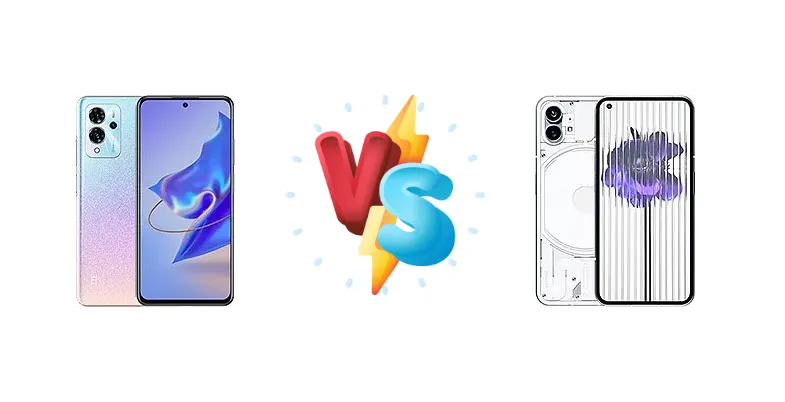
The mid-range smartphone market is fiercely competitive, and the ZTE Blade V40 Pro and Nothing Phone (1) represent distinct approaches. The Blade V40 Pro focuses on aggressive pricing and fast charging, while the Nothing Phone (1) prioritizes a unique design and a more refined software experience. This comparison dives deep into the specifications to determine which phone offers the best overall package.
🏆 Quick Verdict
For most users, the Nothing Phone (1) is the superior choice. Its Snapdragon 778G+ chipset delivers significantly better performance and efficiency than the Unisoc Tiger T618 in the ZTE Blade V40 Pro, justifying the price difference. While the Blade V40 Pro boasts faster wired charging, the Nothing Phone (1)'s overall experience is more polished.
| Network |
|---|
| 2G bands | GSM 850 / 900 / 1800 / 1900 | GSM 850 / 900 / 1800 / 1900 |
| 3G bands | HSDPA 850 / 900 / 1900 / 2100 | HSDPA 800 / 850 / 900 / 1700(AWS) / 1900 / 2100 |
| 4G bands | LTE | 1, 2, 3, 4, 5, 7, 8, 12, 17, 18, 19, 20, 26, 28, 32, 34, 38, 39, 40, 41, 66 |
| 5G bands | - | 1, 3, 5, 7, 8, 20, 28, 38, 40, 41, 77, 78 SA/NSA |
| Speed | HSPA, LTE | HSPA, LTE, 5G |
| Technology | GSM / HSPA / LTE | GSM / HSPA / LTE / 5G |
| Launch |
|---|
| Announced | 2022, March 01 | 2022, July 12 |
| Status | Available. Released 2022, July 08 | Available. Released 2022, July 16 |
| Body |
|---|
| Build | Glass front, plastic back, plastic frame | Glass front (Gorilla Glass 5), glass back (Gorilla Glass 5), aluminum frame |
| Dimensions | 163.9 x 76.2 x 8.3 mm (6.45 x 3.00 x 0.33 in) | 159.2 x 75.8 x 8.3 mm (6.27 x 2.98 x 0.33 in) |
| SIM | Nano-SIM + Nano-SIM | Nano-SIM + Nano-SIM |
| Weight | 190 g (6.70 oz) | 193.5 g (6.84 oz) |
| Display |
|---|
| Protection | - | Corning Gorilla Glass 5 |
| Resolution | 1080 x 2400 pixels, 20:9 ratio (~395 ppi density) | 1080 x 2400 pixels, 20:9 ratio (~402 ppi density) |
| Size | 6.67 inches, 107.4 cm2 (~86.0% screen-to-body ratio) | 6.55 inches, 103.6 cm2 (~85.8% screen-to-body ratio) |
| Type | AMOLED | OLED, 1B colors, 120Hz, 1440Hz PWM, HDR10+, 500 nits (typ), 1200 nits (peak) |
| Platform |
|---|
| CPU | Octa-core (2x2.0 GHz Cortex-A75 & 6x2.0 GHz Cortex-A55) | Octa-core (1x2.5 GHz Cortex-A78 & 3x2.4 GHz Cortex-A78 & 4x1.9 GHz Cortex-A55) |
| Chipset | Unisoc Tiger T618 (12 nm) | Qualcomm SM7325-AE Snapdragon 778G+ 5G (6 nm) |
| GPU | Mali G52 MP2 | Adreno 642L |
| OS | Android 11 | Android 12, upgradable to Android 15, up to 3 major Android upgrades, Nothing OS 3.0 |
| Memory |
|---|
| Card slot | No | No |
| Internal | 128GB 6GB RAM | 128GB 8GB RAM, 256GB 8GB RAM, 256GB 12GB RAM |
| Main Camera |
|---|
| Dual | - | 50 MP, f/1.9, 24mm (wide), 1/1.56", 1.0µm, PDAF, OIS
50 MP, f/2.2, 114˚ (ultrawide), 1/2.76", 0.64µm, AF |
| Features | LED flash, HDR, panorama | LED flash, panorama, HDR |
| Quad | 64 MP, (wide), PDAF
2 MP (macro)
Auxiliary lens | - |
| Single | 16 MP | - |
| Video | 1080p@30ps | 4K@30fps, 1080p@30/60fps, gyro-EIS, live HDR |
| Selfie camera |
|---|
| Features | HDR | - |
| Single | 16 MP | 16 MP, f/2.5, (wide), 1/3.1", 1.0µm |
| Video | 1080p@30fps | 1080p@30fps |
| Sound |
|---|
| 3.5mm jack | Yes | - |
| 35mm jack | Yes | No |
| Loudspeaker | Yes | Yes, with stereo speakers |
| Comms |
|---|
| Bluetooth | Yes | 5.2, A2DP, LE |
| NFC | No | Yes |
| Positioning | GPS | GPS (L1), GLONASS (L1), BDS (B1I+B1c), GALILEO (E1), QZSS (L1) |
| Radio | No | No |
| USB | USB Type-C 2.0 | USB Type-C 2.0, OTG |
| WLAN | Yes | Wi-Fi 802.11 a/b/g/n/ac/6, dual-band |
| Features |
|---|
| Sensors | Fingerprint (side-mounted), accelerometer, proximity, compass | Fingerprint (under display, optical), accelerometer, proximity, gyro, compass |
| Battery |
|---|
| Charging | 65W wired, 50% in 15 min | 33W wired, PD3.0, QC4, 50% in 30 min, 100% in 70 min
15W wireless
5W reverse wireless |
| Type | Li-Po 5100 mAh | Li-Ion 4500 mAh (17.42 Wh) |
| Misc |
|---|
| Colors | Dark Green, Iridescent White | White, Black |
| Models | - | A063 |
| Price | About 350 EUR | $ 539.00 / £ 234.77 / € 249.95 / ₹ 17,990 |
| SAR | - | 1.29 W/kg (head) 1.09 W/kg (body) |
| SAR EU | - | 0.99 W/kg (head) 1.48 W/kg (body) |
ZTE Blade V40 Pro
- Extremely fast 65W wired charging
- Aggressive price point
- Potentially longer battery life due to larger capacity (unconfirmed)
- Less powerful Unisoc Tiger T618 chipset
- Likely inferior display quality (LCD vs OLED)
- Limited camera capabilities (details unknown)
Nothing Phone (1)
- Superior Snapdragon 778G+ performance
- Vibrant OLED display with 663 nits brightness
- Wireless and reverse wireless charging
- Slower 33W wired charging
- Higher price tag
- Battery life, while good, isn't exceptional
Display Comparison
The Nothing Phone (1) features a 6.55-inch OLED display capable of reaching 663 nits of peak brightness, providing good visibility even outdoors. While the Blade V40 Pro’s display specifications are not provided, it’s likely to be an LCD panel with lower peak brightness. The Nothing Phone (1)'s OLED technology offers superior contrast and color accuracy. The absence of LTPO technology on either device means neither offers adaptive refresh rates for power saving, but the Nothing Phone (1)'s higher brightness is a clear advantage.
Camera Comparison
Details on the ZTE Blade V40 Pro’s camera are limited. The Nothing Phone (1) offers a dual 50MP rear camera system, focusing on photo and video quality. While megapixel count isn't everything, the Nothing Phone (1)'s image processing and sensor quality are likely superior. The absence of information regarding OIS or aperture on the Blade V40 Pro suggests a less sophisticated camera experience. The Nothing Phone (1)'s emphasis on computational photography will yield better results in challenging lighting conditions.
Performance
The core difference lies in the chipsets. The Nothing Phone (1) utilizes the Qualcomm Snapdragon 778G+ 5G (6nm), featuring an octa-core CPU with a prime Cortex-A78 core clocked at 2.5 GHz. This is a substantial upgrade over the ZTE Blade V40 Pro’s Unisoc Tiger T618 (12nm), which uses older Cortex-A75 cores at 2.0 GHz. The 6nm process node of the Snapdragon 778G+ offers significantly better power efficiency and thermal performance, translating to less throttling during sustained workloads. The Nothing Phone (1) will handle demanding games and multitasking with greater ease.
Battery Life
The Nothing Phone (1) boasts an endurance rating of 108 hours, indicating strong battery life. While the exact battery capacity isn't specified, the Snapdragon 778G+'s efficiency contributes significantly. The Blade V40 Pro compensates with 65W wired charging, achieving 50% charge in just 15 minutes. However, the Nothing Phone (1) still offers respectable charging speeds at 33W (50% in 30 minutes, 100% in 70 minutes) and adds the convenience of 15W wireless and 5W reverse wireless charging – features absent on the ZTE Blade V40 Pro.
Buying Guide
Buy the ZTE Blade V40 Pro if you absolutely prioritize the fastest possible wired charging and are on a very tight budget, willing to compromise on performance and software refinement. Buy the Nothing Phone (1) if you value a smoother user experience, better performance for gaming and demanding apps, and a distinctive design, and are willing to spend a bit more.
Frequently Asked Questions
❓ Does the Unisoc Tiger T618 in the ZTE Blade V40 Pro struggle with graphically intensive games like Genshin Impact?
Yes, the Unisoc Tiger T618 is a mid-range chipset and will likely struggle to deliver a smooth experience in demanding games like Genshin Impact, even at lower settings. Expect noticeable frame drops and potential overheating. The Snapdragon 778G+ in the Nothing Phone (1) offers a significantly better gaming experience.
❓ How does the Nothing Phone (1)'s Glyph Interface impact battery life?
The Glyph Interface, while visually striking, does consume some battery power. However, Nothing has optimized its software to minimize the impact. Users can customize the Glyph Interface's behavior and disable it entirely to conserve battery life. The impact is generally minimal and outweighed by the Snapdragon 778G+'s efficiency.
❓ Is the 33W charging on the Nothing Phone (1) slow compared to other phones in this price range?
While 65W or 80W charging is becoming more common, 33W is still a respectable charging speed. It's slower than the ZTE Blade V40 Pro's 65W, but the Nothing Phone (1) compensates with wireless charging capabilities and a more efficient chipset, leading to a comparable overall user experience.