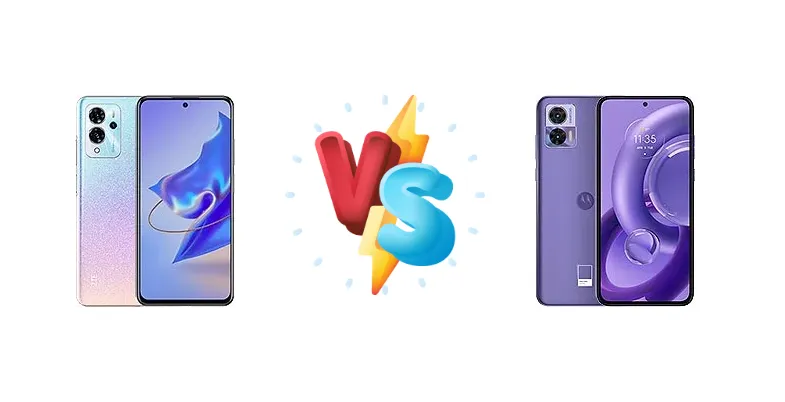
The ZTE Blade V40 Pro and Motorola Edge 30 Neo represent compelling options in the increasingly competitive sub-$300 smartphone market. While both offer 5G connectivity and modern features, they diverge significantly in their core hardware choices, creating distinct strengths and weaknesses. This comparison dives deep into these differences to help you determine which device best suits your needs.
🏆 Quick Verdict
For the average user prioritizing all-around performance and a brighter display, the Motorola Edge 30 Neo emerges as the better choice. Its Snapdragon 695 chipset, built on a more efficient 6nm process, delivers a smoother experience, while the 1004 nit display provides superior visibility. However, the ZTE Blade V40 Pro’s 65W charging is a strong counterpoint.
| Network |
|---|
| 2G bands | GSM 850 / 900 / 1800 / 1900 | GSM 850 / 900 / 1800 / 1900 |
| 3G bands | HSDPA 850 / 900 / 1900 / 2100 | HSDPA 850 / 900 / 1700(AWS) / 1900 / 2100 |
| 4G bands | LTE | 1, 2, 3, 4, 5, 7, 8, 12, 17, 20, 25, 26, 28, 32, 38, 40, 41, 42, 43 |
| 5G bands | - | 1, 3, 5, 7, 8, 20, 28, 38, 40, 41, 66, 78 SA/NSA |
| Speed | HSPA, LTE | HSPA, LTE, 5G |
| Technology | GSM / HSPA / LTE | GSM / HSPA / LTE / 5G |
| Launch |
|---|
| Announced | 2022, March 01 | 2022, September 08 |
| Status | Available. Released 2022, July 08 | Available. Released 2022, October 07 |
| Body |
|---|
| Build | Glass front, plastic back, plastic frame | Glass front, plastic frame, plastic back |
| Dimensions | 163.9 x 76.2 x 8.3 mm (6.45 x 3.00 x 0.33 in) | 152.9 x 71.2 x 7.8 mm (6.02 x 2.80 x 0.31 in) |
| SIM | Nano-SIM + Nano-SIM | · Nano-SIM· Nano-SIM + Nano-SIM |
| Weight | 190 g (6.70 oz) | 155 g (5.47 oz) |
| | - | Splash and dust resistant |
| Display |
|---|
| Resolution | 1080 x 2400 pixels, 20:9 ratio (~395 ppi density) | 1080 x 2400 pixels, 20:9 ratio (~419 ppi density) |
| Size | 6.67 inches, 107.4 cm2 (~86.0% screen-to-body ratio) | 6.28 inches, 95.2 cm2 (~87.5% screen-to-body ratio) |
| Type | AMOLED | P-OLED, 120Hz |
| Platform |
|---|
| CPU | Octa-core (2x2.0 GHz Cortex-A75 & 6x2.0 GHz Cortex-A55) | Octa-core (2x2.2 GHz Kryo 660 Gold & 6x1.7 GHz Kryo 660 Silver) |
| Chipset | Unisoc Tiger T618 (12 nm) | Qualcomm SM6375 Snapdragon 695 5G (6 nm) |
| GPU | Mali G52 MP2 | Adreno 619 |
| OS | Android 11 | Android 12, planned upgrade to Android 15 |
| Memory |
|---|
| Card slot | No | No |
| Internal | 128GB 6GB RAM | 128GB 6GB RAM, 128GB 8GB RAM, 256GB 8GB RAM |
| Main Camera |
|---|
| Dual | - | 64 MP, f/1.8, (wide), 1/1.97", 0.7µm, PDAF, OIS
13 MP, f/2.2, 120˚ (ultrawide), 1/3.0", 1.12µm, AF |
| Features | LED flash, HDR, panorama | Dual-LED flash, HDR, panorama |
| Quad | 64 MP, (wide), PDAF
2 MP (macro)
Auxiliary lens | - |
| Single | 16 MP | - |
| Video | 1080p@30ps | 1080p@30/60/120fps |
| Selfie camera |
|---|
| Features | HDR | HDR |
| Single | 16 MP | 32 MP, f/2.4, (wide), 1/3.0", 0.7µm |
| Video | 1080p@30fps | 1080p@30fps |
| Sound |
|---|
| 3.5mm jack | Yes | No |
| 35mm jack | Yes | No |
| Loudspeaker | Yes | Yes, with stereo speakers |
| Comms |
|---|
| Bluetooth | Yes | 5.1, A2DP, LE, aptX HD, aptX Adaptive |
| NFC | No | Yes |
| Positioning | GPS | GPS, GLONASS, GALILEO |
| Radio | No | No |
| USB | USB Type-C 2.0 | USB Type-C 3.1, OTG |
| WLAN | Yes | Wi-Fi 802.11 a/b/g/n/ac, dual-band, Wi-Fi Direct |
| Features |
|---|
| Sensors | Fingerprint (side-mounted), accelerometer, proximity, compass | Fingerprint (under display, optical), accelerometer, proximity, compass |
| Battery |
|---|
| Charging | 65W wired, 50% in 15 min | 68W wired
5W wireless |
| Type | Li-Po 5100 mAh | Li-Po 4020 mAh |
| Misc |
|---|
| Colors | Dark Green, Iridescent White | Very Peri, Black Onyx, Ice Palace, Aqua Foam |
| Models | - | XT2245-1 |
| Price | About 350 EUR | € 156.44 / $ 185.00 / £ 229.00 |
| Tests |
|---|
| Battery life | - |
Endurance rating 104h
|
| Camera | - |
Photo / Video |
| Display | - |
Contrast ratio: Infinite (nominal) |
| Loudspeaker | - |
-26.4 LUFS (Good)
|
| Performance | - |
AnTuTu: 380818 (v9)
GeekBench: 1964 (v5.1)
GFXBench: 16fps (ES 3.1 onscreen) |
ZTE Blade V40 Pro
- Faster charging speed (65W)
- Potentially lower price point
- Unisoc chipset offers a different experience
- Less efficient 12nm chipset
- Likely lower peak display brightness
- Unisoc’s software optimization is less mature
Motorola Edge 30 Neo
- More efficient 6nm Snapdragon 695
- Brighter 1004 nit display
- Wireless charging support
- Slightly slower wired charging (68W)
- Potentially higher price
- Motorola’s software update commitment can be inconsistent
Display Comparison
The Motorola Edge 30 Neo boasts a significantly brighter display, reaching a measured peak of 1004 nits, compared to an unspecified brightness for the ZTE Blade V40 Pro. This difference translates to better outdoor visibility. While both displays are likely LCD panels given the price point, the Motorola’s higher brightness is a clear advantage. The Edge 30 Neo’s ‘Infinite’ contrast ratio (nominal) suggests a standard LCD contrast ratio, while the Blade V40 Pro’s display characteristics remain unknown. Bezels are likely comparable, given the similar overall phone sizes, but the brighter panel on the Motorola is the defining factor.
Camera Comparison
Both devices are listed as having Photo/Video capabilities, but detailed camera specifications are lacking. Without sensor size or aperture information, a direct comparison is difficult. However, given the price bracket, it’s reasonable to assume both phones rely on primary sensors around the 48-50MP mark. The Motorola Edge 30 Neo likely benefits from Qualcomm’s image signal processor (ISP), which generally delivers better image processing and low-light performance than Unisoc’s offerings. The presence of Optical Image Stabilization (OIS) on the Motorola would be a significant advantage, but this is unconfirmed.
Performance
The chipset is where these phones truly diverge. The Motorola Edge 30 Neo utilizes the Qualcomm Snapdragon 695 5G (6nm), featuring a 2x2.2 GHz Kryo 660 Gold and 6x1.7 GHz Kryo 660 Silver CPU configuration. This 6nm process node offers superior power efficiency compared to the Unisoc Tiger T618 (12nm) in the ZTE Blade V40 Pro, which has a 2x2.0 GHz Cortex-A75 and 6x2.0 GHz Cortex-A55 CPU. The Snapdragon 695’s more modern architecture and smaller process node will result in better sustained performance and reduced thermal throttling, particularly during demanding tasks. While both phones likely feature similar RAM configurations, the Snapdragon 695 benefits from Qualcomm’s optimizations and potentially faster memory controllers.
Battery Life
Both the ZTE Blade V40 Pro and Motorola Edge 30 Neo share an endurance rating of 104 hours, suggesting comparable battery life despite potentially different battery capacities (not specified). However, the charging speeds differ significantly. The ZTE Blade V40 Pro supports 65W wired charging, claiming a 50% charge in 15 minutes. The Motorola Edge 30 Neo offers 68W wired charging *and* 5W wireless charging. While the difference in wired charging speed is marginal, the addition of wireless charging on the Motorola provides added convenience. The more efficient Snapdragon 695 in the Motorola may also contribute to slightly better real-world battery endurance.
Buying Guide
Buy the ZTE Blade V40 Pro if you prioritize fast charging and are comfortable with a potentially less refined software experience. It’s ideal for users who frequently top up their phones and don’t demand peak gaming performance. Buy the Motorola Edge 30 Neo if you value a brighter, more responsive display, a more efficient processor, and the benefits of Motorola’s near-stock Android experience. This phone is better suited for users who stream video, browse the web, and engage in moderate mobile gaming.
Frequently Asked Questions
❓ Does the Unisoc Tiger T618 in the ZTE Blade V40 Pro struggle with graphically intensive games like PUBG Mobile?
The Unisoc Tiger T618 is a capable processor for everyday tasks, but it will likely exhibit frame drops and require lower graphics settings in demanding games like PUBG Mobile. The Snapdragon 695 in the Motorola Edge 30 Neo offers a more consistent gaming experience due to its more powerful GPU and efficient architecture.
❓ Is the 5W wireless charging on the Motorola Edge 30 Neo worth considering, or is it too slow to be practical?
While 5W wireless charging is slower than wired charging, it offers a convenient top-up option for overnight charging or quick boosts throughout the day. It’s particularly useful for users who prefer not to deal with cables frequently.
❓ How does the software experience differ between the ZTE Blade V40 Pro and the Motorola Edge 30 Neo?
Motorola is known for its near-stock Android experience with minimal bloatware, offering a cleaner and more responsive user interface. ZTE’s software, while functional, often includes more pre-installed apps and customizations, which some users may find undesirable.
❓ Given the similar endurance ratings, will I notice a real-world difference in battery life between these two phones?
The Snapdragon 695’s superior power efficiency in the Motorola Edge 30 Neo may translate to slightly longer battery life in real-world usage, especially with moderate to heavy use. However, the difference is unlikely to be dramatic.