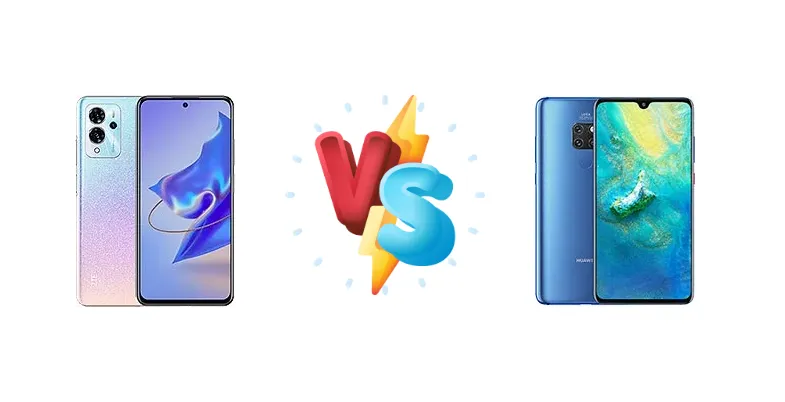
The smartphone market is brimming with options, making it tough to choose. Today, we're pitting two contenders against each other: the ZTE Blade V40 Pro, a modern budget-friendly option, and the Huawei Mate 20, a slightly older but still capable device. Let's dive into a detailed comparison to see which phone reigns supreme.
🏆 Quick Verdict
The Huawei Mate 20 edges out the ZTE Blade V40 Pro thanks to its superior chipset, excellent battery life, and impressive display contrast. While the Blade V40 Pro boasts faster charging, the Mate 20's overall performance and longevity make it the better choice for most users.
| Network |
|---|
| 2G bands | GSM 850 / 900 / 1800 / 1900 | GSM 850 / 900 / 1800 / 1900 |
| 3G bands | HSDPA 850 / 900 / 1900 / 2100 | HSDPA 800 / 850 / 900 / 1700(AWS) / 1900 / 2100 |
| 4G bands | LTE | 1, 2, 3, 4, 5, 6, 7, 8, 9, 12, 17, 18, 19, 20, 26, 28, 32, 34, 38, 39, 40 |
| Speed | HSPA, LTE | HSPA 42.2/5.76 Mbps, LTE Cat21 1400/200 Mbps |
| Technology | GSM / HSPA / LTE | GSM / HSPA / LTE |
| Launch |
|---|
| Announced | 2022, March 01 | 2018, October. Released 2018, November |
| Status | Available. Released 2022, July 08 | Discontinued |
| Body |
|---|
| Build | Glass front, plastic back, plastic frame | Glass front, glass back, aluminum frame |
| Dimensions | 163.9 x 76.2 x 8.3 mm (6.45 x 3.00 x 0.33 in) | 158.2 x 77.2 x 8.3 mm (6.23 x 3.04 x 0.33 in) |
| SIM | Nano-SIM + Nano-SIM | · Nano-SIM· Nano-SIM + Nano-SIM |
| Weight | 190 g (6.70 oz) | 188 g (6.63 oz) |
| | - | IP53, dust and splash resistant |
| Display |
|---|
| Resolution | 1080 x 2400 pixels, 20:9 ratio (~395 ppi density) | 1080 x 2244 pixels, 18.7:9 ratio (~381 ppi density) |
| Size | 6.67 inches, 107.4 cm2 (~86.0% screen-to-body ratio) | 6.53 inches, 107.5 cm2 (~88.0% screen-to-body ratio) |
| Type | AMOLED | IPS LCD, HDR10 |
| Platform |
|---|
| CPU | Octa-core (2x2.0 GHz Cortex-A75 & 6x2.0 GHz Cortex-A55) | Octa-core (2x2.6 GHz Cortex-A76 & 2x1.92 GHz Cortex-A76 & 4x1.8 GHz Cortex-A55) |
| Chipset | Unisoc Tiger T618 (12 nm) | Kirin 980 (7 nm) |
| GPU | Mali G52 MP2 | Mali-G76 MP10 |
| OS | Android 11 | Android 9.0 (Pie), EMUI 9.1 |
| Memory |
|---|
| Card slot | No | Nano Memory (uses shared SIM slot) |
| Internal | 128GB 6GB RAM | 64GB 6GB RAM, 128GB 4GB RAM, 128GB 6GB RAM |
| | - | UFS 2.1 |
| Main Camera |
|---|
| Features | LED flash, HDR, panorama | Laser AF, Leica optics, dual-LED dual-tone flash, panorama, HDR |
| Quad | 64 MP, (wide), PDAF
2 MP (macro)
Auxiliary lens | - |
| Single | 16 MP | - |
| Triple | - | 12 MP, f/1.8, 27mm (wide), 1/2.3", PDAF
8 MP, f/2.4, 54mm (telephoto), PDAF, 2x optical zoom
16 MP, f/2.2, 17mm (ultrawide) |
| Video | 1080p@30ps | 4K@30fps, 1080p@60fps, 1080p@30fps (gyro-EIS), 720p@960fps |
| Selfie camera |
|---|
| Features | HDR | HDR |
| Single | 16 MP | 24 MP, f/2.0, 26mm (wide), 1/2.8", 0.9µm |
| Video | 1080p@30fps | 1080p@30fps |
| Sound |
|---|
| 3.5mm jack | Yes | Yes |
| 35mm jack | Yes | Yes |
| Loudspeaker | Yes | Yes, with stereo speakers |
| | - | 32-bit/384kHz audio
|
| Comms |
|---|
| Bluetooth | Yes | 5.0, A2DP, aptX HD, LE |
| Infrared port | - | Yes |
| NFC | No | Yes |
| Positioning | GPS | GPS (L1+L5), GLONASS (L1), BDS (B1), GALILEO (E1+E5a), QZSS (L1+L5) |
| Radio | No | FM radio |
| USB | USB Type-C 2.0 | USB Type-C 3.1, OTG |
| WLAN | Yes | Wi-Fi 802.11 a/b/g/n/ac, dual-band, DLNA, Wi-Fi Direct |
| Features |
|---|
| Sensors | Fingerprint (side-mounted), accelerometer, proximity, compass | Fingerprint (rear-mounted), accelerometer, gyro, proximity, barometer, compass |
| Battery |
|---|
| Charging | 65W wired, 50% in 15 min | 22.5W wired, 58% in 30 min |
| Type | Li-Po 5100 mAh | Li-Po 4000 mAh, non-removable |
| Misc |
|---|
| Colors | Dark Green, Iridescent White | Midnight Blue, Twilight, Black, Emerald Green, Pink Gold |
| Models | - | HMA-L29, HMA-L09, HMA-LX9, HMA-AL00, HMA-TL00 |
| Price | About 350 EUR | About 460 EUR |
| Tests |
|---|
| Audio quality | - |
Noise -92.1dB / Crosstalk -85.6dB |
| Battery life | - | Endurance rating 92h |
| Camera | - |
Photo / Video |
| Display | - |
Contrast ratio: 1415:1 (nominal), 3.052 (sunlight) |
| Loudspeaker | - |
Voice 74dB / Noise 70dB / Ring 82dB |
| Performance | - |
AnTuTu: 273913 (v7)
GeekBench: 9793 (v4.4)
GFXBench: 28fps (ES 3.1 onscreen) |
ZTE Blade V40 Pro
- Fast 65W Charging
- Modern Design
- Potentially Higher Resolution Display
- Budget-Friendly
- Less Powerful Chipset
- Limited Camera Details
- Unknown Display Quality (beyond contrast)
Huawei Mate 20
- Excellent Battery Life
- Powerful Kirin 980 Chipset
- Vibrant Display
- Good Camera Performance
- Older Model
- Slower Charging (22.5W)
- Potentially Outdated Software Support
Display Comparison
Both phones feature impressive contrast ratios (1415:1 nominal, 3.052 in sunlight). The Mate 20's display, while not the sharpest by today's standards, benefits from Huawei's color calibration, offering accurate and vibrant colors. The Blade V40 Pro likely has a more modern panel, potentially with a higher resolution, but lacks detailed specifications available. Sunlight readability is excellent on both.
Camera Comparison
Camera details are sparse for both devices. The Mate 20 is known for its capable camera system, offering good image quality in various lighting conditions. The Blade V40 Pro likely features a higher resolution main sensor, but image processing and overall quality will depend on ZTE's software optimization. A direct comparison would require detailed testing.
Performance
Here, the Huawei Mate 20 takes a clear lead. Its Kirin 980 chipset, built on a 7nm process, is significantly more powerful than the Unisoc Tiger T618 (12nm) in the Blade V40 Pro. Expect smoother multitasking, faster app loading, and better gaming performance on the Mate 20. The Mate 20's CPU architecture (with Cortex-A76 cores) also contributes to its superior performance.
Battery Life
The Huawei Mate 20 shines in this category. Its endurance rating of 92h is exceptional, indicating outstanding battery life. While the Blade V40 Pro offers incredibly fast 65W charging (50% in 15 minutes), the Mate 20's larger battery capacity and efficient power management provide significantly longer usage time between charges.
Buying Guide
The ZTE Blade V40 Pro is ideal for users prioritizing fast charging and a modern design on a tight budget. The Huawei Mate 20 is a great pick for those seeking long battery life, a vibrant display, and a more powerful processor, even if it's a slightly older model.
Frequently Asked Questions
❓ Is the Huawei Mate 20 still worth buying in 2024?
Yes, if you prioritize battery life and performance over the absolute latest features. However, consider software update support.
❓ How does the charging speed of the Blade V40 Pro compare to the Mate 20?
The Blade V40 Pro's 65W charging is significantly faster than the Mate 20's 22.5W charging.