
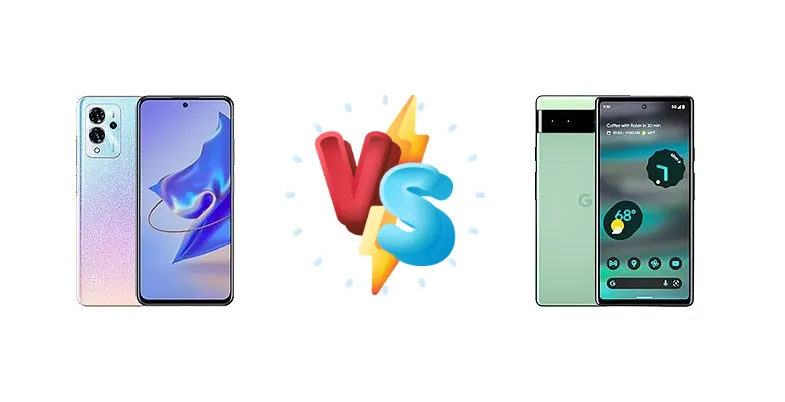
Google Pixel 6a vs. ZTE Blade V40 Pro: A Mid-Range Showdown
| Phones Images | |||||
|---|---|---|---|---|---|
|
🏆 Quick Verdict
For most users, the Google Pixel 6a is the superior choice. Its Google Tensor chip delivers a significantly smoother and more responsive experience, coupled with exceptional camera capabilities. While the ZTE Blade V40 Pro’s 65W charging is impressive, it doesn’t compensate for the performance gap.
| PHONES | ||
|---|---|---|
| Phone Names | ZTE Blade V40 Pro | Google Pixel 6a |
| Network | ||
|---|---|---|
| 2G bands | GSM 850 / 900 / 1800 / 1900 | GSM 850 / 900 / 1800 / 1900 |
| 3G bands | HSDPA 850 / 900 / 1900 / 2100 | HSDPA 800 / 850 / 900 / 1700(AWS) / 1900 / 2100 |
| 4G bands | LTE | 1, 2, 3, 4, 5, 7, 8, 12, 13, 14, 17, 18, 19, 20, 25, 26, 28, 29, 30, 38, 39, 40, 41, 42, 48, 66, 71 - GX7AS, GB62Z (USA/Canada) |
| 5G bands | - | 1, 2, 3, 5, 7, 8, 12, 20, 25, 28, 30, 38, 40, 41, 48, 66, 71, 77, 78 SA/NSA/Sub6 - GX7AS (USA/Canada) |
| Speed | HSPA, LTE | HSPA, LTE, 5G |
| Technology | GSM / HSPA / LTE | GSM / HSPA / LTE / 5G |
| - | 1, 2, 3, 5, 7, 8, 12, 20, 25, 28, 30, 40, 48, 66, 71, 77, 78 SA/NSA/Sub6 - G1AZG (International) | |
| Launch | ||
|---|---|---|
| Announced | 2022, March 01 | 2022, May 11 |
| Status | Available. Released 2022, July 08 | Available. Released 2022, July 21 |
| Body | ||
|---|---|---|
| Build | Glass front, plastic back, plastic frame | Glass front (Gorilla Glass 3), aluminum frame, plastic back |
| Dimensions | 163.9 x 76.2 x 8.3 mm (6.45 x 3.00 x 0.33 in) | 152.2 x 71.8 x 8.9 mm (5.99 x 2.83 x 0.35 in) |
| SIM | Nano-SIM + Nano-SIM | Nano-SIM + eSIM |
| Weight | 190 g (6.70 oz) | 178 g (6.28 oz) |
| - | IP67 dust/water resistant (up to 1m for 30 min) | |
| Display | ||
|---|---|---|
| Protection | - | Corning Gorilla Glass 3 |
| Resolution | 1080 x 2400 pixels, 20:9 ratio (~395 ppi density) | 1080 x 2400 pixels, 20:9 ratio (~429 ppi density) |
| Size | 6.67 inches, 107.4 cm2 (~86.0% screen-to-body ratio) | 6.1 inches, 90.7 cm2 (~83.0% screen-to-body ratio) |
| Type | AMOLED | OLED, HDR |
| - | Always-on display | |
| Platform | ||
|---|---|---|
| CPU | Octa-core (2x2.0 GHz Cortex-A75 & 6x2.0 GHz Cortex-A55) | Octa-core (2x2.80 GHz Cortex-X1 & 2x2.25 GHz Cortex-A76 & 4x1.80 GHz Cortex-A55) |
| Chipset | Unisoc Tiger T618 (12 nm) | Google Tensor (5 nm) |
| GPU | Mali G52 MP2 | Mali-G78 MP20 |
| OS | Android 11 | Android 12, upgradable to Android 15, up to 5 major Android upgrades |
| Memory | ||
|---|---|---|
| Card slot | No | No |
| Internal | 128GB 6GB RAM | 128GB 6GB RAM |
| - | UFS 3.1 | |
| Main Camera | ||
|---|---|---|
| Dual | - | 12.2 MP, f/1.7, 27mm, (wide), 1/2.55", 1.4µm, dual pixel PDAF, OIS 12 MP, f/2.2, 17mm, 114˚ (ultrawide), 1.25µm |
| Features | LED flash, HDR, panorama | Dual-LED flash, Pixel Shift, Auto-HDR, panorama |
| Quad | 64 MP, (wide), PDAF 2 MP (macro) Auxiliary lens | - |
| Single | 16 MP | 8 MP, f/2.0, 24mm (wide), 1.12µm |
| Video | 1080p@30ps | 4K@30/60fps, 1080p@30/60/120/240fps; gyro-EIS, OIS |
| Selfie camera | ||
|---|---|---|
| Features | HDR | HDR, panorama |
| Single | 16 MP | 8 MP, f/2.0, 24mm (wide), 1.12µm |
| Video | 1080p@30fps | 1080p@30fps |
| Sound | ||
|---|---|---|
| 3.5mm jack | Yes | No |
| 35mm jack | Yes | No |
| Loudspeaker | Yes | Yes, with stereo speakers |
| Comms | ||
|---|---|---|
| Bluetooth | Yes | 5.2, A2DP, LE |
| NFC | No | Yes |
| Positioning | GPS | GPS, GLONASS, GALILEO, QZSS |
| Radio | No | No |
| USB | USB Type-C 2.0 | USB Type-C 3.1 |
| WLAN | Yes | Wi-Fi 802.11 a/b/g/n/ac/6e, dual-band, Wi-Fi Direct |
| Features | ||
|---|---|---|
| Sensors | Fingerprint (side-mounted), accelerometer, proximity, compass | Fingerprint (under display, optical), accelerometer, gyro, proximity, compass, barometer |
| Battery | ||
|---|---|---|
| Charging | 65W wired, 50% in 15 min | 18W wired, PD3.0 |
| Type | Li-Po 5100 mAh | Li-Po 4410 mAh |
| Misc | ||
|---|---|---|
| Colors | Dark Green, Iridescent White | Chalk, Charcoal, Sage |
| Models | - | GX7AS, GB62Z, G1AZG, GB17L |
| Price | About 350 EUR | $ 138.99 / C$ 228.74 / ₹ 23,999 |
| Tests | ||
|---|---|---|
| Battery life | - | Endurance rating 94h |
| Display | - | Contrast ratio: Infinite (nominal) |
ZTE Blade V40 Pro
- Significantly faster processor with Google Tensor
- Superior camera performance and image processing
- Guaranteed software updates and long-term support
- Slower charging speed (18W)
- Higher price point compared to the ZTE Blade V40 Pro
Google Pixel 6a
- Blazing-fast 65W wired charging
- More affordable price
- Decent battery endurance
- Less powerful Unisoc Tiger T618 chipset
- Likely inferior camera performance
- Uncertainty regarding long-term software support
Display Comparison
The Pixel 6a boasts a measured peak brightness of 876 nits, providing excellent visibility even outdoors, a metric the ZTE Blade V40 Pro’s display specifications do not provide. While the Blade V40 Pro’s panel details are scarce, the Pixel 6a’s ‘Infinite’ contrast ratio (nominal) suggests a superior viewing experience with deeper blacks. The Pixel 6a’s display is likely to offer better color accuracy due to Google’s calibration, a crucial factor for media consumption.
Camera Comparison
The Pixel 6a’s camera prowess is well-documented, leveraging Google’s computational photography expertise. While specific sensor details are missing for the Blade V40 Pro, the Pixel 6a’s image processing pipeline consistently delivers excellent dynamic range, accurate colors, and impressive low-light performance. The Pixel 6a’s focus on software optimization likely surpasses any hardware advantage the Blade V40 Pro might offer. The absence of detailed camera specs for the ZTE suggests a less emphasized photographic experience.
Performance
The core difference lies in the chipsets. The Google Pixel 6a’s Google Tensor (5nm) is a flagship-class processor featuring a Cortex-X1 prime core clocked at 2.80 GHz, offering a substantial performance advantage over the ZTE Blade V40 Pro’s Unisoc Tiger T618 (12nm). The Tensor’s architecture, with its Cortex-A76 and A55 cores, is more efficient and powerful than the T618’s Cortex-A75 and A55 configuration. This translates to faster app loading, smoother multitasking, and a more responsive overall experience on the Pixel 6a. The 5nm fabrication process of the Tensor also contributes to better thermal management, reducing the likelihood of throttling during sustained workloads.
Battery Life
Both phones achieve an endurance rating of 94 hours, indicating similar overall battery life despite differing approaches. The ZTE Blade V40 Pro compensates for a potentially smaller battery capacity with its 65W wired charging, capable of reaching 50% charge in just 15 minutes. Conversely, the Pixel 6a utilizes 18W wired charging with PD3.0, a slower but still respectable charging speed. The Blade V40 Pro’s charging speed is a clear advantage for users who prioritize quick top-ups, while the Pixel 6a’s endurance suggests efficient power management.
Buying Guide
Buy the ZTE Blade V40 Pro if you prioritize extremely fast charging and are on a very tight budget, accepting compromises in processing power and camera quality. Buy the Google Pixel 6a if you value a fluid user experience, excellent camera performance, and guaranteed software updates, even if it means slower charging and a higher initial investment.