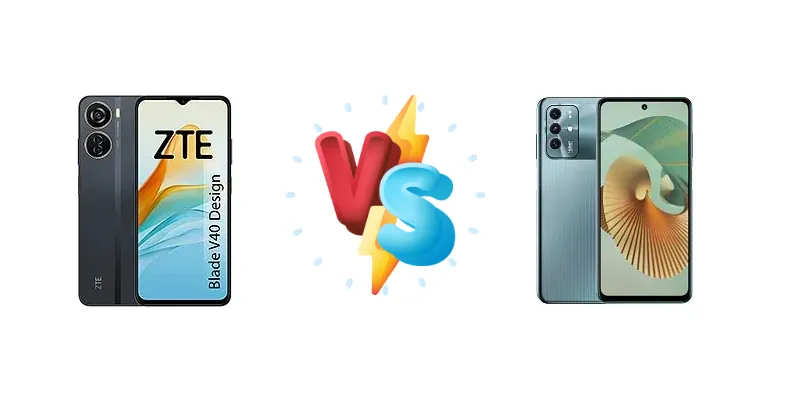
The ZTE Blade V40 series offers compelling budget-friendly options, but with slight variations. This comparison dives deep into the differences between the standard ZTE Blade V40 and the ZTE Blade V40 Design, helping you determine which model best suits your needs and budget. We'll cover everything from processing power to camera capabilities.
🏆 Quick Verdict
The ZTE Blade V40 with the Dimensity 700 chipset is the clear winner. Its superior processor and more efficient 7nm manufacturing process provide significantly better performance and likely improved battery life compared to the V40 Design's Unisoc T616. While both offer 22.5W charging, the Dimensity 700's efficiency makes it the more appealing choice.
| Network |
|---|
| 2G bands | GSM 850 / 900 / 1800 / 1900 | GSM 850 / 900 / 1800 / 1900 |
| 3G bands | HSDPA 850 / 900 / 1900 / 2100 | HSDPA 850 / 900 / 1900 / 2100 |
| 4G bands | LTE | LTE |
| 5G bands | - | SA/NSA |
| Speed | HSPA, LTE | HSPA, LTE, 5G |
| Technology | GSM / HSPA / LTE | GSM / HSPA / LTE / 5G |
| Launch |
|---|
| Announced | 2022, December 21 | 2022, February 28 |
| Status | Available. Released 2023, January 10 | Available. Released 2023, January |
| Body |
|---|
| Dimensions | 163 x 74 x 8 mm (6.42 x 2.91 x 0.31 in) | - |
| SIM | Nano-SIM + Nano-SIM | Nano-SIM + Nano-SIM |
| Weight | 183.4 g (6.46 oz) | - |
| Display |
|---|
| Resolution | 1080 x 2408 pixels, 20:9 ratio (~400 ppi density) | 1080 x 2400 pixels, 20:9 ratio (~395 ppi density) |
| Size | 6.6 inches, 104.9 cm2 (~87.0% screen-to-body ratio) | 6.67 inches, 107.4 cm2 |
| Type | IPS LCD | IPS LCD |
| Platform |
|---|
| CPU | Octa-core (2x2.0 GHz Cortex-A75 & 6x1.8 GHz Cortex-A55) | Octa-core (2x2.2 GHz Cortex-A76 & 6x2.0 GHz Cortex-A55) |
| Chipset | Unisoc Tiger T616 (12 nm) | Mediatek Dimensity 700 (7 nm) |
| GPU | Mali-G57 MP1 | Mali-G57 MC2 |
| OS | Android 12, MyOS 12 | Android 12 |
| Memory |
|---|
| Card slot | microSDXC (dedicated slot) | microSDXC |
| Internal | 128GB 4GB RAM, 128GB 6GB RAM | 128GB 6GB RAM |
| | UFS 2.2 | - |
| Main Camera |
|---|
| Features | LED flash, HDR, panorama | Dual-LED dual-tone flash, HDR, panorama |
| Single | 8 MP, (wide) | 8 MP, f/2.0, (wide) |
| Triple | 50 MP, f/1.8, (wide), PDAF
2 MP (macro)
Auxiliary lens | 48 MP, f/1.8, (wide), PDAF
2 MP (macro)
Auxiliary lens |
| Video | 1080p@30fps | 1080p@30fps |
| Selfie camera |
|---|
| Single | 8 MP, (wide) | 8 MP, f/2.0, (wide) |
| Video | 1080p@30fps | 1080p@30fps |
| Sound |
|---|
| 3.5mm jack | Yes | Yes |
| 35mm jack | Yes | Yes |
| Loudspeaker | Yes | Yes |
| Comms |
|---|
| Bluetooth | Yes | Yes |
| NFC | Yes | Yes (market/region dependent) |
| Positioning | GPS | GPS |
| Radio | Unspecified | Unspecified |
| USB | USB Type-C 2.0 | USB Type-C 2.0 |
| WLAN | Yes | Yes |
| Features |
|---|
| Sensors | Fingerprint (side-mounted), accelerometer, proximity | Fingerprint (side-mounted), accelerometer, proximity |
| Battery |
|---|
| Charging | 22.5W wired | 22.5W wired |
| Type | Li-Po 4500 mAh | Li-Po 6000 mAh |
| Misc |
|---|
| Colors | Sky Blue, Starry Black | Black, Blue |
| Models | 8046 | - |
| Price | About 200 EUR | - |
ZTE Blade V40 Design
- Potentially lower price
- Aesthetically pleasing design variations
- Decent display
- Weaker processor
- Lower performance
- Less efficient battery
- Potentially lower camera quality
ZTE Blade V40
- Significantly better performance
- More efficient processor
- Likely better battery life
- Potentially better camera quality
- More responsive user experience
- Potentially slightly higher price
- Design might be less emphasized
Display Comparison
Both phones likely feature similar display technology (likely an IPS LCD) and resolution (likely FHD+). The 'Design' variant might have subtle aesthetic differences in the back panel material or finish, but the core display specs are expected to be comparable. We'll need to confirm exact display brightness and color accuracy for a definitive comparison.
Camera Comparison
Both phones likely feature a similar camera setup (likely a 48MP main sensor, ultrawide, and macro). However, the Dimensity 700's more powerful image signal processor (ISP) could result in slightly better image quality, especially in low-light conditions. Video recording capabilities are also likely to be improved on the Blade V40.
Performance
This is where the biggest difference lies. The Dimensity 700's 7nm process and Cortex-A76 cores offer a substantial performance advantage over the Unisoc T616's 12nm process and Cortex-A75 cores. Expect noticeably faster app loading, smoother multitasking, and better gaming performance on the Blade V40.
Battery Life
While both have 22.5W charging, the Dimensity 700's efficiency should translate to better real-world battery life on the Blade V40, even with the same battery capacity (likely around 5000mAh). The Unisoc T616 is less efficient, meaning it will drain faster under load.
Buying Guide
The ZTE Blade V40 Design is a good option for users prioritizing aesthetics and a slightly lower price point, who aren't demanding high performance. The ZTE Blade V40 is ideal for those seeking a smoother, faster experience for everyday tasks, gaming, and multitasking, even on a budget.
Frequently Asked Questions
❓ What is the difference between the ZTE Blade V40 and V40 Design?
The primary difference is the chipset. The V40 has a Mediatek Dimensity 700, while the V40 Design uses a Unisoc Tiger T616. This significantly impacts performance.
❓ Is the ZTE Blade V40 Design worth buying?
It's a decent option if you're on a very tight budget and prioritize aesthetics over performance. However, the standard Blade V40 offers much better value for money.