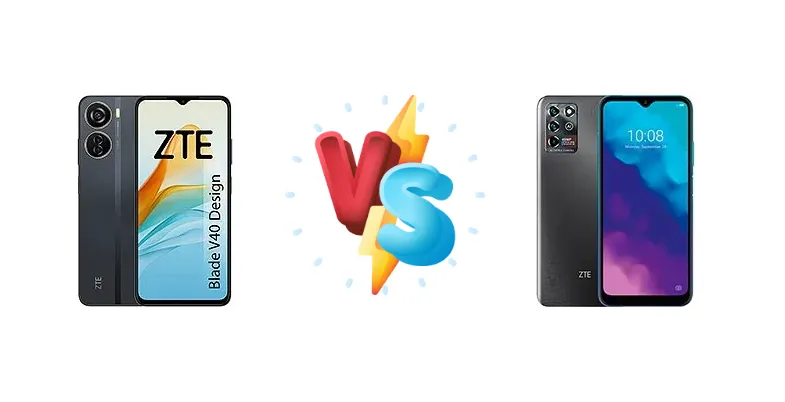
Looking for an affordable smartphone? ZTE's Blade series consistently delivers value. We're pitting the newer Blade V40 Design against the older Blade V30 Vita to see which offers the best bang for your buck. This comparison will help you decide which phone best suits your needs.
🏆 Quick Verdict
The ZTE Blade V40 Design takes the win thanks to its significantly more powerful chipset, faster charging, and likely improved camera capabilities. While the V30 Vita remains a budget option, the V40 Design offers a noticeable performance upgrade for a relatively small price difference.
| Network |
|---|
| 2G bands | GSM 850 / 900 / 1800 / 1900 | GSM 850 / 900 / 1800 / 1900 |
| 3G bands | HSDPA 850 / 900 / 1900 / 2100 | HSDPA 850 / 1700(AWS) / 1900 - Mexico |
| 4G bands | LTE | 1, 2, 4, 5, 7, 26, 28, 66 - Mexico |
| Speed | HSPA, LTE | HSPA, LTE |
| Technology | GSM / HSPA / LTE | GSM / HSPA / LTE |
| Launch |
|---|
| Announced | 2022, December 21 | 2021, July 16 |
| Status | Available. Released 2023, January 10 | Available. Released 2021, August 16 |
| Body |
|---|
| Dimensions | 163 x 74 x 8 mm (6.42 x 2.91 x 0.31 in) | 173 x 78.1 x 8.9 mm (6.81 x 3.07 x 0.35 in) |
| SIM | Nano-SIM + Nano-SIM | Nano-SIM + Nano-SIM |
| Weight | 183.4 g (6.46 oz) | 210 g (7.41 oz) |
| Display |
|---|
| Resolution | 1080 x 2408 pixels, 20:9 ratio (~400 ppi density) | 720 x 1640 pixels, 3:2 ratio (~288 ppi density) |
| Size | 6.6 inches, 104.9 cm2 (~87.0% screen-to-body ratio) | 6.82 inches, 137.8 cm2 (~102.0% screen-to-body ratio) |
| Type | IPS LCD | IPS LCD |
| Platform |
|---|
| CPU | Octa-core (2x2.0 GHz Cortex-A75 & 6x1.8 GHz Cortex-A55) | Octa-core 1.6 GHz |
| Chipset | Unisoc Tiger T616 (12 nm) | - |
| GPU | Mali-G57 MP1 | - |
| OS | Android 12, MyOS 12 | Android 11 |
| Memory |
|---|
| Card slot | microSDXC (dedicated slot) | microSDXC |
| Internal | 128GB 4GB RAM, 128GB 6GB RAM | 128GB 3GB RAM |
| | UFS 2.2 | - |
| Main Camera |
|---|
| Features | LED flash, HDR, panorama | LED flash, HDR, panorama |
| Single | 8 MP, (wide) | 8 MP, f/2.0, (wide) |
| Triple | 50 MP, f/1.8, (wide), PDAF
2 MP (macro)
Auxiliary lens | 48 MP, f/1.8, 26mm (wide), PDAF
5 MP (macro)
Auxiliary lens |
| Video | 1080p@30fps | 1080p@30fps |
| Selfie camera |
|---|
| Single | 8 MP, (wide) | 8 MP, f/2.0, (wide) |
| Video | 1080p@30fps | - |
| Sound |
|---|
| 3.5mm jack | Yes | Yes |
| 35mm jack | Yes | Yes |
| Loudspeaker | Yes | Yes |
| Comms |
|---|
| Bluetooth | Yes | 4.2, A2DP |
| NFC | Yes | No |
| Positioning | GPS | GPS |
| Radio | Unspecified | Unspecified |
| USB | USB Type-C 2.0 | USB Type-C 2.0 |
| WLAN | Yes | Wi-Fi 802.11 b/g/n/ac |
| Features |
|---|
| Sensors | Fingerprint (side-mounted), accelerometer, proximity | Fingerprint (side-mounted), accelerometer, proximity |
| Battery |
|---|
| Charging | 22.5W wired | - |
| Type | Li-Po 4500 mAh | Li-Po 5000 mAh |
| Misc |
|---|
| Colors | Sky Blue, Starry Black | Black, Blue, Green |
| Models | 8046 | 8030 |
| Price | About 200 EUR | - |
ZTE Blade V40 Design
- More powerful chipset
- Faster charging (22.5W)
- Likely better camera
- Potentially larger/better display
- Modern design
- Potentially higher price than V30 Vita
- Unisoc chipset not as well-regarded as Snapdragon
ZTE Blade V30 Vita
- Very affordable
- Decent battery life
- Lightweight and compact
- Slower performance
- Basic camera
- Slower charging
- Older design
- Smaller display
Display Comparison
The Blade V40 Design likely features a larger display with a higher resolution than the V30 Vita, offering a more immersive viewing experience. Expect better color accuracy and brightness on the V40 Design. The V30 Vita probably has a standard HD+ display, adequate for basic use.
Camera Comparison
While specific camera specs are limited for the V30 Vita, the V40 Design likely boasts a higher resolution main camera and potentially additional features like night mode or AI scene detection. Expect better image quality and more versatile shooting options with the V40 Design.
Performance
This is where the V40 Design shines. Its Unisoc Tiger T616 chipset with Cortex-A75 cores provides a substantial performance boost over the V30 Vita's octa-core 1.6 GHz processor. Expect smoother multitasking, faster app loading times, and better overall responsiveness on the V40 Design.
Battery Life
Both phones likely feature a battery capacity around 5000mAh. However, the V40 Design's 22.5W fast charging offers a significant advantage, allowing for quicker top-ups compared to the V30 Vita's likely slower charging speed.
Buying Guide
The ZTE Blade V40 Design is ideal for users who prioritize performance, a smoother user experience, and faster charging. It's a good choice for light gaming and everyday tasks. The ZTE Blade V30 Vita is best suited for users on a very tight budget who primarily need a phone for basic calling, texting, and light social media use.
Frequently Asked Questions
❓ Is the ZTE Blade V40 Design worth the extra cost compared to the V30 Vita?
Yes, if performance and camera quality are important to you. The V40 Design offers a significant upgrade in these areas.
❓ What kind of games can I play on the ZTE Blade V40 Design?
You can comfortably play most casual games and some less demanding titles. However, don't expect to run high-end games at maximum settings.