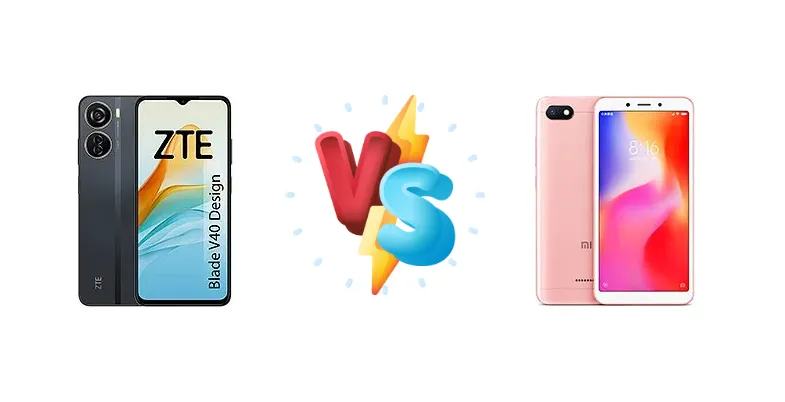
The budget smartphone market is fiercely competitive, offering incredible value for money. Today, we're pitting two contenders against each other: the ZTE Blade V40 Design and the Xiaomi Redmi 6A. Both aim to deliver a solid experience without breaking the bank, but which one comes out on top?
🏆 Quick Verdict
The ZTE Blade V40 Design offers a significant performance upgrade thanks to its more powerful chipset and faster charging. While the Redmi 6A remains a budget-friendly option, the V40 Design provides a noticeably smoother experience and better features, making it the overall winner for most users.
| Network |
|---|
| 2G bands | GSM 850 / 900 / 1800 / 1900 | GSM 850 / 900 / 1800 / 1900 |
| 3G bands | HSDPA 850 / 900 / 1900 / 2100 | HSDPA 850 / 900 / 1900 / 2100 |
| 4G bands | LTE | 1, 2, 3, 4, 5, 7, 8, 20, 38, 40 - Global |
| Speed | HSPA, LTE | HSPA 21.1/5.76 Mbps, LTE (2CA) Cat7 300/150 Mbps |
| Technology | GSM / HSPA / LTE | GSM / CDMA / HSPA / LTE |
| | - | 1, 3, 5, 7, 8, 34, 38, 39, 40, 41 |
| Launch |
|---|
| Announced | 2022, December 21 | 2018, June. Released 2018, June |
| Status | Available. Released 2023, January 10 | Discontinued |
| Body |
|---|
| Build | - | Glass front, plastic back, plastic frame |
| Dimensions | 163 x 74 x 8 mm (6.42 x 2.91 x 0.31 in) | 147.5 x 71.5 x 8.3 mm (5.81 x 2.81 x 0.33 in) |
| SIM | Nano-SIM + Nano-SIM | Nano-SIM + Nano-SIM |
| Weight | 183.4 g (6.46 oz) | 145 g (5.11 oz) |
| Display |
|---|
| Resolution | 1080 x 2408 pixels, 20:9 ratio (~400 ppi density) | 720 x 1440 pixels, 18:9 ratio (~295 ppi density) |
| Size | 6.6 inches, 104.9 cm2 (~87.0% screen-to-body ratio) | 5.45 inches, 76.7 cm2 (~72.7% screen-to-body ratio) |
| Type | IPS LCD | IPS LCD |
| Platform |
|---|
| CPU | Octa-core (2x2.0 GHz Cortex-A75 & 6x1.8 GHz Cortex-A55) | Quad-core 2.0 GHz Cortex-A53 |
| Chipset | Unisoc Tiger T616 (12 nm) | Mediatek MT6761 Helio A22 (12 nm) |
| GPU | Mali-G57 MP1 | PowerVR GE8320 |
| OS | Android 12, MyOS 12 | Android 8.1 (Oreo), planned upgrade to Android 10, MIUI 12 |
| Memory |
|---|
| Card slot | microSDXC (dedicated slot) | microSDXC (dedicated slot) |
| Internal | 128GB 4GB RAM, 128GB 6GB RAM | 16GB 2GB RAM, 32GB 2GB RAM, 32GB 3GB RAM |
| | UFS 2.2 | eMMC 5.1 |
| Main Camera |
|---|
| Features | LED flash, HDR, panorama | LED flash, HDR, panorama |
| Single | 8 MP, (wide) | 13 MP, f/2.2, PDAF |
| Triple | 50 MP, f/1.8, (wide), PDAF
2 MP (macro)
Auxiliary lens | - |
| Video | 1080p@30fps | 1080p@30fps |
| Selfie camera |
|---|
| Single | 8 MP, (wide) | 5 MP, f/2.2 |
| Video | 1080p@30fps | - |
| Sound |
|---|
| 3.5mm jack | Yes | Yes |
| 35mm jack | Yes | Yes |
| Loudspeaker | Yes | Yes |
| Comms |
|---|
| Bluetooth | Yes | 4.2, A2DP, LE |
| NFC | Yes | No |
| Positioning | GPS | GPS, GLONASS, BDS |
| Radio | Unspecified | FM radio |
| USB | USB Type-C 2.0 | microUSB 2.0 |
| WLAN | Yes | Wi-Fi 802.11 b/g/n, Wi-Fi Direct |
| Features |
|---|
| Sensors | Fingerprint (side-mounted), accelerometer, proximity | Accelerometer, proximity, compass |
| Battery |
|---|
| Charging | 22.5W wired | - |
| Type | Li-Po 4500 mAh | Li-Ion 3000 mAh, non-removable |
| Misc |
|---|
| Colors | Sky Blue, Starry Black | Black, Grey, Blue, Gold, Rose Gold |
| Models | 8046 | M1804C3CG, M1804C3CH, M1804C3CI |
| Price | About 200 EUR | About 110 EUR |
| SAR | - | 0.78 W/kg (head) 1.17 W/kg (body) |
| SAR EU | - | 0.66 W/kg (head) 1.52 W/kg (body) |
| Tests |
|---|
| Performance | - |
AnTuTu: 61660 (v7)
GeekBench: 2450 (v4.4)
GFXBench: 3.1fps (ES 3.1 onscreen) |
ZTE Blade V40 Design
- More powerful chipset
- Faster charging (22.5W)
- Likely better camera
- Potentially larger/better display
- Potentially higher price
- Unisoc chipset reputation (can vary)
Xiaomi Redmi 6A
- Extremely affordable
- Compact size
- Simple and reliable
- Outdated chipset
- Slow charging
- Basic camera
- Smaller display
Display Comparison
The ZTE Blade V40 Design likely features a larger and higher resolution display than the Redmi 6A, offering a more immersive viewing experience. While specific display details for the V40 are needed, it's expected to have better color accuracy and brightness. The Redmi 6A has a smaller, more basic display suitable for simple tasks.
Camera Comparison
The ZTE Blade V40 Design is expected to have a more capable camera system, likely with higher resolution sensors and improved image processing. While the Redmi 6A's camera is adequate for basic snapshots, the V40 should deliver better image quality, especially in low-light conditions. Specific camera specs are needed for a more precise comparison.
Performance
Here's where the ZTE Blade V40 Design truly shines. Its Unisoc Tiger T616 chipset with dual Cortex-A75 cores provides a substantial performance boost over the Redmi 6A's quad-core Cortex-A53 processor. Expect smoother multitasking, faster app loading times, and a more responsive overall experience on the V40.
Battery Life
Both phones likely offer all-day battery life with moderate usage. However, the ZTE Blade V40 Design's 22.5W fast charging support provides a significant advantage, allowing for quicker top-ups compared to the Redmi 6A's slower charging speeds.
Buying Guide
The ZTE Blade V40 Design is ideal for users who prioritize performance, a better camera, and faster charging. It's a good choice for light to moderate users who want a responsive phone for everyday tasks. The Xiaomi Redmi 6A is best suited for users on an extremely tight budget who primarily need a basic phone for calls, texts, and very light app usage.
Frequently Asked Questions
❓ Is the ZTE Blade V40 Design worth the extra cost compared to the Redmi 6A?
Yes, if performance and camera quality are important to you. The V40 offers a significantly better experience for a relatively small price increase.
❓ Which phone is better for gaming?
The ZTE Blade V40 Design is the clear winner for gaming due to its more powerful chipset.