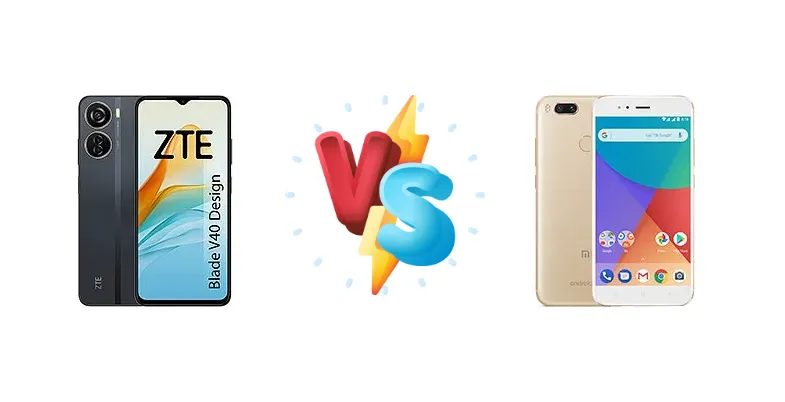
The budget smartphone market is fiercely competitive, offering incredible value for money. Today, we're pitting two contenders against each other: the ZTE Blade V40 Design and the Xiaomi Mi A1 (also known as Mi 5X). Both aim to deliver a solid experience without breaking the bank, but which one comes out on top?
🏆 Quick Verdict
The Xiaomi Mi A1 (Mi 5X) edges out the ZTE Blade V40 Design thanks to its superior battery life and proven Snapdragon 625 chipset. While the Blade V40 offers faster charging, the Mi A1's longevity and reliable performance make it the better overall choice for most users.
| Network |
|---|
| 2G bands | GSM 850 / 900 / 1800 / 1900 | GSM 850 / 900 / 1800 / 1900 - SIM 1 & SIM 2 |
| 3G bands | HSDPA 850 / 900 / 1900 / 2100 | HSDPA 850 / 900 / 1900 / 2100 |
| 4G bands | LTE | 1, 3, 5, 7, 8, 20, 38, 40 |
| Speed | HSPA, LTE | HSPA 42.2/5.76 Mbps, LTE (2CA) Cat6 300/50 Mbps |
| Technology | GSM / HSPA / LTE | GSM / HSPA / LTE |
| Launch |
|---|
| Announced | 2022, December 21 | 2017, September. Released 2017, September |
| Status | Available. Released 2023, January 10 | Discontinued |
| Body |
|---|
| Build | - | Glass front (Gorilla Glass 3), aluminum back, aluminum frame |
| Dimensions | 163 x 74 x 8 mm (6.42 x 2.91 x 0.31 in) | 155.4 x 75.8 x 7.3 mm (6.12 x 2.98 x 0.29 in) |
| SIM | Nano-SIM + Nano-SIM | Nano-SIM + Nano-SIM |
| Weight | 183.4 g (6.46 oz) | 165 g (5.82 oz) |
| Display |
|---|
| Protection | - | Corning Gorilla Glass 3 |
| Resolution | 1080 x 2408 pixels, 20:9 ratio (~400 ppi density) | 1080 x 1920 pixels, 16:9 ratio (~403 ppi density) |
| Size | 6.6 inches, 104.9 cm2 (~87.0% screen-to-body ratio) | 5.5 inches, 82.6 cm2 (~70.1% screen-to-body ratio) |
| Type | IPS LCD | IPS LCD |
| Platform |
|---|
| CPU | Octa-core (2x2.0 GHz Cortex-A75 & 6x1.8 GHz Cortex-A55) | Octa-core 2.0 GHz Cortex-A53 |
| Chipset | Unisoc Tiger T616 (12 nm) | Qualcomm MSM8953 Snapdragon 625 (14 nm) |
| GPU | Mali-G57 MP1 | Adreno 506 |
| OS | Android 12, MyOS 12 | Android 7.1.2 (Nougat), upgradable to Android 9.0 (Pie), Android One |
| Memory |
|---|
| Card slot | microSDXC (dedicated slot) | microSDXC (uses shared SIM slot) |
| Internal | 128GB 4GB RAM, 128GB 6GB RAM | 32GB 4GB RAM, 64GB 4GB RAM |
| | UFS 2.2 | eMMC 5.1 |
| Main Camera |
|---|
| Dual | - | 12 MP, f/2.2, 26mm (wide), 1/2.9", 1.25µm, PDAF
12 MP, f/2.6, 50mm (telephoto), 1.0µm, AF, 2x optical zoom |
| Features | LED flash, HDR, panorama | Dual-LED dual-tone flash, HDR, panorama |
| Single | 8 MP, (wide) | - |
| Triple | 50 MP, f/1.8, (wide), PDAF
2 MP (macro)
Auxiliary lens | - |
| Video | 1080p@30fps | 4K@30fps, 1080p@30fps, 720p@120fps |
| Selfie camera |
|---|
| Single | 8 MP, (wide) | 5 MP |
| Video | 1080p@30fps | 1080p@30fps |
| Sound |
|---|
| 3.5mm jack | Yes | Yes |
| 35mm jack | Yes | Yes |
| Loudspeaker | Yes | Yes |
| Comms |
|---|
| Bluetooth | Yes | 4.2, A2DP, LE |
| Infrared port | - | Yes |
| NFC | Yes | No |
| Positioning | GPS | GPS, GLONASS, BDS |
| Radio | Unspecified | FM radio |
| USB | USB Type-C 2.0 | USB Type-C 2.0 |
| WLAN | Yes | Wi-Fi 802.11 a/b/g/n/ac, dual-band, Wi-Fi Direct |
| Features |
|---|
| Sensors | Fingerprint (side-mounted), accelerometer, proximity | Fingerprint (rear-mounted), accelerometer, gyro, proximity |
| Battery |
|---|
| Charging | 22.5W wired | 10W wired |
| Type | Li-Po 4500 mAh | Li-Po 3080 mAh, non-removable |
| Misc |
|---|
| Colors | Sky Blue, Starry Black | Black, Gold, Rose Gold, Red |
| Models | 8046 | MDG2, MDI2 |
| Price | About 200 EUR | About 170 EUR |
| SAR | - | 1.75 W/kg (head) 0.76 W/kg (body) |
| Tests |
|---|
| Audio quality | - |
Noise -91.0dB / Crosstalk -82.5dB |
| Battery life | - | Endurance rating 87h |
| Camera | - |
Photo / Video |
| Display | - |
Contrast ratio: 1570:1 (nominal), 2.689 (sunlight) |
| Loudspeaker | - |
Voice 74dB / Noise 73dB / Ring 90dB |
| Performance | - |
GeekBench: 4292 (v4.4)
GFXBench: 3.5fps (ES 3.1 onscreen) |
ZTE Blade V40 Design
- Faster Charging (22.5W)
- Modern Design
- Potentially Brighter Display
- Less Powerful Chipset
- Uncertain Camera Performance
- Battery Life Not as Impressive
Xiaomi Mi A1 (Mi 5X)
- Exceptional Battery Life (87h Endurance)
- Reliable Snapdragon 625 Chipset
- Clean Android Experience
- Proven Performance
- Slower Charging (10W)
- Older Design
- May be Difficult to Find in Excellent Condition
Display Comparison
Both phones feature displays with a respectable contrast ratio of 1570:1 (nominal) and 2.689 in sunlight. However, the Mi A1's display is generally considered to be slightly more color-accurate. The Blade V40 likely has a more modern panel, potentially with better brightness, but specific details are scarce.
Camera Comparison
Camera performance is difficult to definitively assess without detailed reviews. The Mi A1 was known for its dual-camera setup which offered decent image quality and portrait mode capabilities. The Blade V40 likely has a higher resolution main sensor, but image processing and software optimization are crucial factors. Expect the Mi A1 to offer more consistent results.
Performance
The Xiaomi Mi A1's Snapdragon 625 chipset is a proven performer, known for its efficiency and smooth operation. While the ZTE Blade V40's Unisoc Tiger T616 boasts a dual-core Cortex-A75 setup, its overall performance is likely to be less consistent than the Mi A1's. The Snapdragon 625's optimization and maturity give it an edge.
Battery Life
This is where the Mi A1 truly shines. Its endurance rating of 87 hours is exceptional. The Blade V40's 22.5W charging is faster, but the Mi A1's significantly larger battery capacity provides far greater longevity.
Buying Guide
The ZTE Blade V40 Design is ideal for users prioritizing fast charging and a more modern design. The Xiaomi Mi A1 (Mi 5X) is a great pick for those seeking exceptional battery life, a reliable chipset, and a clean Android experience, especially if you can find one in good condition.
Frequently Asked Questions
❓ Is the ZTE Blade V40 Design worth buying in 2024?
It depends on your priorities. If fast charging and a modern design are key, it's a decent option. However, consider the Mi A1's superior battery life and proven performance.
❓ Where can I find a Xiaomi Mi A1 (Mi 5X) in good condition?
Due to its age, you'll likely find the Mi A1 on online marketplaces like eBay or Swappa. Be sure to check the seller's reputation and the phone's condition carefully.