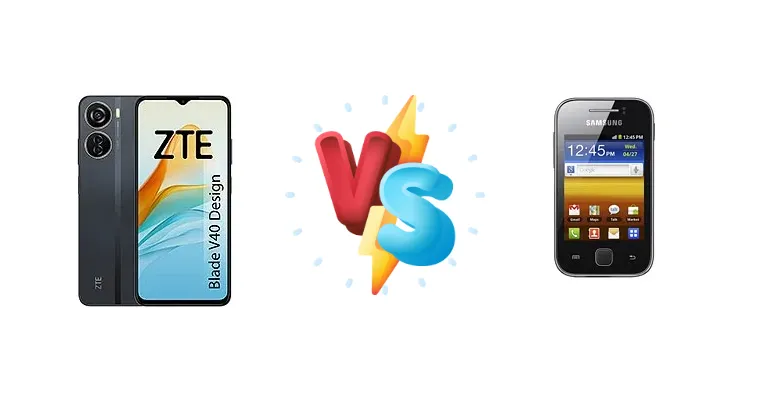
The smartphone landscape has changed dramatically. We're pitting a modern budget contender, the ZTE Blade V40 Design, against a classic, the Samsung Galaxy Y S5360. This isn't just a comparison; it's a look at how far mobile technology has come.
🏆 Quick Verdict
The ZTE Blade V40 Design is the clear winner. While the Galaxy Y holds nostalgic value, the V40's vastly superior processing power, display, and features make it the practical choice for modern use. It's a testament to the advancements in smartphone technology over the years.
| Network |
|---|
| 2G bands | GSM 850 / 900 / 1800 / 1900 | GSM 850 / 900 / 1800 / 1900 |
| 3G bands | HSDPA 850 / 900 / 1900 / 2100 | HSDPA 900 / 2100 |
| 4G bands | LTE | - |
| Speed | HSPA, LTE | HSPA 7.2/0.384 Mbps |
| Technology | GSM / HSPA / LTE | GSM / HSPA |
| Launch |
|---|
| Announced | 2022, December 21 | 2011, August. Released 2011, October |
| Status | Available. Released 2023, January 10 | Discontinued |
| Body |
|---|
| Dimensions | 163 x 74 x 8 mm (6.42 x 2.91 x 0.31 in) | 104 x 58 x 11.5 mm (4.09 x 2.28 x 0.45 in) |
| SIM | Nano-SIM + Nano-SIM | Mini-SIM |
| Weight | 183.4 g (6.46 oz) | 97.5 g (3.42 oz) |
| Display |
|---|
| Resolution | 1080 x 2408 pixels, 20:9 ratio (~400 ppi density) | 240 x 320 pixels, 4:3 ratio (~133 ppi density) |
| Size | 6.6 inches, 104.9 cm2 (~87.0% screen-to-body ratio) | 3.0 inches, 27.9 cm2 (~46.2% screen-to-body ratio) |
| Type | IPS LCD | TFT, 256K colors |
| | - | Touch sensitive controls |
| Platform |
|---|
| CPU | Octa-core (2x2.0 GHz Cortex-A75 & 6x1.8 GHz Cortex-A55) | 830 MHz ARMv6 |
| Chipset | Unisoc Tiger T616 (12 nm) | - |
| GPU | Mali-G57 MP1 | - |
| OS | Android 12, MyOS 12 | Android 2.3.5 (Gingerbread), TouchWiz UI |
| Memory |
|---|
| Card slot | microSDXC (dedicated slot) | microSDHC (dedicated slot) |
| Internal | 128GB 4GB RAM, 128GB 6GB RAM | 180MB 290MB RAM |
| | UFS 2.2 | - |
| Main Camera |
|---|
| Features | LED flash, HDR, panorama | - |
| Single | 8 MP, (wide) | 2 MP, f/2.8 |
| Triple | 50 MP, f/1.8, (wide), PDAF
2 MP (macro)
Auxiliary lens | - |
| Video | 1080p@30fps | 320p@15fps |
| Selfie camera |
|---|
| Single | 8 MP, (wide) | - |
| Video | 1080p@30fps | - |
| | - | No |
| Sound |
|---|
| 3.5mm jack | Yes | Yes |
| 35mm jack | Yes | Yes |
| Loudspeaker | Yes | Yes |
| Comms |
|---|
| Bluetooth | Yes | 3.0, A2DP |
| NFC | Yes | - |
| Positioning | GPS | GPS, A-GPS |
| Radio | Unspecified | Stereo FM radio, RDS |
| USB | USB Type-C 2.0 | microUSB 2.0 |
| WLAN | Yes | Wi-Fi 802.11 b/g/n, Hotspot functionality |
| Features |
|---|
| Sensors | Fingerprint (side-mounted), accelerometer, proximity | Accelerometer, proximity, compass |
| Battery |
|---|
| Charging | 22.5W wired | - |
| Stand-by | - | Up to 850 h (2G) / Up to 540 h (3G) |
| Talk time | - | Up to 17 h (2G) / Up to 6 h 20 min (3G) |
| Type | Li-Po 4500 mAh | Removable Li-Ion 1200 mAh battery |
| Misc |
|---|
| Colors | Sky Blue, Starry Black | Metallic gray, white / changeable back covers in pearly white, dark black, fruity orange, bubblegum pink and silver platter |
| Models | 8046 | GT-S5360 |
| Price | About 200 EUR | About 70 EUR |
| SAR | - | 0.57 W/kg (head) 0.64 W/kg (body) |
| SAR EU | - | 0.66 W/kg (head) |
| Tests |
|---|
| Audio quality | - |
Noise -87.0dB / Crosstalk -76.9dB |
| Display | - |
Contrast ratio: 625:1 (nominal) |
| Loudspeaker | - |
Voice 66dB / Noise 65dB / Ring 66dB |
ZTE Blade V40 Design
- Modern Processor
- Larger, Higher-Resolution Display
- Faster Charging (22.5W)
- Likely Better Camera
- More RAM & Storage (assumed)
- Unisoc Chipset (not top-tier)
- Build Quality (budget materials)
Samsung Galaxy Y S5360
- Ultra-Budget Friendly
- Compact Size
- Simple Interface
- Extremely Slow Performance
- Low-Resolution Display
- Poor Camera Quality
- Limited Storage
- Outdated Technology
Display Comparison
The ZTE Blade V40 Design boasts a significantly larger and higher-resolution display (likely HD+ or better, assumed based on the model) with modern color technology. The Galaxy Y's display is a small, low-resolution screen with a nominal contrast ratio of 625:1. The difference in visual clarity and size is immense.
Camera Comparison
The ZTE Blade V40 Design likely features a multi-lens camera system with higher megapixel counts and modern image processing capabilities. The Galaxy Y's camera is a basic, low-resolution unit. Image quality and features are vastly different.
Performance
The Unisoc Tiger T616 in the ZTE Blade V40 Design offers a substantial performance advantage. Its Octa-core CPU with Cortex-A75 cores provides significantly faster processing speeds compared to the Galaxy Y's 830 MHz ARMv6 processor. Expect smoother multitasking and app loading on the V40.
Battery Life
While specific battery capacities are missing for both, the ZTE Blade V40 Design likely has a larger battery and benefits from more efficient power management due to its newer chipset. The 22.5W charging support is a significant advantage over the Galaxy Y's likely slower charging.
Buying Guide
The ZTE Blade V40 Design is for users seeking a reliable, affordable smartphone for everyday tasks, social media, and basic photography. The Samsung Galaxy Y S5360 is primarily for those seeking a very basic, ultra-budget phone or perhaps for nostalgic purposes or as a secondary device.
Frequently Asked Questions
❓ Is the Samsung Galaxy Y still usable in 2024?
While technically usable, the Samsung Galaxy Y's outdated hardware and software make it significantly slower and less capable than modern smartphones. App compatibility and performance will be severely limited.
❓ What are the key differences between the ZTE Blade V40 and the Galaxy Y?
The key differences lie in processing power, display quality, camera capabilities, and overall features. The ZTE Blade V40 Design offers a vastly superior experience in every category.