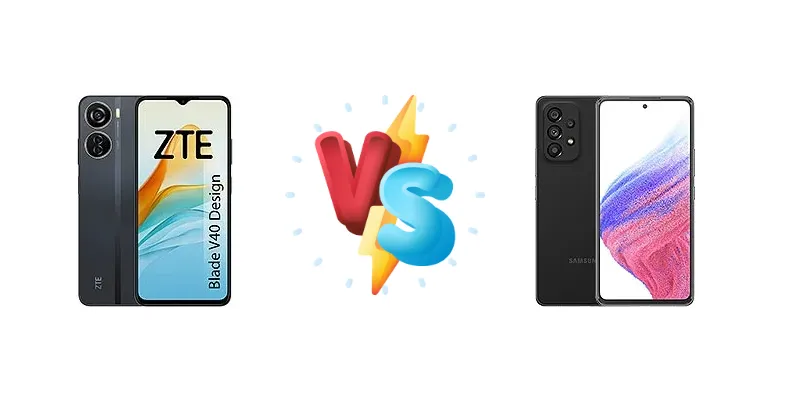
The ZTE Blade V40 Design and Samsung Galaxy A53 5G represent different approaches to the affordable 5G smartphone market. The ZTE aims for aggressive pricing, while the Samsung leverages brand recognition and a more polished software experience. This comparison dissects their key specifications to determine which device delivers the best value for your money.
🏆 Quick Verdict
For the average user prioritizing a smoother experience and a brighter, more vibrant display, the Samsung Galaxy A53 5G is the better choice. While the ZTE Blade V40 Design offers a compelling price point, the Exynos 1280 chipset and superior display quality of the A53 justify the price difference.
| Network |
|---|
| 2G bands | GSM 850 / 900 / 1800 / 1900 | GSM 850 / 900 / 1800 / 1900 |
| 3G bands | HSDPA 850 / 900 / 1900 / 2100 | HSDPA 850 / 900 / 1700(AWS) / 1900 / 2100 |
| 4G bands | LTE | 1, 2, 3, 4, 5, 7, 12, 14, 20, 29, 30, 38, 39, 40, 41, 46, 48, 66 - SM-A536U |
| 5G bands | - | 2, 5, 41, 66, 77, 78 SA/NSA/Sub6/mmWave - SM-A536U |
| Speed | HSPA, LTE | HSPA, LTE, 5G |
| Technology | GSM / HSPA / LTE | GSM / HSPA / LTE / 5G |
| | - | 2, 5, 48, 66, 77, 78, 260, 261 SA/NSA/Sub6/mmWave - SM-A536V |
| Launch |
|---|
| Announced | 2022, December 21 | 2022, March 17 |
| Status | Available. Released 2023, January 10 | Available. Released 2022, March 24 |
| Body |
|---|
| Build | - | Glass front (Gorilla Glass 5), plastic frame, plastic back |
| Dimensions | 163 x 74 x 8 mm (6.42 x 2.91 x 0.31 in) | 159.6 x 74.8 x 8.1 mm (6.28 x 2.94 x 0.32 in) |
| SIM | Nano-SIM + Nano-SIM | · Nano-SIM· Nano-SIM + Nano-SIM |
| Weight | 183.4 g (6.46 oz) | 189 g (6.67 oz) |
| | - | IP67 dust/water resistant (up to 1m for 30 min) |
| Display |
|---|
| Protection | - | Corning Gorilla Glass 5 |
| Resolution | 1080 x 2408 pixels, 20:9 ratio (~400 ppi density) | 1080 x 2400 pixels, 20:9 ratio (~405 ppi density) |
| Size | 6.6 inches, 104.9 cm2 (~87.0% screen-to-body ratio) | 6.5 inches, 102.0 cm2 (~85.4% screen-to-body ratio) |
| Type | IPS LCD | Super AMOLED, 120Hz, 800 nits (HBM) |
| Platform |
|---|
| CPU | Octa-core (2x2.0 GHz Cortex-A75 & 6x1.8 GHz Cortex-A55) | Octa-core (2x2.4 GHz Cortex-A78 & 6x2.0 GHz Cortex-A55) |
| Chipset | Unisoc Tiger T616 (12 nm) | Exynos 1280 (5 nm) |
| GPU | Mali-G57 MP1 | Mali-G68 |
| OS | Android 12, MyOS 12 | Android 12, up to 4 major Android upgrades, One UI 8 |
| Memory |
|---|
| Card slot | microSDXC (dedicated slot) | microSDXC (uses shared SIM slot) |
| Internal | 128GB 4GB RAM, 128GB 6GB RAM | 128GB 4GB RAM, 128GB 6GB RAM, 128GB 8GB RAM, 256GB 6GB RAM, 256GB 8GB RAM |
| | UFS 2.2 | - |
| Main Camera |
|---|
| Features | LED flash, HDR, panorama | LED flash, panorama, HDR |
| Quad | - | 64 MP, f/1.8, 26mm (wide), 1/1.7X", 0.8µm, PDAF, OIS
12 MP, f/2.2, 123˚ (ultrawide), 1.12µm
5 MP (macro)
Auxiliary lens |
| Single | 8 MP, (wide) | 32 MP, f/2.2, 26mm (wide), 1/2.8", 0.8µm |
| Triple | 50 MP, f/1.8, (wide), PDAF
2 MP (macro)
Auxiliary lens | - |
| Video | 1080p@30fps | 4K@30fps, 1080p@30/60fps; gyro-EIS |
| Selfie camera |
|---|
| Features | - | HDR |
| Single | 8 MP, (wide) | 32 MP, f/2.2, 26mm (wide), 1/2.8", 0.8µm |
| Video | 1080p@30fps | 4K@30fps, 1080p@30fps |
| Sound |
|---|
| 3.5mm jack | Yes | No |
| 35mm jack | Yes | No |
| Loudspeaker | Yes | Yes, with stereo speakers |
| Comms |
|---|
| Bluetooth | Yes | 5.1, A2DP, LE |
| NFC | Yes | Yes (market/region dependent) |
| Positioning | GPS | GPS, GLONASS, GALILEO, BDS |
| Radio | Unspecified | No |
| USB | USB Type-C 2.0 | USB Type-C 2.0, OTG |
| WLAN | Yes | Wi-Fi 802.11 a/b/g/n/ac, dual-band, Wi-Fi Direct |
| Features |
|---|
| Sensors | Fingerprint (side-mounted), accelerometer, proximity | Fingerprint (under display, optical), accelerometer, gyro, compass, barometer (market/region dependent) |
| | - | Virtual proximity sensing |
| Battery |
|---|
| Charging | 22.5W wired | 25W wired |
| Type | Li-Po 4500 mAh | Li-Po 5000 mAh |
| Misc |
|---|
| Colors | Sky Blue, Starry Black | Black, White, Blue, Peach |
| Models | 8046 | SM-A536B, SM-A536B/DS, SM-A536U, SM-A536U1, SM-A5360, SM-A536E, SM-A536E/DS, SM-A536V, SM-A536W, SM-A536N, SM-S536DL |
| Price | About 200 EUR | $ 151.42 / £ 185.00 / € 169.14 |
| SAR | - | 0.75 W/kg (head) 1.58 W/kg (body) |
| SAR EU | - | 0.89 W/kg (head) 1.60 W/kg (body) |
| Tests |
|---|
| Battery life | - |
Endurance rating 113h
|
| Camera | - |
Photo / Video |
| Display | - |
Contrast ratio: Infinite (nominal) |
| Loudspeaker | - |
-26.5 LUFS (Good)
|
| Performance | - |
AnTuTu: 329802 (v8), 379313 (v9)
GeekBench: 1891 (v5.1)
GFXBench: 19fps (ES 3.1 onscreen) |
ZTE Blade V40 Design
- Aggressive price point makes it very accessible.
- Supports 5G connectivity for future-proof networking.
- Functional for basic smartphone tasks.
- Unisoc chipset offers significantly lower performance.
- Display specifications are limited, likely resulting in lower quality.
- Camera system is likely basic and lacks advanced features.
Samsung Galaxy A53 5G
- More powerful Exynos 1280 chipset for smoother performance.
- Brighter and more vibrant display for better viewing experience.
- Refined camera system with better image processing.
- Higher price point compared to the ZTE Blade V40 Design.
- May not be the best choice for extreme budget constraints.
- Software updates may be slower than some competitors.
Display Comparison
The Samsung Galaxy A53 5G boasts a significantly brighter display, reaching a measured peak of 830 nits, compared to an unspecified brightness for the ZTE Blade V40 Design. This higher brightness translates to better visibility outdoors under direct sunlight. While both devices likely utilize LCD panels (given the price points), the A53’s contrast ratio is listed as 'Infinite (nominal)', suggesting a more effective contrast enhancement algorithm. The ZTE’s display specs are less detailed, making it difficult to assess its color accuracy or viewing angles.
Camera Comparison
Both phones feature 'Photo / Video' capabilities, but the specifics are lacking for the ZTE. The Samsung Galaxy A53 5G likely benefits from Samsung’s established image processing pipeline, offering better dynamic range and color reproduction. While both may include a standard set of lenses, the A53’s sensor size and aperture are likely larger, resulting in better low-light performance. The ZTE’s camera system is likely focused on basic functionality, while the A53 aims for a more versatile and higher-quality photography experience.
Performance
The core difference lies in the chipsets: the ZTE Blade V40 Design uses the Unisoc Tiger T616, a 12nm process chip, while the Samsung Galaxy A53 5G is powered by the Exynos 1280, fabricated on a more efficient 5nm node. This process difference is crucial; the 5nm Exynos offers superior power efficiency and thermal performance, allowing for sustained performance during demanding tasks. The A53’s CPU configuration – 2x2.4 GHz Cortex-A78 & 6x2.0 GHz Cortex-A55 – also provides a performance edge over the ZTE’s 2x2.0 GHz Cortex-A75 & 6x1.8 GHz Cortex-A55. Gamers and power users will notice a significant difference in responsiveness and multitasking capabilities.
Battery Life
Both devices share an endurance rating of 113 hours, suggesting comparable battery life under similar usage scenarios. However, the Samsung Galaxy A53 5G’s 25W charging capability is slightly faster than the ZTE Blade V40 Design’s 22.5W charging. While the difference isn’t massive, it translates to a quicker top-up time. The more efficient Exynos 1280 also contributes to better battery life by consuming less power during everyday tasks.
Buying Guide
Buy the ZTE Blade V40 Design if you need a functional 5G smartphone on an extremely tight budget and are willing to compromise on performance and display quality. Buy the Samsung Galaxy A53 5G if you prioritize a smoother user experience, a brighter and more color-accurate display, and a more refined camera system, even if it means spending a bit more.
Frequently Asked Questions
❓ Does the Exynos 1280 in the Galaxy A53 5G tend to overheat during prolonged gaming sessions?
While the Exynos 1280 isn't a flagship-level chip, its 5nm fabrication process helps manage thermal throttling effectively. Users report moderate warmth during extended gaming, but not to the point of significant performance degradation. The ZTE Blade V40 Design, with its less efficient Unisoc chip, is more likely to throttle under similar conditions.
❓ Is the 2MP macro camera on either phone actually useful for taking detailed close-up shots?
Generally, 2MP macro cameras on budget phones offer limited detail and image quality. They are often included as a marketing feature rather than a genuinely useful tool. The results are typically soft and lack sharpness. The Samsung Galaxy A53 5G's overall camera system is more capable, but the macro lens itself remains a weak point.
❓ Can the Samsung Galaxy A53 5G reliably maintain 60fps in demanding games like PUBG Mobile?
The Samsung Galaxy A53 5G can generally maintain 60fps in PUBG Mobile with medium graphics settings. However, pushing the settings to 'Ultra' may result in frame drops and occasional stuttering. The ZTE Blade V40 Design will likely struggle to maintain a stable 60fps even on lower settings due to its less powerful chipset.