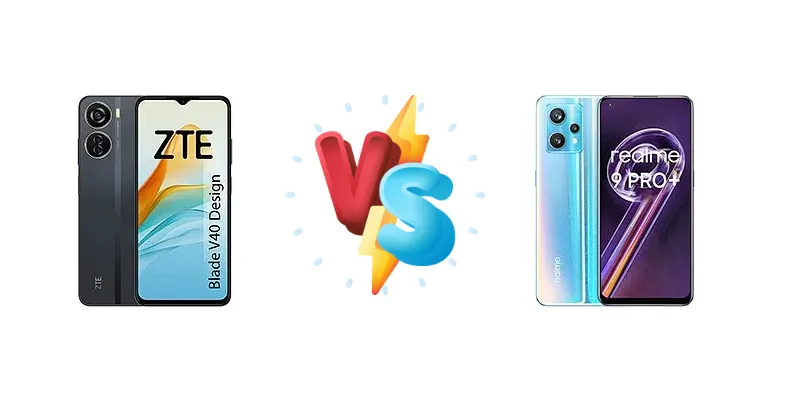
The smartphone market is crowded with options, but finding the right balance between price and performance can be challenging. We pit the ZTE Blade V40 Design, a budget-focused device, against the Realme 9 Pro+, a more ambitious mid-range contender, to determine which offers the best experience for different user needs.
🏆 Quick Verdict
For most users, the Realme 9 Pro+ is the superior choice. Its significantly more powerful Mediatek Dimensity 920 chipset and 60W fast charging provide a smoother, more responsive experience and drastically reduce downtime. While the ZTE Blade V40 Design offers affordability, it compromises heavily on performance.
| Network |
|---|
| 2G bands | GSM 850 / 900 / 1800 / 1900 | GSM 850 / 900 / 1800 / 1900 - SIM 1 & SIM 2 |
| 3G bands | HSDPA 850 / 900 / 1900 / 2100 | HSDPA 850 / 900 / 1700(AWS) / 1900 / 2100 |
| 4G bands | LTE | 1, 2, 3, 4, 5, 7, 8, 12, 13, 17, 18, 19, 20, 26, 28, 38, 39, 40, 41, 66 - International |
| 5G bands | - | 1, 3, 5, 7, 8, 20, 28, 38, 40, 41, 66, 77, 78 SA/NSA - International |
| Speed | HSPA, LTE | HSPA, LTE-A, 5G |
| Technology | GSM / HSPA / LTE | GSM / HSPA / LTE / 5G |
| | - | 1, 28, 41, 77, 78 SA/NSA - India |
| Launch |
|---|
| Announced | 2022, December 21 | 2022, February 16 |
| Status | Available. Released 2023, January 10 | Available. Released 2022, February 21 |
| Body |
|---|
| Build | - | Glass front (Gorilla Glass 5), glass back |
| Dimensions | 163 x 74 x 8 mm (6.42 x 2.91 x 0.31 in) | 160.2 x 73.3 x 8 mm (6.31 x 2.89 x 0.31 in) |
| SIM | Nano-SIM + Nano-SIM | Dual SIM (Nano-SIM, dual stand-by) |
| Weight | 183.4 g (6.46 oz) | 182 g (6.42 oz) |
| Display |
|---|
| Protection | - | Corning Gorilla Glass 5 |
| Resolution | 1080 x 2408 pixels, 20:9 ratio (~400 ppi density) | 1080 x 2400 pixels, 20:9 ratio (~411 ppi density) |
| Size | 6.6 inches, 104.9 cm2 (~87.0% screen-to-body ratio) | 6.4 inches, 98.9 cm2 (~84.2% screen-to-body ratio) |
| Type | IPS LCD | Super AMOLED, 90Hz, 430 nits (typ), 600 nits (HBM) |
| Platform |
|---|
| CPU | Octa-core (2x2.0 GHz Cortex-A75 & 6x1.8 GHz Cortex-A55) | Octa-core (2x2.5 GHz Cortex-A78 & 6x2.0 GHz Cortex-A55) |
| Chipset | Unisoc Tiger T616 (12 nm) | Mediatek Dimensity 920 (6 nm) |
| GPU | Mali-G57 MP1 | Mali-G68 MC4 |
| OS | Android 12, MyOS 12 | Android 12, upgradable to Android 13, Realme UI 4.0 |
| Memory |
|---|
| Card slot | microSDXC (dedicated slot) | No |
| Internal | 128GB 4GB RAM, 128GB 6GB RAM | 128GB 6GB RAM, 128GB 8GB RAM, 256GB 8GB RAM |
| | UFS 2.2 | UFS 2.2 |
| Main Camera |
|---|
| Features | LED flash, HDR, panorama | LED flash, HDR, panorama |
| Single | 8 MP, (wide) | 16 MP, f/2.4, 27mm (wide), 1/3.09", 1.0µm |
| Triple | 50 MP, f/1.8, (wide), PDAF
2 MP (macro)
Auxiliary lens | 50 MP, f/1.8, 24mm (wide), 1/1.56", 1.0µm, PDAF, OIS
8 MP, f/2.2, 119˚, 16mm (ultrawide), 1/4.0", 1.12µm
2 MP, f/2.4, (macro) |
| Video | 1080p@30fps | 4K@30fps, 1080p@30/60/120/480fps, 720p@960fps, gyro-EIS |
| Selfie camera |
|---|
| Features | - | HDR, panorama |
| Single | 8 MP, (wide) | 16 MP, f/2.4, 27mm (wide), 1/3.09", 1.0µm |
| Video | 1080p@30fps | 1080p@30fps, gyro-EIS |
| Sound |
|---|
| 3.5mm jack | Yes | Yes |
| 35mm jack | Yes | - |
| Loudspeaker | Yes | Yes, with stereo speakers |
| | - | 24-bit/192kHz audio |
| Comms |
|---|
| Bluetooth | Yes | 5.2, A2DP, LE, aptX HD |
| NFC | Yes | Yes (market/region dependent) |
| Positioning | GPS | GPS, GLONASS, BDS |
| Radio | Unspecified | No |
| USB | USB Type-C 2.0 | USB Type-C 2.0, OTG |
| WLAN | Yes | Wi-Fi 802.11 a/b/g/n/ac/6, dual-band |
| Features |
|---|
| Sensors | Fingerprint (side-mounted), accelerometer, proximity | Fingerprint (under display, optical), accelerometer, gyro, proximity, compass |
| Battery |
|---|
| Charging | 22.5W wired | 60W wired, PD3.0, 100% in 44 min (advertised) |
| Type | Li-Po 4500 mAh | Li-Po 4500 mAh, non-removable |
| Misc |
|---|
| Colors | Sky Blue, Starry Black | Midnight Black, Aurora Green, Sunrise Blue, Free Fire Limited Edition |
| Models | 8046 | RMX3392, RMX3393 |
| Price | About 200 EUR | € 289.90 / $ 390.00 / ₹ 25,999 |
| SAR | - | 1.19 W/kg (head) 0.73 W/kg (body) |
| Tests |
|---|
| Battery life | - |
Endurance rating 117h
|
| Camera | - |
Photo / Video |
| Display | - |
Contrast ratio: Infinite (nominal) |
| Loudspeaker | - |
-25.3 LUFS (Very good)
|
| Performance | - |
AnTuTu: 495096 (v8), 416031 (v9)
GeekBench: 2335 (v5.1)
GFXBench: 27fps (ES 3.1 onscreen) |
ZTE Blade V40 Design
- Highly affordable price point
- Acceptable for basic smartphone tasks
- Decent battery life for light usage
- Significantly weaker performance
- Slow charging speed
- Likely lower quality display
Realme 9 Pro+
- Powerful Mediatek Dimensity 920 chipset
- Ultra-fast 60W charging
- Long battery endurance (117h)
- Higher price compared to ZTE Blade V40 Design
- Camera details are limited
- May be overkill for basic users
Display Comparison
The Realme 9 Pro+ boasts an 'Infinite' (nominal) contrast ratio, suggesting a vibrant display experience, though specific details like panel type (IPS vs AMOLED) and peak brightness are missing. The ZTE Blade V40 Design’s display specifications are not provided, making a direct comparison difficult. However, given its price point, it likely utilizes a standard IPS LCD panel with lower brightness and contrast. This difference will be noticeable in direct sunlight and when viewing HDR content.
Camera Comparison
While both phones feature cameras, the Realme 9 Pro+ is expected to offer a more refined photography experience. Details on the Realme 9 Pro+'s camera are limited to 'Photo/Video', but its positioning suggests a more capable sensor and image processing pipeline. The Unisoc T616 in the ZTE Blade V40 Design is paired with a less sophisticated ISP, resulting in lower image quality, especially in low-light conditions. The absence of details on the ZTE's camera specs suggests a focus on basic functionality rather than photographic excellence.
Performance
The core difference lies in the chipsets. The Realme 9 Pro+’s Mediatek Dimensity 920 (6nm) is a substantial upgrade over the ZTE Blade V40 Design’s Unisoc Tiger T616 (12nm). The Dimensity 920 features more powerful Cortex-A78 cores clocked at 2.5 GHz versus the A75 cores at 2.0 GHz in the Unisoc chip. The 6nm process node also contributes to better power efficiency and thermal management, meaning the Realme 9 Pro+ will sustain peak performance for longer periods, particularly during demanding tasks like gaming. The Realme's chipset will deliver a significantly smoother experience in graphically intensive applications.
Battery Life
The Realme 9 Pro+’s 60W wired charging, with a claimed 100% charge in 44 minutes, is a game-changer compared to the ZTE Blade V40 Design’s 22.5W charging. This drastically reduces downtime and offers significantly more convenience. While the Realme 9 Pro+ has an endurance rating of 117 hours, the ZTE Blade V40 Design’s battery life is not specified. However, the less efficient Unisoc chipset will likely result in shorter battery life despite potentially having a similar capacity. The faster charging of the Realme 9 Pro+ effectively mitigates any potential battery capacity disadvantage.
Buying Guide
Buy the ZTE Blade V40 Design if you prioritize extreme affordability and basic smartphone functionality – calls, texts, and light social media use. It’s a suitable option for first-time smartphone users or those on a very tight budget. Buy the Realme 9 Pro+ if you value performance for gaming, multitasking, and photography, alongside the convenience of incredibly fast 60W charging and a longer-lasting battery. It’s ideal for users who demand more from their device.
Frequently Asked Questions
❓ Is the Unisoc Tiger T616 chipset in the ZTE Blade V40 Design sufficient for playing modern mobile games?
The Unisoc Tiger T616 is a budget-oriented chipset. While it can handle some mobile games, you'll likely need to lower graphics settings and expect lower frame rates, especially in demanding titles. It's not ideal for serious mobile gamers.
❓ How does the 60W charging on the Realme 9 Pro+ compare to standard charging speeds?
60W charging is significantly faster than standard charging (typically 15-25W). The Realme 9 Pro+ can charge from 0 to 100% in approximately 44 minutes, whereas a phone with standard charging might take over two hours. This is a major convenience factor for users who are always on the go.
❓ Does the Realme 9 Pro+ experience overheating during prolonged gaming sessions?
The Mediatek Dimensity 920, combined with the 6nm process node, is generally efficient and well-managed. While some heat generation is normal during gaming, the Realme 9 Pro+ is unlikely to experience significant throttling or overheating issues due to its thermal design.
❓ What type of charging protocol does the Realme 9 Pro+ support beyond standard USB-PD?
The Realme 9 Pro+ supports PD3.0 charging, which allows for faster and more efficient charging with compatible chargers and cables. This ensures compatibility with a wider range of charging accessories.