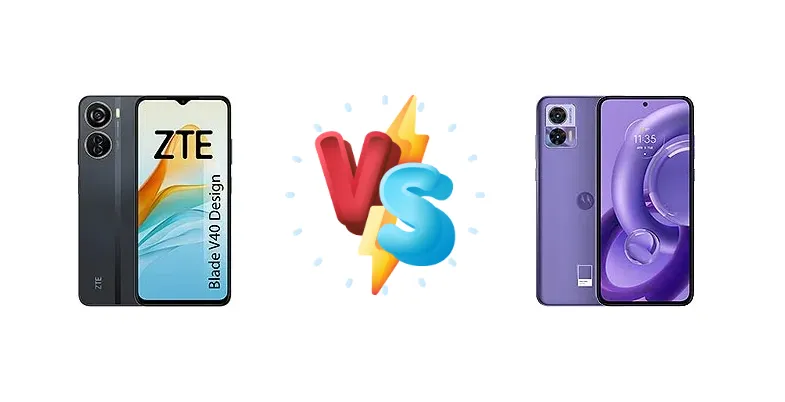
The ZTE Blade V40 Design and Motorola Edge 30 Neo represent distinct approaches to the affordable smartphone market. The Blade V40 Design focuses on providing a functional experience at a very competitive price point, while the Edge 30 Neo aims for a more premium feel with faster charging and a more modern chipset. This comparison dissects their key differences to determine which device offers the best value.
🏆 Quick Verdict
For most users, the Motorola Edge 30 Neo is the superior choice. Its Snapdragon 695 5G chipset, coupled with 68W charging, provides a noticeable performance and convenience advantage over the ZTE Blade V40 Design’s Unisoc T616 and 22.5W charging. While the Blade V40 Design is cheaper, the Edge 30 Neo’s benefits justify the price difference.
| Network |
|---|
| 2G bands | GSM 850 / 900 / 1800 / 1900 | GSM 850 / 900 / 1800 / 1900 |
| 3G bands | HSDPA 850 / 900 / 1900 / 2100 | HSDPA 850 / 900 / 1700(AWS) / 1900 / 2100 |
| 4G bands | LTE | 1, 2, 3, 4, 5, 7, 8, 12, 17, 20, 25, 26, 28, 32, 38, 40, 41, 42, 43 |
| 5G bands | - | 1, 3, 5, 7, 8, 20, 28, 38, 40, 41, 66, 78 SA/NSA |
| Speed | HSPA, LTE | HSPA, LTE, 5G |
| Technology | GSM / HSPA / LTE | GSM / HSPA / LTE / 5G |
| Launch |
|---|
| Announced | 2022, December 21 | 2022, September 08 |
| Status | Available. Released 2023, January 10 | Available. Released 2022, October 07 |
| Body |
|---|
| Build | - | Glass front, plastic frame, plastic back |
| Dimensions | 163 x 74 x 8 mm (6.42 x 2.91 x 0.31 in) | 152.9 x 71.2 x 7.8 mm (6.02 x 2.80 x 0.31 in) |
| SIM | Nano-SIM + Nano-SIM | · Nano-SIM· Nano-SIM + Nano-SIM |
| Weight | 183.4 g (6.46 oz) | 155 g (5.47 oz) |
| | - | Splash and dust resistant |
| Display |
|---|
| Resolution | 1080 x 2408 pixels, 20:9 ratio (~400 ppi density) | 1080 x 2400 pixels, 20:9 ratio (~419 ppi density) |
| Size | 6.6 inches, 104.9 cm2 (~87.0% screen-to-body ratio) | 6.28 inches, 95.2 cm2 (~87.5% screen-to-body ratio) |
| Type | IPS LCD | P-OLED, 120Hz |
| Platform |
|---|
| CPU | Octa-core (2x2.0 GHz Cortex-A75 & 6x1.8 GHz Cortex-A55) | Octa-core (2x2.2 GHz Kryo 660 Gold & 6x1.7 GHz Kryo 660 Silver) |
| Chipset | Unisoc Tiger T616 (12 nm) | Qualcomm SM6375 Snapdragon 695 5G (6 nm) |
| GPU | Mali-G57 MP1 | Adreno 619 |
| OS | Android 12, MyOS 12 | Android 12, planned upgrade to Android 15 |
| Memory |
|---|
| Card slot | microSDXC (dedicated slot) | No |
| Internal | 128GB 4GB RAM, 128GB 6GB RAM | 128GB 6GB RAM, 128GB 8GB RAM, 256GB 8GB RAM |
| | UFS 2.2 | - |
| Main Camera |
|---|
| Dual | - | 64 MP, f/1.8, (wide), 1/1.97", 0.7µm, PDAF, OIS
13 MP, f/2.2, 120˚ (ultrawide), 1/3.0", 1.12µm, AF |
| Features | LED flash, HDR, panorama | Dual-LED flash, HDR, panorama |
| Single | 8 MP, (wide) | - |
| Triple | 50 MP, f/1.8, (wide), PDAF
2 MP (macro)
Auxiliary lens | - |
| Video | 1080p@30fps | 1080p@30/60/120fps |
| Selfie camera |
|---|
| Features | - | HDR |
| Single | 8 MP, (wide) | 32 MP, f/2.4, (wide), 1/3.0", 0.7µm |
| Video | 1080p@30fps | 1080p@30fps |
| Sound |
|---|
| 3.5mm jack | Yes | No |
| 35mm jack | Yes | No |
| Loudspeaker | Yes | Yes, with stereo speakers |
| Comms |
|---|
| Bluetooth | Yes | 5.1, A2DP, LE, aptX HD, aptX Adaptive |
| NFC | Yes | Yes |
| Positioning | GPS | GPS, GLONASS, GALILEO |
| Radio | Unspecified | No |
| USB | USB Type-C 2.0 | USB Type-C 3.1, OTG |
| WLAN | Yes | Wi-Fi 802.11 a/b/g/n/ac, dual-band, Wi-Fi Direct |
| Features |
|---|
| Sensors | Fingerprint (side-mounted), accelerometer, proximity | Fingerprint (under display, optical), accelerometer, proximity, compass |
| Battery |
|---|
| Charging | 22.5W wired | 68W wired
5W wireless |
| Type | Li-Po 4500 mAh | Li-Po 4020 mAh |
| Misc |
|---|
| Colors | Sky Blue, Starry Black | Very Peri, Black Onyx, Ice Palace, Aqua Foam |
| Models | 8046 | XT2245-1 |
| Price | About 200 EUR | € 156.44 / $ 185.00 / £ 229.00 |
| Tests |
|---|
| Battery life | - |
Endurance rating 104h
|
| Camera | - |
Photo / Video |
| Display | - |
Contrast ratio: Infinite (nominal) |
| Loudspeaker | - |
-26.4 LUFS (Good)
|
| Performance | - |
AnTuTu: 380818 (v9)
GeekBench: 1964 (v5.1)
GFXBench: 16fps (ES 3.1 onscreen) |
ZTE Blade V40 Design
- Most affordable option
- Decent battery endurance (104h)
- Functional and reliable for basic tasks
- Slower processor (Unisoc T616)
- Slow charging speed (22.5W)
- Limited display brightness information
Motorola Edge 30 Neo
- Faster processor (Snapdragon 695 5G)
- Significantly faster charging (68W)
- Brighter display (1004 nits)
- Higher price point
- Wireless charging is slow (5W)
- Camera details are limited
Display Comparison
The Motorola Edge 30 Neo boasts a brighter display, reaching a measured peak brightness of 1004 nits, which translates to better visibility outdoors compared to the ZTE Blade V40 Design (brightness data unavailable). While both devices likely utilize LCD panels given their price points, the Edge 30 Neo’s higher brightness is a significant advantage. Contrast ratio is listed as infinite (nominal) for the Edge 30 Neo, suggesting a well-tuned panel, though this is a common marketing claim. The Blade V40 Design’s display specifications are less detailed, making a direct comparison difficult, but it’s reasonable to assume a lower peak brightness.
Camera Comparison
Both devices feature photo and video capabilities, but detailed camera specifications are limited. Without information on sensor size, aperture, or image processing algorithms, a definitive comparison is challenging. However, the Motorola Edge 30 Neo’s brand reputation suggests a more refined camera experience. The ZTE Blade V40 Design likely relies on software processing to compensate for potentially lower-quality hardware. The absence of details on OIS or advanced features on either device suggests a focus on basic photography.
Performance
The Motorola Edge 30 Neo’s Qualcomm Snapdragon 695 5G (6nm) offers a clear advantage over the ZTE Blade V40 Design’s Unisoc Tiger T616 (12nm). The 6nm process node of the Snapdragon 695 results in improved power efficiency and thermal management, allowing for sustained performance during demanding tasks. The Edge 30 Neo’s CPU, with 2x2.2 GHz Kryo 660 Gold cores, also outperforms the Blade V40 Design’s 2x2.0 GHz Cortex-A75 cores. While both are octa-core CPUs, the Snapdragon’s architecture is more modern and efficient. The Edge 30 Neo is better suited for gaming and multitasking.
Battery Life
Both the ZTE Blade V40 Design and Motorola Edge 30 Neo share an endurance rating of 104 hours, indicating similar overall battery life under typical usage. However, the charging speeds are drastically different. The Motorola Edge 30 Neo supports 68W wired charging and 5W wireless charging, allowing for a significantly faster 0-100% charge time. The ZTE Blade V40 Design is limited to 22.5W wired charging, resulting in a much slower charging experience. This charging speed difference is a major advantage for the Edge 30 Neo, offering greater convenience for users who frequently need to top up their battery.
Buying Guide
Buy the ZTE Blade V40 Design if you prioritize absolute affordability and a basic, functional smartphone experience. It’s ideal for users who primarily need calling, texting, and light social media use. Buy the Motorola Edge 30 Neo if you value faster performance for gaming and multitasking, significantly quicker charging speeds, and a more refined overall user experience, even if it means spending a bit more.
Frequently Asked Questions
❓ How much faster is the Motorola Edge 30 Neo's charging compared to the ZTE Blade V40 Design?
The Motorola Edge 30 Neo's 68W charging is significantly faster than the ZTE Blade V40 Design's 22.5W charging. While exact charge times depend on various factors, the Edge 30 Neo can likely charge from 0-100% in under an hour, whereas the Blade V40 Design will take considerably longer – potentially over two hours.
❓ Will the Snapdragon 695 in the Motorola Edge 30 Neo handle demanding games like PUBG or Call of Duty?
The Snapdragon 695 is capable of running PUBG and Call of Duty, but you'll likely need to lower graphics settings for a smooth experience. It's not a flagship-level gaming chip, but it offers a noticeable improvement over the Unisoc T616 in the ZTE Blade V40 Design, providing more consistent frame rates and less lag.
❓ Is the 5W wireless charging on the Motorola Edge 30 Neo practical for daily use?
5W wireless charging is relatively slow and best suited for overnight or occasional top-ups. It's a convenient feature to have, but don't expect it to replace wired charging for quickly replenishing the battery. The 68W wired charging is the primary method for fast charging on the Edge 30 Neo.