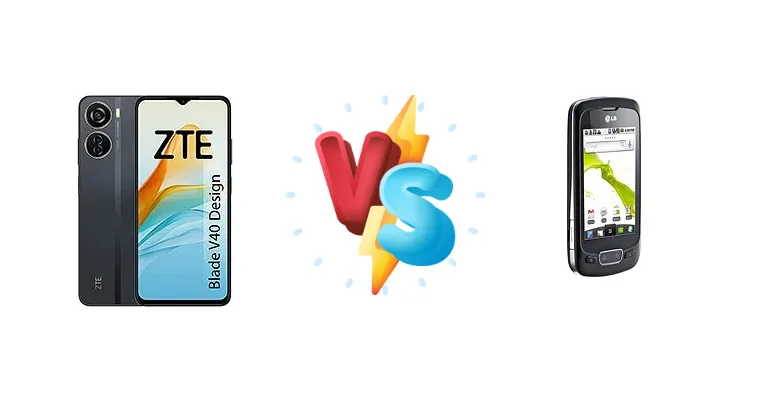
The smartphone landscape has changed dramatically. Today, we pit a modern budget contender, the ZTE Blade V40 Design, against a relic of the early Android era, the LG Optimus One P500. This isn't just a comparison; it's a journey through smartphone evolution.
🏆 Quick Verdict
The ZTE Blade V40 Design is the clear winner. While the LG Optimus One holds nostalgic value, the V40's modern chipset, display, and charging capabilities offer a vastly superior user experience. It's a testament to how far smartphone technology has advanced.
| Network |
|---|
| 2G bands | GSM 850 / 900 / 1800 / 1900 | GSM 850 / 900 / 1800 / 1900 |
| 3G bands | HSDPA 850 / 900 / 1900 / 2100 | HSDPA 900 / 2100 |
| 4G bands | LTE | - |
| Speed | HSPA, LTE | HSPA 7.2/0.384 Mbps |
| Technology | GSM / HSPA / LTE | GSM / HSPA |
| Launch |
|---|
| Announced | 2022, December 21 | 2010, July. Released 2010, October |
| Status | Available. Released 2023, January 10 | Discontinued |
| Body |
|---|
| Dimensions | 163 x 74 x 8 mm (6.42 x 2.91 x 0.31 in) | 113.5 x 59 x 13.3 mm (4.47 x 2.32 x 0.52 in) |
| SIM | Nano-SIM + Nano-SIM | Mini-SIM |
| Weight | 183.4 g (6.46 oz) | 129 g (4.55 oz) |
| Display |
|---|
| Resolution | 1080 x 2408 pixels, 20:9 ratio (~400 ppi density) | 320 x 480 pixels, 3:2 ratio (~180 ppi density) |
| Size | 6.6 inches, 104.9 cm2 (~87.0% screen-to-body ratio) | 3.2 inches, 30.5 cm2 (~45.5% screen-to-body ratio) |
| Type | IPS LCD | TFT, 256K colors |
| Platform |
|---|
| CPU | Octa-core (2x2.0 GHz Cortex-A75 & 6x1.8 GHz Cortex-A55) | 600 MHz ARM 11 |
| Chipset | Unisoc Tiger T616 (12 nm) | Qualcomm MSM7227 Snapdragon S1 |
| GPU | Mali-G57 MP1 | Adreno 200 |
| OS | Android 12, MyOS 12 | Android 2.2 (Froyo), upgradable to 2.3 (Gingerbread) |
| Memory |
|---|
| Card slot | microSDXC (dedicated slot) | microSDHC (dedicated slot), 2 GB included |
| Internal | 128GB 4GB RAM, 128GB 6GB RAM | 170MB 512MB RAM |
| | UFS 2.2 | - |
| Main Camera |
|---|
| Features | LED flash, HDR, panorama | - |
| Single | 8 MP, (wide) | 3.15 MP, AF |
| Triple | 50 MP, f/1.8, (wide), PDAF
2 MP (macro)
Auxiliary lens | - |
| Video | 1080p@30fps | 480p@18fps |
| Selfie camera |
|---|
| Single | 8 MP, (wide) | - |
| Video | 1080p@30fps | - |
| | - | No |
| Sound |
|---|
| 3.5mm jack | Yes | Yes |
| 35mm jack | Yes | Yes |
| Loudspeaker | Yes | Yes |
| Comms |
|---|
| Bluetooth | Yes | 2.1, A2DP |
| NFC | Yes | - |
| Positioning | GPS | GPS, A-GPS |
| Radio | Unspecified | Stereo FM radio |
| USB | USB Type-C 2.0 | microUSB |
| WLAN | Yes | Wi-Fi 802.11 b/g, hotspot |
| Features |
|---|
| Browser | - | HTML |
| Sensors | Fingerprint (side-mounted), accelerometer, proximity | Accelerometer, proximity, compass |
| | - | DivX/Xvid/MP4/H.264/WMV player
MP3/WAV/WMA/eAAC+ player
Document viewer/editor
Organizer
Voice memo
Predictive text input |
| Battery |
|---|
| Charging | 22.5W wired | - |
| Stand-by | - | Up to 700 h (2G) / Up to 550 h (3G) |
| Talk time | - | Up to 8 h (2G) / Up to 7 h 30 min (3G) |
| Type | Li-Po 4500 mAh | Removable Li-Ion 1500 mAh battery |
| Misc |
|---|
| Colors | Sky Blue, Starry Black | Black, wine, titan, blue, silver, purple |
| Models | 8046 | - |
| Price | About 200 EUR | About 100 EUR |
| SAR | - | 0.45 W/kg (head) 0.37 W/kg (body) |
| SAR EU | - | 0.93 W/kg (head) 0.70 W/kg (body) |
| Tests |
|---|
| Audio quality | - |
Noise -85.6dB / Crosstalk -86.2dB |
| Camera | - |
Photo |
| Loudspeaker | - |
Voice 77dB / Noise 74dB / Ring 77dB |
ZTE Blade V40 Design
- Modern chipset and performance
- Larger and higher-resolution display
- Better camera quality
- Longer battery life
- Fast charging support
- May lack premium build materials
- Unisoc chipset isn't flagship level
LG Optimus One P500
- Nostalgic value for early Android enthusiasts
- Compact size
- Extremely slow performance
- Low-resolution display
- Poor camera quality
- Short battery life
- Lack of modern features
Display Comparison
The ZTE Blade V40 Design boasts a significantly larger and higher-resolution display (likely IPS LCD, around 6.67 inches, FHD+). The LG Optimus One P500 has a small, low-resolution screen (3.2 inches, HVGA). The difference is night and day; the V40 offers a much more immersive viewing experience.
Camera Comparison
While both phones are described as having a 'photo' camera, the ZTE Blade V40 Design likely features a much higher resolution sensor and more advanced image processing capabilities. Expect vastly superior image quality, detail, and low-light performance from the V40. The Optimus One's camera is rudimentary by today's standards.
Performance
The Unisoc Tiger T616 in the ZTE Blade V40 Design is worlds ahead of the LG Optimus One's 600 MHz ARM 11 processor. The V40's octa-core CPU and 12nm process provide significantly faster performance for multitasking, gaming, and app usage. The Optimus One struggles with even basic tasks.
Battery Life
The ZTE Blade V40 Design likely has a larger battery capacity (around 5000mAh) and supports 22.5W fast charging. The LG Optimus One P500's battery is considerably smaller and lacks fast charging. The V40 offers significantly longer battery life and quicker charging times.
Buying Guide
The ZTE Blade V40 Design is for budget-conscious users seeking a reliable daily driver with a decent camera and modern features. The LG Optimus One P500 is primarily for collectors or those seeking a nostalgic experience of early Android, understanding its limitations.
Frequently Asked Questions
❓ Is the LG Optimus One P500 still usable in 2024?
While technically usable, the LG Optimus One P500's performance is severely limited by its outdated hardware. It struggles with modern apps and websites.
❓ Why compare a modern phone to an old one?
This comparison highlights the incredible advancements in smartphone technology over the years and demonstrates the value of investing in a more modern device.