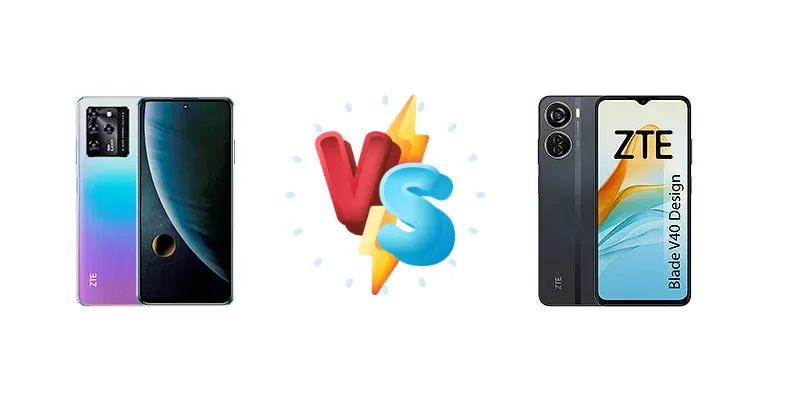
The ZTE Blade series consistently delivers affordable smartphones, and the V30 and V40 Design are no exception. But which one offers the best value for your money? This comprehensive comparison dives deep into their specs, performance, and features to help you make an informed decision.
🏆 Quick Verdict
The ZTE Blade V40 Design edges out the V30 thanks to its slightly faster charging, marginally better chipset, and potentially improved camera capabilities (though specifics are limited). Both are solid budget options, but the V40 offers a small upgrade for a potentially similar price.
| Network |
|---|
| 2G bands | GSM 850 / 900 / 1800 / 1900 | GSM 850 / 900 / 1800 / 1900 |
| 3G bands | HSDPA 850 / 1700(AWS) / 1900 - Mexico | HSDPA 850 / 900 / 1900 / 2100 |
| 4G bands | 1, 2, 3, 4, 5, 7, 12, 13, 26, 28, 66 - Mexico | LTE |
| Speed | HSPA, LTE | HSPA, LTE |
| Technology | GSM / HSPA / LTE | GSM / HSPA / LTE |
| Launch |
|---|
| Announced | 2021, July 16 | 2022, December 21 |
| Status | Available. Released 2021, September 01 | Available. Released 2023, January 10 |
| Body |
|---|
| Dimensions | 165.8 x 77.8 x 8.9 mm (6.53 x 3.06 x 0.35 in) | 163 x 74 x 8 mm (6.42 x 2.91 x 0.31 in) |
| SIM | Nano-SIM + Nano-SIM | Nano-SIM + Nano-SIM |
| Weight | 193 g (6.81 oz) | 183.4 g (6.46 oz) |
| Display |
|---|
| Resolution | 1080 x 2400 pixels, 20:9 ratio (~395 ppi density) | 1080 x 2408 pixels, 20:9 ratio (~400 ppi density) |
| Size | 6.67 inches, 107.4 cm2 (~83.3% screen-to-body ratio) | 6.6 inches, 104.9 cm2 (~87.0% screen-to-body ratio) |
| Type | IPS LCD | IPS LCD |
| Platform |
|---|
| CPU | Octa-core (2x2.0 GHz Cortex-A75 & 6x2.0 GHz Cortex-A55) | Octa-core (2x2.0 GHz Cortex-A75 & 6x1.8 GHz Cortex-A55) |
| Chipset | Unisoc Tiger T618 (12 nm) | Unisoc Tiger T616 (12 nm) |
| GPU | Mali G52 MP2 | Mali-G57 MP1 |
| OS | Android 11 | Android 12, MyOS 12 |
| Memory |
|---|
| Card slot | microSDXC | microSDXC (dedicated slot) |
| Internal | 128GB 4GB RAM | 128GB 4GB RAM, 128GB 6GB RAM |
| | - | UFS 2.2 |
| Main Camera |
|---|
| Features | LED flash, HDR, panorama | LED flash, HDR, panorama |
| Single | 16 MP, f/2.0, (wide) | 8 MP, (wide) |
| Triple | 64 MP, f/1.8, 26mm (wide), PDAF
8 MP, f/2.4, 120˚, 16mm (ultrawide)
5 MP (macro)
Auxiliary lens | 50 MP, f/1.8, (wide), PDAF
2 MP (macro)
Auxiliary lens |
| Video | 1080p@30fps | 1080p@30fps |
| Selfie camera |
|---|
| Single | 16 MP, f/2.0, (wide) | 8 MP, (wide) |
| Video | - | 1080p@30fps |
| Sound |
|---|
| 3.5mm jack | Yes | Yes |
| 35mm jack | Yes | Yes |
| Loudspeaker | Yes | Yes |
| Comms |
|---|
| Bluetooth | 5.0, A2DP, LE | Yes |
| NFC | No | Yes |
| Positioning | GPS | GPS |
| Radio | Unspecified | Unspecified |
| USB | USB Type-C 2.0 | USB Type-C 2.0 |
| WLAN | Wi-Fi 802.11 b/g/n/ac | Yes |
| Features |
|---|
| Sensors | Fingerprint (side-mounted), accelerometer, gyro, proximity | Fingerprint (side-mounted), accelerometer, proximity |
| Battery |
|---|
| Charging | 18W wired | 22.5W wired |
| Type | Li-Po 5000 mAh | Li-Po 4500 mAh |
| Misc |
|---|
| Colors | Black, Blue | Sky Blue, Starry Black |
| Models | 9030 | 8046 |
| Price | About 200 EUR | About 200 EUR |
ZTE Blade V30
- Very affordable
- Decent battery life
- Large display
- Slower charging
- Potentially less powerful chipset
- Camera performance may be limited
ZTE Blade V40 Design
- Faster charging (22.5W)
- Slightly better chipset
- Potentially improved camera
- May be slightly more expensive
- Still a budget phone with limitations
- Camera still likely limited in low light
Display Comparison
Both phones likely feature similar display technology (likely IPS LCD) and resolution, around 6.67 inches. Expect comparable viewing experiences, though the V40 might have slightly better color accuracy or brightness depending on the specific panel used. Detailed display specs are often not released for these budget models.
Camera Comparison
Camera specifications are often a weak point in budget phones. While both likely feature a multi-lens setup (likely a main sensor, ultrawide, and macro), the V40 Design *may* have a slightly improved main sensor or image processing algorithms. Expect decent image quality in good lighting conditions, but struggles in low light. Specific megapixel counts are often not clearly stated.
Performance
The V40 Design's Unisoc Tiger T616 has a slightly higher clock speed on its Cortex-A55 cores (1.8 GHz vs 2.0 GHz on the V30), suggesting a small performance advantage in everyday tasks. The V30's T618 has slightly faster Cortex-A75 cores, but the overall difference is likely minimal for typical usage. Both will handle basic apps and multitasking adequately.
Battery Life
Both phones likely have a battery capacity around 5000mAh. The V40 Design's 22.5W charging support offers a faster charging experience compared to the V30's 18W charging. This means the V40 will likely charge to 50% faster.
Buying Guide
The ZTE Blade V30 is a good choice for users prioritizing a very budget-friendly device for basic tasks like calling, texting, and light social media use. The ZTE Blade V40 Design is better suited for those who want a slightly more responsive experience, faster charging, and potentially better camera performance without breaking the bank.
Frequently Asked Questions
❓ What is the difference between the Unisoc Tiger T618 and T616 chipsets?
The T616 has slightly faster Cortex-A55 cores, while the T618 has slightly faster Cortex-A75 cores. The real-world difference in performance is likely minimal for most users.
❓ Are these phones 5G capable?
No, neither the ZTE Blade V30 nor the ZTE Blade V40 Design support 5G connectivity. They are both 4G LTE devices.