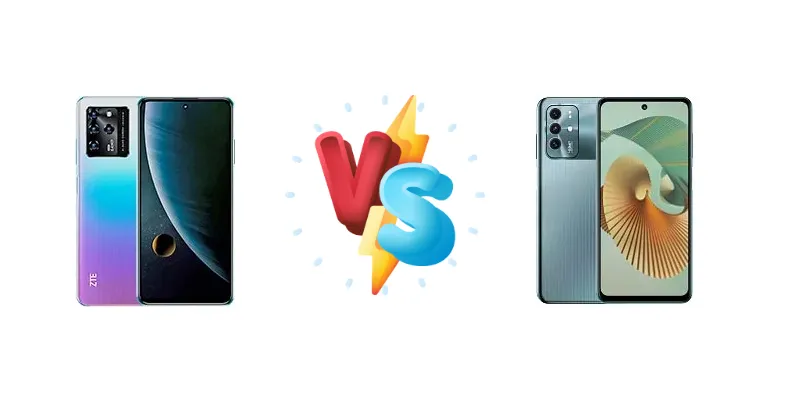
Looking for an affordable smartphone? The ZTE Blade V30 and V40 are strong contenders in the budget market. But which one offers the best value for your money? This comprehensive comparison dives deep into their specs, performance, and features to help you decide.
🏆 Quick Verdict
The ZTE Blade V40 is the clear winner. Its Dimensity 700 chipset provides significantly better performance and efficiency than the V30's Unisoc T618. While both offer decent features, the V40's improved processor and slightly faster charging make it the superior choice.
| Network |
|---|
| 2G bands | GSM 850 / 900 / 1800 / 1900 | GSM 850 / 900 / 1800 / 1900 |
| 3G bands | HSDPA 850 / 1700(AWS) / 1900 - Mexico | HSDPA 850 / 900 / 1900 / 2100 |
| 4G bands | 1, 2, 3, 4, 5, 7, 12, 13, 26, 28, 66 - Mexico | LTE |
| 5G bands | - | SA/NSA |
| Speed | HSPA, LTE | HSPA, LTE, 5G |
| Technology | GSM / HSPA / LTE | GSM / HSPA / LTE / 5G |
| Launch |
|---|
| Announced | 2021, July 16 | 2022, February 28 |
| Status | Available. Released 2021, September 01 | Available. Released 2023, January |
| Body |
|---|
| Dimensions | 165.8 x 77.8 x 8.9 mm (6.53 x 3.06 x 0.35 in) | - |
| SIM | Nano-SIM + Nano-SIM | Nano-SIM + Nano-SIM |
| Weight | 193 g (6.81 oz) | - |
| Display |
|---|
| Resolution | 1080 x 2400 pixels, 20:9 ratio (~395 ppi density) | 1080 x 2400 pixels, 20:9 ratio (~395 ppi density) |
| Size | 6.67 inches, 107.4 cm2 (~83.3% screen-to-body ratio) | 6.67 inches, 107.4 cm2 |
| Type | IPS LCD | IPS LCD |
| Platform |
|---|
| CPU | Octa-core (2x2.0 GHz Cortex-A75 & 6x2.0 GHz Cortex-A55) | Octa-core (2x2.2 GHz Cortex-A76 & 6x2.0 GHz Cortex-A55) |
| Chipset | Unisoc Tiger T618 (12 nm) | Mediatek Dimensity 700 (7 nm) |
| GPU | Mali G52 MP2 | Mali-G57 MC2 |
| OS | Android 11 | Android 12 |
| Memory |
|---|
| Card slot | microSDXC | microSDXC |
| Internal | 128GB 4GB RAM | 128GB 6GB RAM |
| Main Camera |
|---|
| Features | LED flash, HDR, panorama | Dual-LED dual-tone flash, HDR, panorama |
| Single | 16 MP, f/2.0, (wide) | 8 MP, f/2.0, (wide) |
| Triple | 64 MP, f/1.8, 26mm (wide), PDAF
8 MP, f/2.4, 120˚, 16mm (ultrawide)
5 MP (macro)
Auxiliary lens | 48 MP, f/1.8, (wide), PDAF
2 MP (macro)
Auxiliary lens |
| Video | 1080p@30fps | 1080p@30fps |
| Selfie camera |
|---|
| Single | 16 MP, f/2.0, (wide) | 8 MP, f/2.0, (wide) |
| Video | - | 1080p@30fps |
| Sound |
|---|
| 3.5mm jack | Yes | Yes |
| 35mm jack | Yes | Yes |
| Loudspeaker | Yes | Yes |
| Comms |
|---|
| Bluetooth | 5.0, A2DP, LE | Yes |
| NFC | No | Yes (market/region dependent) |
| Positioning | GPS | GPS |
| Radio | Unspecified | Unspecified |
| USB | USB Type-C 2.0 | USB Type-C 2.0 |
| WLAN | Wi-Fi 802.11 b/g/n/ac | Yes |
| Features |
|---|
| Sensors | Fingerprint (side-mounted), accelerometer, gyro, proximity | Fingerprint (side-mounted), accelerometer, proximity |
| Battery |
|---|
| Charging | 18W wired | 22.5W wired |
| Type | Li-Po 5000 mAh | Li-Po 6000 mAh |
| Misc |
|---|
| Colors | Black, Blue | Black, Blue |
| Models | 9030 | - |
| Price | About 200 EUR | - |
ZTE Blade V30
- Large Display
- Affordable Price
- Decent Battery Life
- Underpowered Chipset
- Slower Charging
- Potentially Less Accurate Colors
ZTE Blade V40
- Faster Performance
- More Efficient Chipset
- Slightly Faster Charging
- Better Image Processing
- Slightly Higher Price
- May lack some features of higher-end phones
Display Comparison
Both phones feature large displays, likely around 6.6-6.8 inches, with Full HD+ resolution. Expect similar viewing experiences, though the V40 might have slightly better color accuracy due to its more modern chipset potentially enabling better display calibration. The V30 likely uses a standard LCD panel, while the V40 may have a slightly improved panel.
Camera Comparison
While both phones likely feature a multi-lens camera system (likely a 48MP main sensor, ultrawide, and macro), the V40's more powerful processor will likely result in better image processing, improved low-light performance, and potentially better video recording capabilities. Expect slightly more detailed and vibrant photos from the V40.
Performance
This is where the V40 shines. The Dimensity 700's 7nm process and Cortex-A76 cores offer a substantial performance boost over the V30's 12nm Unisoc T618 and Cortex-A75 cores. Expect smoother app loading, faster multitasking, and better gaming performance on the V40. The V30 will handle basic tasks adequately, but may struggle with more demanding applications.
Battery Life
Both phones likely have a battery capacity around 5000mAh. The V40's more efficient Dimensity 700 chipset should translate to slightly better battery life despite the slightly faster 22.5W charging. The V30's charging speed is 18W.
Buying Guide
The ZTE Blade V30 is a good option for users on a very tight budget who prioritize basic functionality and a large display. The ZTE Blade V40 is ideal for those seeking a smoother user experience, better performance for multitasking and gaming, and a more future-proof device.
Frequently Asked Questions
❓ Is the ZTE Blade V30 good for gaming?
The ZTE Blade V30 can handle basic games, but it will struggle with more demanding titles. The V40 is a better choice for gaming due to its more powerful processor.
❓ Which phone has better battery life?
The ZTE Blade V40 likely offers slightly better battery life due to its more efficient Dimensity 700 chipset, despite having a slightly faster charging speed.