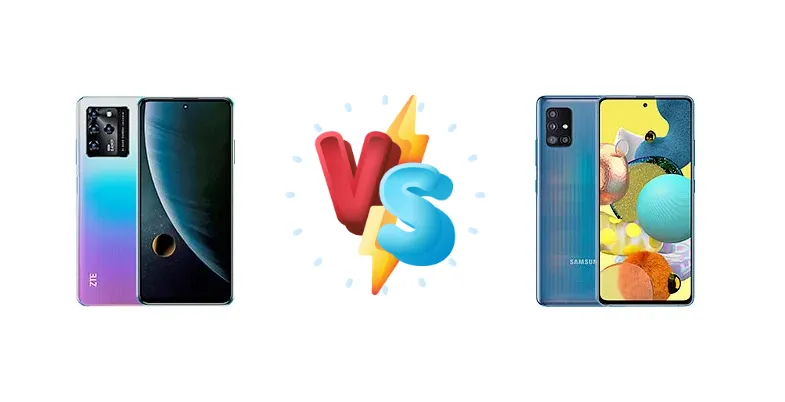
Looking for a budget-friendly smartphone? The ZTE Blade V30 and Samsung Galaxy A51 5G UW are both contenders, offering compelling features at accessible price points. But which one reigns supreme? This comprehensive comparison dives deep into their specs, performance, and overall value.
🏆 Quick Verdict
The Samsung Galaxy A51 5G UW is the clear winner. Its Snapdragon 765G chipset, 5G connectivity, and generally superior camera system offer a significantly better experience than the ZTE Blade V30, despite slightly slower charging.
| Network |
|---|
| 2G bands | GSM 850 / 900 / 1800 / 1900 | GSM 850 / 900 / 1800 / 1900 |
| 3G bands | HSDPA 850 / 1700(AWS) / 1900 - Mexico | HSDPA 850 / 900 / 1900 / 2100 |
| 4G bands | 1, 2, 3, 4, 5, 7, 12, 13, 26, 28, 66 - Mexico | 2, 4, 5, 13, 66 |
| 5G bands | - | 260, 261 mmWave |
| Speed | HSPA, LTE | HSPA, LTE, 5G |
| Technology | GSM / HSPA / LTE | GSM / HSPA / LTE / 5G |
| Launch |
|---|
| Announced | 2021, July 16 | 2020, August 14 |
| Status | Available. Released 2021, September 01 | Available. Released 2020, August 14 |
| Body |
|---|
| Build | - | Glass front (Gorilla Glass 3), plastic back, aluminum frame |
| Dimensions | 165.8 x 77.8 x 8.9 mm (6.53 x 3.06 x 0.35 in) | 158.8 x 73.4 x 8.6 mm (6.25 x 2.89 x 0.34 in) |
| SIM | Nano-SIM + Nano-SIM | Nano-SIM (pre-installed) |
| Weight | 193 g (6.81 oz) | 188.8 g (6.67 oz) |
| Display |
|---|
| Protection | - | Corning Gorilla Glass 3 |
| Resolution | 1080 x 2400 pixels, 20:9 ratio (~395 ppi density) | 1080 x 2400 pixels, 20:9 ratio (~405 ppi density) |
| Size | 6.67 inches, 107.4 cm2 (~83.3% screen-to-body ratio) | 6.5 inches, 102.0 cm2 (~87.5% screen-to-body ratio) |
| Type | IPS LCD | Super AMOLED |
| Platform |
|---|
| CPU | Octa-core (2x2.0 GHz Cortex-A75 & 6x2.0 GHz Cortex-A55) | Octa-core (1x2.4 GHz Kryo 475 Prime & 1x2.2 GHz Kryo 475 Gold & 6x1.8 GHz Kryo 475 Silver) |
| Chipset | Unisoc Tiger T618 (12 nm) | Qualcomm SM7250 Snapdragon 765G 5G (7 nm) |
| GPU | Mali G52 MP2 | Adreno 620 |
| OS | Android 11 | Android 10, One UI 2 |
| Memory |
|---|
| Card slot | microSDXC | microSDXC (uses shared SIM slot) |
| Internal | 128GB 4GB RAM | 128GB 6GB RAM |
| | - | UFS 2.1 |
| Main Camera |
|---|
| Features | LED flash, HDR, panorama | LED flash, panorama, HDR |
| Quad | - | 48 MP, f/2.0, 26mm (wide), 1/2.0", 0.8µm, PDAF
12 MP, f/2.2, 123˚ (ultrawide)
5 MP (macro)
Auxiliary lens |
| Single | 16 MP, f/2.0, (wide) | 5 MP, AF |
| Triple | 64 MP, f/1.8, 26mm (wide), PDAF
8 MP, f/2.4, 120˚, 16mm (ultrawide)
5 MP (macro)
Auxiliary lens | - |
| Video | 1080p@30fps | 4K@30fps, 1080p@30/120fps; gyro-EIS |
| Selfie camera |
|---|
| Features | - | HDR |
| Single | 16 MP, f/2.0, (wide) | 32 MP, f/2.2, 26mm (wide), 1/2.8", 0.8µm |
| Video | - | 4K@30fps, 1080p@30fps |
| Sound |
|---|
| 3.5mm jack | Yes | Yes |
| 35mm jack | Yes | Yes |
| Loudspeaker | Yes | Yes |
| Comms |
|---|
| Bluetooth | 5.0, A2DP, LE | 5.0, A2DP, LE |
| NFC | No | Yes |
| Positioning | GPS | GPS, GLONASS, GALILEO, BDS |
| Radio | Unspecified | FM radio, RDS, recording |
| USB | USB Type-C 2.0 | USB Type-C 2.0, OTG |
| WLAN | Wi-Fi 802.11 b/g/n/ac | Wi-Fi 802.11 a/b/g/n/ac, dual-band, Wi-Fi Direct |
| Features |
|---|
| Sensors | Fingerprint (side-mounted), accelerometer, gyro, proximity | Fingerprint (under display, optical), accelerometer, gyro, proximity, compass |
| | - | ANT+ |
| Battery |
|---|
| Charging | 18W wired | 15W wired |
| Stand-by | - | Up to 672 h |
| Talk time | - | Up to 5 h |
| Type | Li-Po 5000 mAh | Li-Po 4500 mAh |
| Misc |
|---|
| Colors | Black, Blue | Prism Bricks Blue |
| Models | 9030 | SM-A516V |
| Price | About 200 EUR | About 470 EUR |
| SAR | - | 0.70 W/kg (head) 1.25 W/kg (body) |
| SAR EU | - | 0.59 W/kg (head) 1.32 W/kg (body) |
ZTE Blade V30
- Affordable
- Decent battery life
- Slightly faster charging
- Less powerful processor
- Lower quality display
- Less capable camera
- No 5G
Samsung Galaxy A51 5G UW
- Powerful Snapdragon 765G processor
- 5G connectivity
- Excellent Super AMOLED display
- Versatile camera system
- Reliable brand
- Slower charging
- Can be slightly more expensive
Display Comparison
The Samsung Galaxy A51 5G UW typically features a 6.5-inch Super AMOLED display with a 120Hz refresh rate (depending on the specific variant), offering vibrant colors and smooth scrolling. The ZTE Blade V30 likely has an LCD display, which is generally less vibrant and may have a lower refresh rate. Samsung wins here.
Camera Comparison
The Galaxy A51 5G UW boasts a versatile quad-camera system, often including a high-resolution main sensor, ultrawide lens, macro lens, and depth sensor. The Blade V30's camera setup is likely less sophisticated, potentially with fewer lenses and lower resolution. Samsung's image processing is also generally superior.
Performance
The Snapdragon 765G in the Galaxy A51 5G UW is a significantly more powerful chipset than the Unisoc Tiger T618 in the Blade V30. Expect noticeably faster app loading times, smoother multitasking, and better gaming performance on the Samsung device. The Galaxy A51 5G UW's CPU architecture is also more efficient.
Battery Life
Both phones offer decent battery life, but the Galaxy A51 5G UW's larger battery capacity (typically 4500mAh) and more efficient processor give it a slight edge. While the Blade V30 has slightly faster charging (18W vs 15W), the difference is minimal.
Buying Guide
The ZTE Blade V30 is ideal for users prioritizing affordability and basic functionality. It's a good option for first-time smartphone users or those needing a secondary device. The Samsung Galaxy A51 5G UW is better suited for users who want 5G connectivity, a smoother performance, a better camera, and the reliability of the Samsung brand.
Frequently Asked Questions
❓ Is the ZTE Blade V30 worth buying?
The ZTE Blade V30 is a decent budget option if you're extremely price-sensitive and don't need 5G or high-end performance. However, the Galaxy A51 5G UW offers significantly more value for a slightly higher price.
❓ Does the Samsung Galaxy A51 5G UW support 5G?
Yes, the '5G UW' in the name indicates that it supports 5G connectivity, specifically utilizing the UW (Ultra Wideband) spectrum for faster speeds where available.