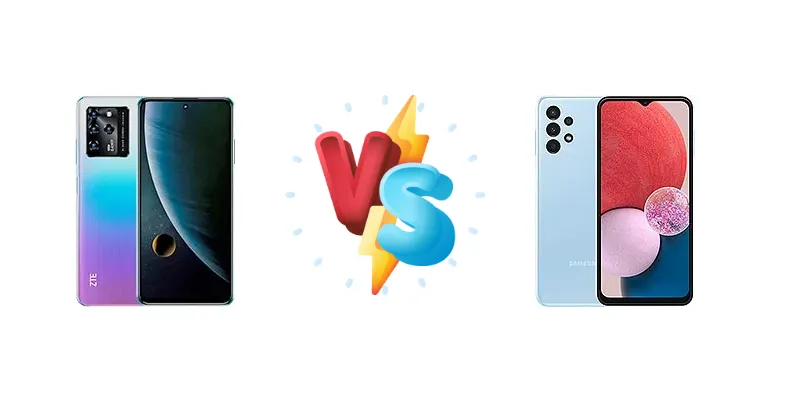
The budget smartphone market is fiercely competitive, offering incredible value for your money. Two contenders vying for your attention are the ZTE Blade V30 and the Samsung Galaxy A13. But which one offers the best overall experience? Let's dive into a detailed comparison to help you decide.
🏆 Quick Verdict
The Samsung Galaxy A13 edges out the ZTE Blade V30 thanks to its generally better software support, more established brand reputation, and slightly more versatile camera system. While the Blade V30 offers a competitive chipset, Samsung's ecosystem and reliability give it the slight advantage.
| Network |
|---|
| 2G bands | GSM 850 / 900 / 1800 / 1900 | GSM 850 / 900 / 1800 / 1900 |
| 3G bands | HSDPA 850 / 1700(AWS) / 1900 - Mexico | HSDPA 850 / 900 / 2100 |
| 4G bands | 1, 2, 3, 4, 5, 7, 12, 13, 26, 28, 66 - Mexico | 1, 3, 5, 7, 8, 20, 28, 38, 40, 41 |
| Speed | HSPA, LTE | HSPA, LTE |
| Technology | GSM / HSPA / LTE | GSM / HSPA / LTE |
| Launch |
|---|
| Announced | 2021, July 16 | 2022, June |
| Status | Available. Released 2021, September 01 | Available. Released 2022, July |
| Body |
|---|
| Build | - | Glass front (Gorilla Glass 5), plastic frame, plastic back |
| Dimensions | 165.8 x 77.8 x 8.9 mm (6.53 x 3.06 x 0.35 in) | 165.1 x 76.4 x 8.8 mm (6.5 x 3.01 x 0.35 in) |
| SIM | Nano-SIM + Nano-SIM | · Nano-SIM· Nano-SIM + Nano-SIM |
| Weight | 193 g (6.81 oz) | 195 g (6.88 oz) |
| Display |
|---|
| Protection | - | Corning Gorilla Glass 5 |
| Resolution | 1080 x 2400 pixels, 20:9 ratio (~395 ppi density) | 1080 x 2408 pixels, 20:9 ratio (~400 ppi density) |
| Size | 6.67 inches, 107.4 cm2 (~83.3% screen-to-body ratio) | 6.6 inches, 104.9 cm2 (~83.2% screen-to-body ratio) |
| Type | IPS LCD | PLS LCD |
| Platform |
|---|
| CPU | Octa-core (2x2.0 GHz Cortex-A75 & 6x2.0 GHz Cortex-A55) | Octa-core (2x2.0 GHz Cortex-A75 & 6x1.8 GHz Cortex-A55) |
| Chipset | Unisoc Tiger T618 (12 nm) | Mediatek MT6769V/CU Helio G80 (12 nm) |
| GPU | Mali G52 MP2 | Mali-G52 MC2 |
| OS | Android 11 | Android 12, upgradable to Android 14, One UI 6.1 |
| Memory |
|---|
| Card slot | microSDXC | microSDXC (dedicated slot) |
| Internal | 128GB 4GB RAM | 32GB 3GB RAM, 32GB 4GB RAM, 64GB 4GB RAM, 128GB 4GB RAM |
| | - | eMMC 5.1 |
| Main Camera |
|---|
| Features | LED flash, HDR, panorama | LED flash, panorama, HDR |
| Quad | - | 50 MP, f/1.8, (wide), PDAF
5 MP, f/2.2, 123˚ (ultrawide), 1/5.0", 1.12µm
2 MP (macro)
Auxiliary lens |
| Single | 16 MP, f/2.0, (wide) | 8 MP, f/2.2, (wide) |
| Triple | 64 MP, f/1.8, 26mm (wide), PDAF
8 MP, f/2.4, 120˚, 16mm (ultrawide)
5 MP (macro)
Auxiliary lens | - |
| Video | 1080p@30fps | 1080p@30fps |
| Selfie camera |
|---|
| Single | 16 MP, f/2.0, (wide) | 8 MP, f/2.2, (wide) |
| Video | - | 1080p@30fps |
| Sound |
|---|
| 3.5mm jack | Yes | Yes |
| 35mm jack | Yes | Yes |
| Loudspeaker | Yes | Yes |
| Comms |
|---|
| Bluetooth | 5.0, A2DP, LE | 5.2, A2DP, LE |
| NFC | No | Yes |
| Positioning | GPS | GPS, GLONASS, GALILEO, BDS |
| Radio | Unspecified | No |
| USB | USB Type-C 2.0 | USB Type-C 2.0, OTG |
| WLAN | Wi-Fi 802.11 b/g/n/ac | Wi-Fi 802.11 a/b/g/n/ac, dual-band, Wi-Fi Direct |
| Features |
|---|
| Sensors | Fingerprint (side-mounted), accelerometer, gyro, proximity | Fingerprint (side-mounted), accelerometer, compass |
| | - | Virtual proximity sensing |
| Battery |
|---|
| Charging | 18W wired | 15W wired |
| Type | Li-Po 5000 mAh | Li-Po 5000 mAh |
| Misc |
|---|
| Colors | Black, Blue | Black, White, Blue |
| Models | 9030 | SM-A137F, SM-A137F/DSN, SM-A137F/DS |
| Price | About 200 EUR | About 180 EUR |
| SAR EU | - | 0.35 W/kg (head) 1.22 W/kg (body) |
ZTE Blade V30
- Slightly faster CPU core clock
- Potentially more modern design
- Faster charging (18W)
- Less established brand
- Potentially less optimized software
- Likely less versatile camera system
Samsung Galaxy A13 (SM-A137)
- Strong brand reputation
- Better software support and updates
- More versatile camera system
- Generally better display quality
- Slower charging (15W)
- Potentially slightly slower performance in some scenarios
Display Comparison
Both phones feature large displays, likely around 6.5 inches, with FHD+ resolution. The Galaxy A13 typically boasts a slightly better panel with more accurate colors and potentially higher brightness, though this can vary based on specific panel variations. The Blade V30 might offer a more modern design with a smaller notch or punch-hole camera.
Camera Comparison
The Samsung Galaxy A13 generally offers a more versatile camera system, typically including a main sensor, ultrawide lens, and macro lens. The Blade V30 likely focuses on a single, high-resolution main sensor. Image quality on the A13 is generally better, especially in low light, thanks to Samsung's image processing algorithms.
Performance
The ZTE Blade V30's Unisoc Tiger T618 has a slightly faster CPU core clock speed (2.0 GHz Cortex-A75) compared to the Galaxy A13's Helio G80 (2.0 GHz Cortex-A75). However, the Helio G80 often performs better in real-world usage due to better optimization and Mali-G52 MC2 GPU. Gaming performance will likely be similar, but the A13 might handle more demanding titles slightly better.
Battery Life
Both phones feature large batteries, likely around 5000mAh. However, the Galaxy A13's 15W charging is slower than the Blade V30's 18W charging. Battery life itself will be comparable, with both phones easily lasting a full day of moderate use.
Buying Guide
The ZTE Blade V30 is a good choice for users prioritizing a slightly faster processor and a more modern design at a potentially lower price point. The Samsung Galaxy A13 is ideal for those seeking a reliable, well-supported device with a strong brand name and a more mature software experience, even if it means sacrificing a bit of raw processing power.
Frequently Asked Questions
❓ Which phone has better software updates?
The Samsung Galaxy A13 is likely to receive more frequent and longer-term software updates due to Samsung's commitment to supporting its devices.
❓ Is the ZTE Blade V30 good for gaming?
While the Blade V30's chipset is decent, the Samsung Galaxy A13's GPU and overall optimization make it a slightly better choice for gaming, especially for more demanding titles.