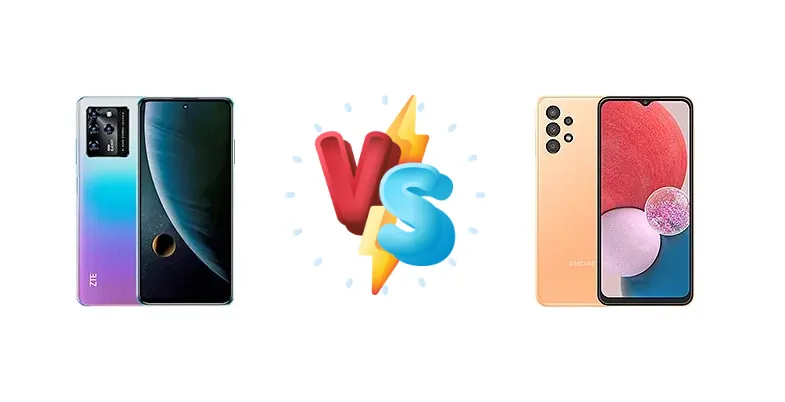
Looking for a budget-friendly smartphone that doesn't compromise too much? The ZTE Blade V30 and Samsung Galaxy A13 are both contenders, offering affordability and essential features. But which one reigns supreme? Let's dive into a detailed comparison to help you decide.
🏆 Quick Verdict
The Samsung Galaxy A13 edges out the ZTE Blade V30 thanks to its superior display brightness, more established brand reputation, and generally better software support. While the Blade V30 offers a slightly more powerful chipset, the A13's overall package provides a more polished user experience.
| Network |
|---|
| 2G bands | GSM 850 / 900 / 1800 / 1900 | GSM 850 / 900 / 1800 / 1900 |
| 3G bands | HSDPA 850 / 1700(AWS) / 1900 - Mexico | HSDPA 850 / 900 / 2100 |
| 4G bands | 1, 2, 3, 4, 5, 7, 12, 13, 26, 28, 66 - Mexico | 1, 3, 5, 7, 8, 20, 28, 38, 40, 41 |
| Speed | HSPA, LTE | HSPA, LTE |
| Technology | GSM / HSPA / LTE | GSM / HSPA / LTE |
| Launch |
|---|
| Announced | 2021, July 16 | 2022, March 04 |
| Status | Available. Released 2021, September 01 | Available. Released 2022, March 23 |
| Body |
|---|
| Build | - | Glass front (Gorilla Glass 5), plastic frame, plastic back |
| Dimensions | 165.8 x 77.8 x 8.9 mm (6.53 x 3.06 x 0.35 in) | 165.1 x 76.4 x 8.8 mm (6.5 x 3.01 x 0.35 in) |
| SIM | Nano-SIM + Nano-SIM | · Nano-SIM· Nano-SIM + Nano-SIM |
| Weight | 193 g (6.81 oz) | 195 g (6.88 oz) |
| Display |
|---|
| Protection | - | Corning Gorilla Glass 5 |
| Resolution | 1080 x 2400 pixels, 20:9 ratio (~395 ppi density) | 1080 x 2408 pixels, 20:9 ratio (~400 ppi density) |
| Size | 6.67 inches, 107.4 cm2 (~83.3% screen-to-body ratio) | 6.6 inches, 104.9 cm2 (~83.2% screen-to-body ratio) |
| Type | IPS LCD | PLS LCD |
| Platform |
|---|
| CPU | Octa-core (2x2.0 GHz Cortex-A75 & 6x2.0 GHz Cortex-A55) | Octa-core (4x2.0 GHz Cortex-A55 & 4x2.0 GHz Cortex-A55) |
| Chipset | Unisoc Tiger T618 (12 nm) | Exynos 850 (8 nm) |
| GPU | Mali G52 MP2 | Mali-G52 |
| OS | Android 11 | Android 12, upgradable to Android 14, One UI 6.1 |
| Memory |
|---|
| Card slot | microSDXC | microSDXC (dedicated slot) |
| Internal | 128GB 4GB RAM | 32GB 3GB RAM, 32GB 4GB RAM, 64GB 4GB RAM, 128GB 3GB RAM, 128GB 4GB RAM, 128GB 6GB RAM |
| | - | eMMC 5.1 |
| Main Camera |
|---|
| Features | LED flash, HDR, panorama | LED flash, panorama, HDR |
| Quad | - | 50 MP, f/1.8, (wide), PDAF
5 MP, f/2.2, 123˚ (ultrawide), 1/5.0", 1.12µm
2 MP (macro)
Auxiliary lens |
| Single | 16 MP, f/2.0, (wide) | 8 MP, f/2.2, (wide) |
| Triple | 64 MP, f/1.8, 26mm (wide), PDAF
8 MP, f/2.4, 120˚, 16mm (ultrawide)
5 MP (macro)
Auxiliary lens | - |
| Video | 1080p@30fps | 1080p@30fps |
| Selfie camera |
|---|
| Single | 16 MP, f/2.0, (wide) | 8 MP, f/2.2, (wide) |
| Video | - | 1080p@30fps |
| Sound |
|---|
| 3.5mm jack | Yes | Yes |
| 35mm jack | Yes | Yes |
| Loudspeaker | Yes | Yes |
| Comms |
|---|
| Bluetooth | 5.0, A2DP, LE | 5.0, A2DP, LE |
| NFC | No | Yes (market/region dependent) |
| Positioning | GPS | GPS, GLONASS, GALILEO, BDS |
| Radio | Unspecified | No |
| USB | USB Type-C 2.0 | USB Type-C 2.0, OTG |
| WLAN | Wi-Fi 802.11 b/g/n/ac | Wi-Fi 802.11 a/b/g/n/ac, dual-band, Wi-Fi Direct |
| Features |
|---|
| Sensors | Fingerprint (side-mounted), accelerometer, gyro, proximity | Fingerprint (side-mounted), accelerometer, compass |
| | - | Virtual proximity sensing |
| Battery |
|---|
| Charging | 18W wired | 15W wired |
| Type | Li-Po 5000 mAh | Li-Po 5000 mAh |
| Misc |
|---|
| Colors | Black, Blue | Black, White, Peach, Blue |
| Models | 9030 | SM-A135F, SM-A135F/DS, SM-A135M, SM-A135U, SM-A135U1, SM-A135N |
| Price | About 200 EUR | € 94.99 / $ 129.99 / £ 89.00 |
| SAR | - | 0.49 W/kg (head) |
| SAR EU | - | 0.37 W/kg (head) 1.39 W/kg (body) |
| Tests |
|---|
| Battery life | - |
Endurance rating 114h
|
| Camera | - |
Photo / Video |
| Display | - |
Contrast ratio: 1324:1 (nominal) |
| Loudspeaker | - |
-29.7 LUFS (Average)
|
| Performance | - |
AnTuTu: 122822 (v8), 136286 (v9)
GeekBench: 588 (v5.1)
GFXBench: 5.2fps (ES 3.1 onscreen) |
ZTE Blade V30
- Potentially faster chipset
- Competitive price
- Modern design
- Less established brand
- Potentially weaker camera
- Lower display brightness
Samsung Galaxy A13
- Brighter display
- Trusted brand
- Good software support
- Reliable camera
- Slightly slower chipset
- 15W charging (slower than some competitors)
Display Comparison
The Samsung Galaxy A13 boasts a significantly brighter display (587 nits measured) compared to the Blade V30, making it easier to view outdoors. Both offer a high contrast ratio (1324:1), but the A13's brightness gives it a noticeable advantage. The Blade V30's display is likely adequate indoors, but struggles in direct sunlight.
Camera Comparison
Camera quality is subjective, but the Samsung Galaxy A13 generally receives better reviews for its camera performance. While specific megapixel counts are not provided, Samsung's image processing is typically more refined. The Blade V30's camera is likely adequate for basic photography, but won't compete with the A13's capabilities.
Performance
The ZTE Blade V30's Unisoc Tiger T618 chipset, with its Cortex-A75 cores, *potentially* offers a slight edge in raw processing power compared to the Galaxy A13's Exynos 850. However, real-world performance differences are likely to be minimal for everyday tasks. The A13's chipset is more efficient and benefits from Samsung's software optimization.
Battery Life
Both phones boast impressive endurance ratings (114h), suggesting excellent battery life. However, the A13's more efficient chipset and potentially better power management could give it a slight advantage in real-world usage.
Buying Guide
The ZTE Blade V30 is a good choice for users prioritizing raw processing power on a tight budget and who are comfortable with a less mainstream brand. The Samsung Galaxy A13 is ideal for those seeking a reliable, well-supported device with a vibrant display and a trusted brand name, even if it means slightly less processing power.
Frequently Asked Questions
❓ Which phone has better gaming performance?
While the ZTE Blade V30 has a slightly more powerful chipset on paper, the Samsung Galaxy A13's optimized software and efficient processor often result in smoother gameplay, especially for less demanding titles.
❓ How long will the battery last on each phone?
Both phones offer excellent battery life, easily lasting a full day with moderate usage. The endurance rating of 114h suggests they can both handle multiple days of light use.