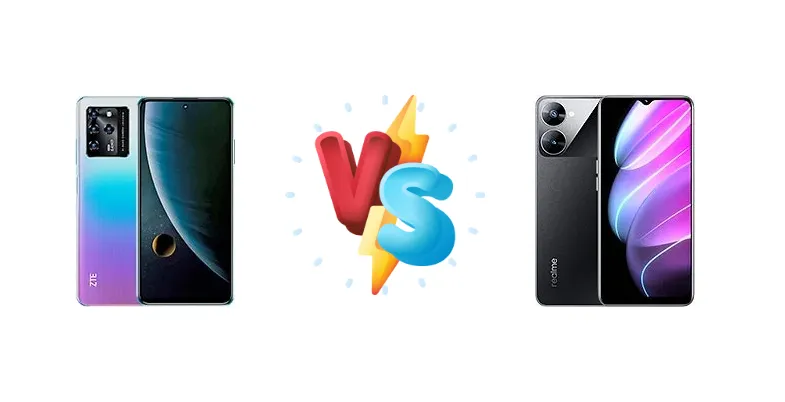
The budget smartphone market is fiercely competitive, offering incredible value for money. Today, we're pitting two contenders against each other: the ZTE Blade V30 and the Realme V30. Both promise a lot, but which one delivers the best overall experience?
🏆 Quick Verdict
The Realme V30 likely edges out the ZTE Blade V30 due to its superior chipset (MediaTek vs. Unisoc) which generally translates to better performance and smoother multitasking. While both are budget options, Realme's processing power gives it a slight advantage for the price.
| Network |
|---|
| 2G bands | GSM 850 / 900 / 1800 / 1900 | GSM 850 / 900 / 1800 / 1900 |
| 3G bands | HSDPA 850 / 1700(AWS) / 1900 - Mexico | HSDPA 850 / 900 / 2100 |
| 4G bands | 1, 2, 3, 4, 5, 7, 12, 13, 26, 28, 66 - Mexico | LTE |
| 5G bands | - | SA/NSA |
| Speed | HSPA, LTE | HSPA, LTE, 5G |
| Technology | GSM / HSPA / LTE | GSM / HSPA / LTE / 5G |
| Launch |
|---|
| Announced | 2021, July 16 | 2023, February 09 |
| Status | Available. Released 2021, September 01 | Available. Released 2023, March 20 |
| Body |
|---|
| Build | - | Glass front, plastic frame, plastic back |
| Dimensions | 165.8 x 77.8 x 8.9 mm (6.53 x 3.06 x 0.35 in) | 8.1 mm thickness |
| SIM | Nano-SIM + Nano-SIM | Nano-SIM + Nano-SIM |
| Weight | 193 g (6.81 oz) | 186 g (6.56 oz) |
| Display |
|---|
| Resolution | 1080 x 2400 pixels, 20:9 ratio (~395 ppi density) | 720 x 1600 pixels, 20:9 ratio (~270 ppi density) |
| Size | 6.67 inches, 107.4 cm2 (~83.3% screen-to-body ratio) | 6.5 inches, 102.0 cm2 |
| Type | IPS LCD | IPS LCD, 600 nits |
| Platform |
|---|
| CPU | Octa-core (2x2.0 GHz Cortex-A75 & 6x2.0 GHz Cortex-A55) | - |
| Chipset | Unisoc Tiger T618 (12 nm) | Mediatek |
| GPU | Mali G52 MP2 | - |
| OS | Android 11 | Android 12, Realme UI 3.0 |
| Memory |
|---|
| Card slot | microSDXC | microSDXC |
| Internal | 128GB 4GB RAM | 128GB 6GB RAM, 128GB 8GB RAM |
| Main Camera |
|---|
| Dual | - | 13 MP, (wide), AF
Auxiliary lens |
| Features | LED flash, HDR, panorama | LED flash, HDR, panorama |
| Single | 16 MP, f/2.0, (wide) | 5 MP (wide) |
| Triple | 64 MP, f/1.8, 26mm (wide), PDAF
8 MP, f/2.4, 120˚, 16mm (ultrawide)
5 MP (macro)
Auxiliary lens | - |
| Video | 1080p@30fps | 1080p@30fps |
| Selfie camera |
|---|
| Single | 16 MP, f/2.0, (wide) | 5 MP (wide) |
| Video | - | 720p@30fps |
| Sound |
|---|
| 3.5mm jack | Yes | Yes |
| 35mm jack | Yes | Yes |
| Loudspeaker | Yes | Yes |
| Comms |
|---|
| Bluetooth | 5.0, A2DP, LE | Yes |
| NFC | No | Unspecified |
| Positioning | GPS | Yes |
| Radio | Unspecified | No |
| USB | USB Type-C 2.0 | USB Type-C 2.0 |
| WLAN | Wi-Fi 802.11 b/g/n/ac | Yes |
| Features |
|---|
| Sensors | Fingerprint (side-mounted), accelerometer, gyro, proximity | Fingerprint (side-mounted), accelerometer, proximity |
| Battery |
|---|
| Charging | 18W wired | - |
| Type | Li-Po 5000 mAh | 5000 mAh |
| Misc |
|---|
| Colors | Black, Blue | Black, Gold |
| Models | 9030 | RMX3618 |
| Price | About 200 EUR | About 150 EUR |
ZTE Blade V30
- Clean Android experience
- Potentially lower price
- Decent battery life
- Good for basic tasks
- Less powerful chipset
- May struggle with demanding games
- Unisoc chipset performance can be inconsistent
- Potentially lower display quality
Realme V30
- More powerful MediaTek chipset
- Smoother performance
- Better multitasking
- Potentially better camera software
- Likely better display quality
- Slightly higher price
- Realme UI can be polarizing (some find it bloated)
Display Comparison
Both phones likely feature a large, LCD display around 6.5-6.7 inches with a standard refresh rate (60Hz or 90Hz). Expect similar resolution (likely FHD+). The Realme V30 might have slightly better color accuracy and brightness due to Realme's generally higher display quality standards.
Camera Comparison
Camera specs are likely comparable, with both phones featuring a multi-lens setup (likely a 48MP main sensor, ultrawide, and macro). Image quality will depend heavily on software processing. Realme often has a slight edge in camera software optimization, potentially resulting in slightly better photos in various conditions. Expect decent daytime shots from both.
Performance
This is where the Realme V30 has a significant advantage. The MediaTek chipset in the Realme V30 is generally more powerful and efficient than the Unisoc Tiger T618 in the ZTE Blade V30. Expect smoother app loading, better multitasking, and improved gaming performance on the Realme V30. The ZTE Blade V30 will handle basic tasks adequately, but may struggle with demanding games or heavy multitasking.
Battery Life
Both phones are expected to have a large battery capacity (5000mAh or greater). Battery life should be similar, offering a full day of moderate use. The Realme V30's more efficient chipset might give it a slight edge in overall battery endurance.
Buying Guide
The ZTE Blade V30 is a good choice for users prioritizing a clean Android experience and potentially a slightly lower price point. The Realme V30 is ideal for those seeking better performance, smoother gaming, and a more modern chipset, even if it means spending a bit more.
Frequently Asked Questions
❓ Which phone is better for gaming?
The Realme V30 is significantly better for gaming due to its more powerful chipset. The ZTE Blade V30 will struggle with demanding titles.
❓ Is the ZTE Blade V30 worth buying if I only need a phone for basic tasks?
Yes, the ZTE Blade V30 can be a good option for basic tasks like calling, texting, and browsing the web, especially if you prioritize a clean Android experience and a lower price.