
ZTE Blade V30 Vita vs Xiaomi 12T Pro: A Detailed Showdown
| Phones Images | |||||
|---|---|---|---|---|---|
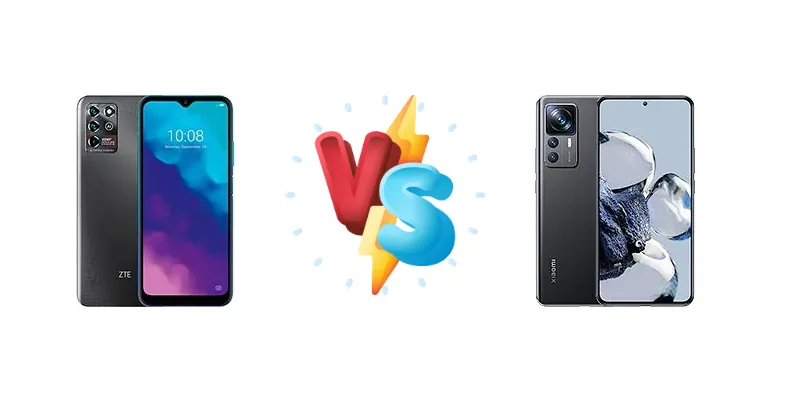
|
🏆 Quick Verdict
The Xiaomi 12T Pro is the clear winner, offering significantly superior performance, a stunning display, and blazing-fast charging. While the ZTE Blade V30 Vita is a decent budget option, it can't compete with the 12T Pro's overall capabilities. It's a premium vs. budget battle.
| PHONES | ||
|---|---|---|
| Phone Names | ZTE Blade V30 Vita | Xiaomi 12T Pro |
| Network | ||
|---|---|---|
| 2G bands | GSM 850 / 900 / 1800 / 1900 | GSM 850 / 900 / 1800 / 1900 |
| 3G bands | HSDPA 850 / 1700(AWS) / 1900 - Mexico | HSDPA 800 / 850 / 900 / 1700(AWS) / 1900 / 2100 |
| 4G bands | 1, 2, 4, 5, 7, 26, 28, 66 - Mexico | 1, 2, 3, 4, 5, 7, 8, 12, 13, 17, 18, 19, 20, 25, 26, 28, 32, 38, 39, 40, 41, 42, 48, 66 |
| 5G bands | - | 1, 3, 5, 7, 8, 20, 28, 38, 40, 41, 66, 77, 78, 75 SA/NSA |
| Speed | HSPA, LTE | HSPA, LTE, 5G |
| Technology | GSM / HSPA / LTE | GSM / HSPA / LTE / 5G |
| Launch | ||
|---|---|---|
| Announced | 2021, July 16 | 2022, October 04 |
| Status | Available. Released 2021, August 16 | Available. Released 2022, October 06 |
| Body | ||
|---|---|---|
| Dimensions | 173 x 78.1 x 8.9 mm (6.81 x 3.07 x 0.35 in) | 163.1 x 75.9 x 8.6 mm (6.42 x 2.99 x 0.34 in) |
| SIM | Nano-SIM + Nano-SIM | · Nano-SIM + eSIM· Nano-SIM + Nano-SIM |
| Weight | 210 g (7.41 oz) | 205 g (7.23 oz) |
| - | IP53, dust and splash resistant | |
| Display | ||
|---|---|---|
| Protection | - | Corning Gorilla Glass 5 |
| Resolution | 720 x 1640 pixels, 3:2 ratio (~288 ppi density) | 1220 x 2712 pixels, 20:9 ratio (~446 ppi density) |
| Size | 6.82 inches, 137.8 cm2 (~102.0% screen-to-body ratio) | 6.67 inches, 107.4 cm2 (~86.7% screen-to-body ratio) |
| Type | IPS LCD | AMOLED, 68B colors, 120Hz, Dolby Vision, HDR10+, 500 nits (typ), 900 nits (peak) |
| Platform | ||
|---|---|---|
| CPU | Octa-core 1.6 GHz | Octa-core (1x3.19 GHz Cortex-X2 & 3x2.75 GHz Cortex-A710 & 4x2.0 GHz Cortex-A510) |
| Chipset | - | Qualcomm SM8475 Snapdragon 8+ Gen 1 (4 nm) |
| GPU | - | Adreno 730 |
| OS | Android 11 | Android 12, upgradable to Android 14, HyperOS |
| Memory | ||
|---|---|---|
| Card slot | microSDXC | No |
| Internal | 128GB 3GB RAM | 128GB 8GB RAM, 256GB 8GB RAM, 256GB 12GB RAM |
| - | UFS 3.1 | |
| Main Camera | ||
|---|---|---|
| Features | LED flash, HDR, panorama | Color spectrum sensor, Dual-LED dual-tone flash, HDR, panorama |
| Single | 8 MP, f/2.0, (wide) | - |
| Triple | 48 MP, f/1.8, 26mm (wide), PDAF 5 MP (macro) Auxiliary lens | 200 MP, f/1.7, (wide), 1/1.22", 0.64µm, PDAF, OIS 8 MP, f/2.2, 120˚ (ultrawide), 1/4.0", 1.12µm 2 MP (macro) |
| Video | 1080p@30fps | 8K@24fps, 4K@30/60fps, 1080p@30/60/120/240fps, HDR10+ |
| Selfie camera | ||
|---|---|---|
| Features | - | HDR, panorama |
| Single | 8 MP, f/2.0, (wide) | 20 MP, f/2.2, (wide), 1/3.47", 0.8µm |
| Video | - | 1080p@30/60fps, HDR |
| Sound | ||
|---|---|---|
| 3.5mm jack | Yes | No |
| 35mm jack | Yes | No |
| Loudspeaker | Yes | Yes, with stereo speakers |
| - | Tuned by Harman Kardon 24-bit/192kHz audio | |
| Comms | ||
|---|---|---|
| Bluetooth | 4.2, A2DP | 5.2, A2DP, LE, aptX HD |
| Infrared port | - | Yes |
| NFC | No | Yes (market/region dependent) |
| Positioning | GPS | GPS (L1+L5), GLONASS (L1), BDS (B1I+B1c+B2a), GALILEO (E1+E5a), QZSS (L1+L5), NavIC (L5) |
| Radio | Unspecified | No |
| USB | USB Type-C 2.0 | USB Type-C 2.0, OTG |
| WLAN | Wi-Fi 802.11 b/g/n/ac | Wi-Fi 802.11 a/b/g/n/ac/6, dual-band, Wi-Fi Direct |
| Features | ||
|---|---|---|
| Sensors | Fingerprint (side-mounted), accelerometer, proximity | Fingerprint (under display, optical), accelerometer, gyro, proximity, compass |
| Battery | ||
|---|---|---|
| Charging | - | 120W wired, 100% in 19 min |
| Type | Li-Po 5000 mAh | Li-Po 5000 mAh |
| Misc | ||
|---|---|---|
| Colors | Black, Blue, Green | Black, Silver, Blue |
| Models | 8030 | 22081212UG, 22081212G |
| Price | - | $ 208.76 / € 167.62 |
| SAR | - | 1.08 W/kg (head) 1.07 W/kg (body) |
| SAR EU | - | 1.00 W/kg (head) 1.00 W/kg (body) |
| Tests | ||
|---|---|---|
| Battery life | - | Endurance rating 91h |
| Camera | - | Photo / Video |
| Display | - | Contrast ratio: Infinite (nominal) |
| Loudspeaker | - | -24.1 LUFS (Very good) |
| Performance | - | AnTuTu: 1032185 (v9) GeekBench: 4081 (v5.1) GFXBench: 65fps (ES 3.1 onscreen) |
ZTE Blade V30 Vita
- Affordable
- Decent battery life
- Sleek design (likely)
- Lower performance
- Less impressive camera
- Basic display
- Slower charging
Xiaomi 12T Pro
- Flagship performance
- Excellent camera
- Stunning display
- Blazing-fast charging
- Premium build quality
- Higher price
- Potentially larger size/weight
Display Comparison
The Xiaomi 12T Pro's 6.67-inch AMOLED display with a 120Hz refresh rate and a peak brightness of 913 nits blows the Blade V30 Vita's display out of the water. The 12T Pro offers vibrant colors, deep blacks, and smooth scrolling, while the Blade V30 Vita likely has a more standard LCD panel with lower brightness and refresh rate. Contrast ratio is also significantly better on the 12T Pro.
Camera Comparison
The Xiaomi 12T Pro's camera system, likely featuring a high-resolution main sensor and advanced image processing, will deliver significantly better photo and video quality than the Blade V30 Vita. Expect better low-light performance, dynamic range, and overall detail. Specific camera specs for the Blade V30 Vita are needed for a more precise comparison, but it's likely to be a simpler setup.
Performance
The Snapdragon 8+ Gen 1 in the Xiaomi 12T Pro is a powerhouse, easily handling demanding games and multitasking. The Blade V30 Vita's Octa-core 1.6 GHz processor is adequate for everyday tasks but will struggle with more intensive applications. The 12T Pro's chipset is in a different league.
Battery Life
Both phones boast impressive endurance ratings (91h), but the Xiaomi 12T Pro's 120W fast charging is a game-changer. It can fully charge in just 19 minutes, while the Blade V30 Vita will likely take considerably longer. While battery life is similar on paper, charging speed is a major advantage for the 12T Pro.
Buying Guide
The ZTE Blade V30 Vita is ideal for users on a tight budget who prioritize affordability and basic smartphone functionality. The Xiaomi 12T Pro is perfect for power users, photography enthusiasts, and anyone who wants a premium experience with top-tier performance and features.