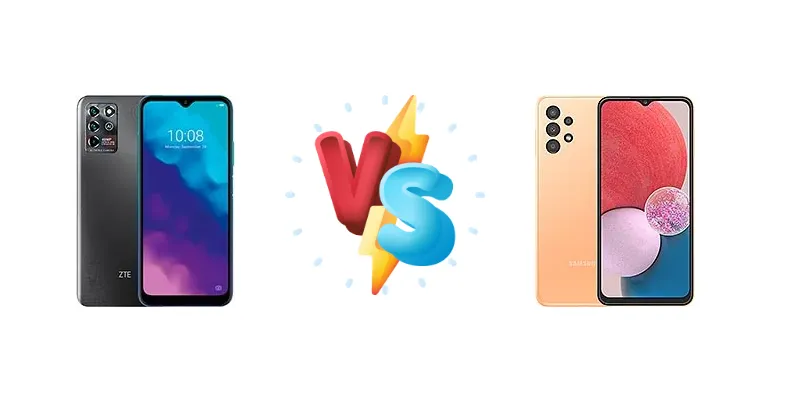
The budget smartphone market is fiercely competitive, offering incredible value for your money. Today, we're pitting two contenders against each other: the ZTE Blade V30 Vita and the Samsung Galaxy A13. Both promise affordability, but which one delivers the better overall experience?
🏆 Quick Verdict
The Samsung Galaxy A13 edges out the ZTE Blade V30 Vita thanks to its superior chipset, brighter display, and generally more polished software experience. While the ZTE offers a potentially more modern design, the A13's reliability and performance make it the slightly better choice for most users.
| Network |
|---|
| 2G bands | GSM 850 / 900 / 1800 / 1900 | GSM 850 / 900 / 1800 / 1900 |
| 3G bands | HSDPA 850 / 1700(AWS) / 1900 - Mexico | HSDPA 850 / 900 / 2100 |
| 4G bands | 1, 2, 4, 5, 7, 26, 28, 66 - Mexico | 1, 3, 5, 7, 8, 20, 28, 38, 40, 41 |
| Speed | HSPA, LTE | HSPA, LTE |
| Technology | GSM / HSPA / LTE | GSM / HSPA / LTE |
| Launch |
|---|
| Announced | 2021, July 16 | 2022, March 04 |
| Status | Available. Released 2021, August 16 | Available. Released 2022, March 23 |
| Body |
|---|
| Build | - | Glass front (Gorilla Glass 5), plastic frame, plastic back |
| Dimensions | 173 x 78.1 x 8.9 mm (6.81 x 3.07 x 0.35 in) | 165.1 x 76.4 x 8.8 mm (6.5 x 3.01 x 0.35 in) |
| SIM | Nano-SIM + Nano-SIM | · Nano-SIM· Nano-SIM + Nano-SIM |
| Weight | 210 g (7.41 oz) | 195 g (6.88 oz) |
| Display |
|---|
| Protection | - | Corning Gorilla Glass 5 |
| Resolution | 720 x 1640 pixels, 3:2 ratio (~288 ppi density) | 1080 x 2408 pixels, 20:9 ratio (~400 ppi density) |
| Size | 6.82 inches, 137.8 cm2 (~102.0% screen-to-body ratio) | 6.6 inches, 104.9 cm2 (~83.2% screen-to-body ratio) |
| Type | IPS LCD | PLS LCD |
| Platform |
|---|
| CPU | Octa-core 1.6 GHz | Octa-core (4x2.0 GHz Cortex-A55 & 4x2.0 GHz Cortex-A55) |
| Chipset | - | Exynos 850 (8 nm) |
| GPU | - | Mali-G52 |
| OS | Android 11 | Android 12, upgradable to Android 14, One UI 6.1 |
| Memory |
|---|
| Card slot | microSDXC | microSDXC (dedicated slot) |
| Internal | 128GB 3GB RAM | 32GB 3GB RAM, 32GB 4GB RAM, 64GB 4GB RAM, 128GB 3GB RAM, 128GB 4GB RAM, 128GB 6GB RAM |
| | - | eMMC 5.1 |
| Main Camera |
|---|
| Features | LED flash, HDR, panorama | LED flash, panorama, HDR |
| Quad | - | 50 MP, f/1.8, (wide), PDAF
5 MP, f/2.2, 123˚ (ultrawide), 1/5.0", 1.12µm
2 MP (macro)
Auxiliary lens |
| Single | 8 MP, f/2.0, (wide) | 8 MP, f/2.2, (wide) |
| Triple | 48 MP, f/1.8, 26mm (wide), PDAF
5 MP (macro)
Auxiliary lens | - |
| Video | 1080p@30fps | 1080p@30fps |
| Selfie camera |
|---|
| Single | 8 MP, f/2.0, (wide) | 8 MP, f/2.2, (wide) |
| Video | - | 1080p@30fps |
| Sound |
|---|
| 3.5mm jack | Yes | Yes |
| 35mm jack | Yes | Yes |
| Loudspeaker | Yes | Yes |
| Comms |
|---|
| Bluetooth | 4.2, A2DP | 5.0, A2DP, LE |
| NFC | No | Yes (market/region dependent) |
| Positioning | GPS | GPS, GLONASS, GALILEO, BDS |
| Radio | Unspecified | No |
| USB | USB Type-C 2.0 | USB Type-C 2.0, OTG |
| WLAN | Wi-Fi 802.11 b/g/n/ac | Wi-Fi 802.11 a/b/g/n/ac, dual-band, Wi-Fi Direct |
| Features |
|---|
| Sensors | Fingerprint (side-mounted), accelerometer, proximity | Fingerprint (side-mounted), accelerometer, compass |
| | - | Virtual proximity sensing |
| Battery |
|---|
| Charging | - | 15W wired |
| Type | Li-Po 5000 mAh | Li-Po 5000 mAh |
| Misc |
|---|
| Colors | Black, Blue, Green | Black, White, Peach, Blue |
| Models | 8030 | SM-A135F, SM-A135F/DS, SM-A135M, SM-A135U, SM-A135U1, SM-A135N |
| Price | - | € 94.99 / $ 129.99 / £ 89.00 |
| SAR | - | 0.49 W/kg (head) |
| SAR EU | - | 0.37 W/kg (head) 1.39 W/kg (body) |
| Tests |
|---|
| Battery life | - |
Endurance rating 114h
|
| Camera | - |
Photo / Video |
| Display | - |
Contrast ratio: 1324:1 (nominal) |
| Loudspeaker | - |
-29.7 LUFS (Average)
|
| Performance | - |
AnTuTu: 122822 (v8), 136286 (v9)
GeekBench: 588 (v5.1)
GFXBench: 5.2fps (ES 3.1 onscreen) |
ZTE Blade V30 Vita
- Potentially more modern design
- Likely lower price point
- Decent for basic usage
- Weaker processor
- Less bright display
- Uncertain software support
- Potentially lower camera quality
Samsung Galaxy A13
- Brighter and more vibrant display
- More powerful chipset (Exynos 850)
- Better camera processing
- Reliable brand and software support
- Longer battery life (potentially)
- Slightly less sleek design (subjective)
- 15W charging is relatively slow
- May be slightly more expensive
Display Comparison
The Samsung Galaxy A13 boasts a measured peak brightness of 587 nits and a 1324:1 contrast ratio, offering a noticeably brighter and more vibrant display compared to the ZTE Blade V30 Vita. While the V30 Vita's display is likely adequate, the A13's screen provides a better viewing experience, especially outdoors. Resolution and panel type (likely LCD for both) are likely similar, but the A13's brightness is a key differentiator.
Camera Comparison
Camera details are limited for both devices. However, Samsung generally has a stronger reputation for camera processing and image quality, even in their budget lines. The Galaxy A13 likely offers more consistent results and potentially better low-light performance. Both phones likely feature a multi-lens setup, but the A13's software optimization is expected to be superior.
Performance
The Samsung Galaxy A13's Exynos 850 chipset (8nm) provides a significant performance advantage over the ZTE Blade V30 Vita's Octa-core 1.6 GHz processor. The Exynos 850's architecture (4x2.0 GHz Cortex-A55 & 4x2.0 GHz Cortex-A55) offers better efficiency and responsiveness for everyday tasks and even light gaming. The ZTE's processor is likely sufficient for basic usage, but will struggle with more demanding applications.
Battery Life
Both phones claim impressive battery life with an endurance rating of 114 hours. In real-world usage, the Galaxy A13's more efficient chipset and optimized software likely contribute to slightly better battery longevity. The 15W wired charging on the A13 is standard for this price range.
Buying Guide
The ZTE Blade V30 Vita is a good option for users prioritizing a sleek design and a potentially lower price point, especially if they're light users. The Samsung Galaxy A13 is ideal for those seeking a more reliable and performant device with a brighter display and longer software support, even if it means spending a bit more.
Frequently Asked Questions
❓ Which phone has better performance?
The Samsung Galaxy A13's Exynos 850 chipset offers significantly better performance than the ZTE Blade V30 Vita's processor.
❓ Is the ZTE Blade V30 Vita worth considering?
It's a viable option if you're on a very tight budget and prioritize design over performance. However, the Galaxy A13 offers a more well-rounded experience.