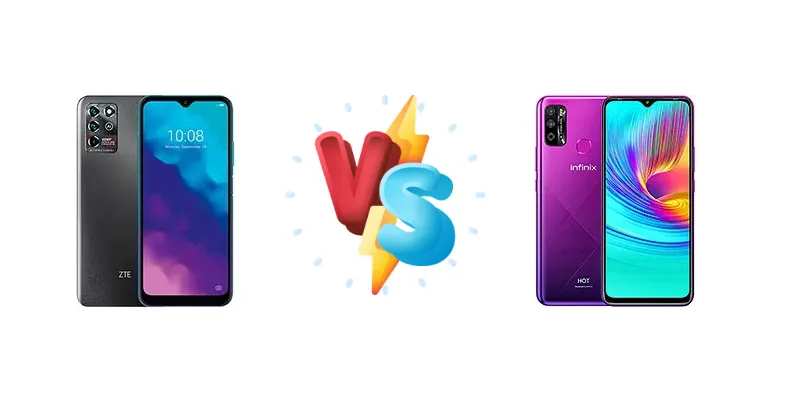
Looking for an affordable smartphone that doesn't completely break the bank? The ZTE Blade V30 Vita and Infinix Hot 9 Play are both contenders in the budget phone arena. But which one offers the best bang for your buck? Let's dive into a detailed comparison.
🏆 Quick Verdict
The Infinix Hot 9 Play edges out the ZTE Blade V30 Vita thanks to its more versatile chipset options and reverse charging capability. While both are budget-friendly, the Hot 9 Play provides slightly better performance and added convenience, making it the overall winner for most users.
| Network |
|---|
| 2G bands | GSM 850 / 900 / 1800 / 1900 | GSM 850 / 900 / 1800 / 1900 |
| 3G bands | HSDPA 850 / 1700(AWS) / 1900 - Mexico | HSDPA 850 / 900 / 1700(AWS) / 1900 / 2100 |
| 4G bands | 1, 2, 4, 5, 7, 26, 28, 66 - Mexico | 1, 2, 3, 4, 5, 7, 8, 20, 38, 40, 41 |
| Speed | HSPA, LTE | HSPA 42.2/5.76 Mbps, LTE Cat4 150/50 Mbps |
| Technology | GSM / HSPA / LTE | GSM / HSPA / LTE |
| Launch |
|---|
| Announced | 2021, July 16 | 2020, April 09. Released 2020, April 09 |
| Status | Available. Released 2021, August 16 | Discontinued |
| Body |
|---|
| Build | - | Glass front, plastic back, plastic frame |
| Dimensions | 173 x 78.1 x 8.9 mm (6.81 x 3.07 x 0.35 in) | 171.8 x 78 x 8.9 mm (6.76 x 3.07 x 0.35 in) |
| SIM | Nano-SIM + Nano-SIM | Nano-SIM + Nano-SIM |
| Weight | 210 g (7.41 oz) | 209 g (7.37 oz) |
| Display |
|---|
| Protection | - | Corning Gorilla Glass 3 |
| Resolution | 720 x 1640 pixels, 3:2 ratio (~288 ppi density) | 720 x 1640 pixels (~263 ppi density) |
| Size | 6.82 inches, 137.8 cm2 (~102.0% screen-to-body ratio) | 6.82 inches, 110.5 cm2 (~82.4% screen-to-body ratio) |
| Type | IPS LCD | IPS LCD |
| Platform |
|---|
| CPU | Octa-core 1.6 GHz | Quad-core 2.0 GHz Cortex-A53 - 32/2GBOcta-core (4x1.8 GHz Cortex-A53 & 4x1.5 GHz Cortex-A53) - 32/3GB, 64/3-4GB |
| Chipset | - | Mediatek MT6761 Helio A22 (12 nm) - 32/2GBMediatek MT6762D Helio A25 (12 nm) - 32/3GB, 64/3-4GB |
| GPU | - | PowerVR GE8300PowerVR GE8320 |
| OS | Android 11 | Android 9.0 Pie (Go edition) - 32/2GBAndroid 9.0 (Pie) - 32/3GB, 64/3-4GB |
| Memory |
|---|
| Card slot | microSDXC | microSDXC (dedicated slot) |
| Internal | 128GB 3GB RAM | 32GB 2GB RAM, 32GB 3GB RAM, 64GB 3GB RAM, 64GB 4GB RAM |
| | - | eMMC 5.1 |
| Main Camera |
|---|
| Dual | - | 13 MP, (wide), 1/3.1", 1.12µm, AF
Auxiliary lens |
| Features | LED flash, HDR, panorama | Triple-LED flash, panorama, HDR |
| Single | 8 MP, f/2.0, (wide) | 13 MP, AF |
| Triple | 48 MP, f/1.8, 26mm (wide), PDAF
5 MP (macro)
Auxiliary lens | - |
| Video | 1080p@30fps | 1080p@30fps |
| Selfie camera |
|---|
| Single | 8 MP, f/2.0, (wide) | 8 MP, (wide) |
| Video | - | 1080p@30fps |
| Sound |
|---|
| 3.5mm jack | Yes | Yes |
| 35mm jack | Yes | Yes |
| Loudspeaker | Yes | Yes |
| Comms |
|---|
| Bluetooth | 4.2, A2DP | 5.0, A2DP, LE |
| NFC | No | No |
| Positioning | GPS | GPS |
| Radio | Unspecified | FM radio |
| USB | USB Type-C 2.0 | microUSB 2.0, OTG |
| WLAN | Wi-Fi 802.11 b/g/n/ac | Wi-Fi 802.11 a/b/g/n/ac, dual-band, Wi-Fi Direct |
| Features |
|---|
| Sensors | Fingerprint (side-mounted), accelerometer, proximity | Fingerprint (rear-mounted), accelerometer, gyro, proximity, compass |
| Battery |
|---|
| Charging | - | 10W wired
Reverse wired |
| Stand-by | - | Up to 750 h |
| Talk time | - | Up to 25 h |
| Type | Li-Po 5000 mAh | 6000 mAh |
| Misc |
|---|
| Colors | Black, Blue, Green | Midnight Black, Quetzal Cyan, Violet, Ocean Wave |
| Models | 8030 | X680, X680B, X680C |
| Price | - | About 100 EUR |
| SAR EU | - | 0.35 W/kg (head) |
ZTE Blade V30 Vita
- Potentially more modern design
- Clean user interface
- Adequate performance for basic tasks
- Less powerful processor
- No reverse charging
- Limited chipset options
Infinix Hot 9 Play
- More powerful chipset options (Helio A22/A25)
- Reverse wired charging
- Wider range of RAM/storage configurations
- Generally better performance
- Older chipset architecture
- Potentially less refined design
Display Comparison
Both phones feature large displays, likely around 6.5 inches, with HD+ resolution. Expect decent viewing angles but don't anticipate vibrant colors or high brightness. The ZTE might have a slightly more modern panel, but the difference will be minimal in everyday use.
Camera Comparison
Camera specs are likely similar – expect a primary rear camera around 13MP with a few secondary lenses for depth sensing or macro shots. Image quality will be adequate in good lighting conditions, but low-light performance will be a challenge on both devices. Infinix might have a slight edge due to potentially better software processing.
Performance
Here's where the Infinix Hot 9 Play has an advantage. The Mediatek Helio A22/A25 chipsets, even though older, offer more processing power than the ZTE's single Octa-core 1.6 GHz processor. Expect smoother multitasking and slightly better gaming performance on the Infinix. The ZTE will handle basic tasks adequately.
Battery Life
Both phones boast large batteries, likely around 5000mAh. Expect all-day battery life with moderate usage. The Infinix Hot 9 Play's reverse charging feature is a significant advantage, allowing you to charge other devices in a pinch.
Buying Guide
Who should buy the ZTE Blade V30 Vita? Users prioritizing a clean, simple interface and a potentially slightly more modern design. Who should buy the Infinix Hot 9 Play? Those seeking a bit more processing power, reverse charging, and a wider range of RAM/storage configurations.
Frequently Asked Questions
❓ What is the difference between the Mediatek Helio A22 and A25 chipsets?
The Helio A25 is a slightly improved version of the A22, offering a bit more processing power and efficiency. Both are entry-level chipsets, but the A25 generally performs better.
❓ Can I play demanding games on either of these phones?
Neither phone is ideal for demanding games. You'll be able to play less intensive games at lower settings. The Infinix Hot 9 Play will offer a slightly better experience due to its more powerful chipset.