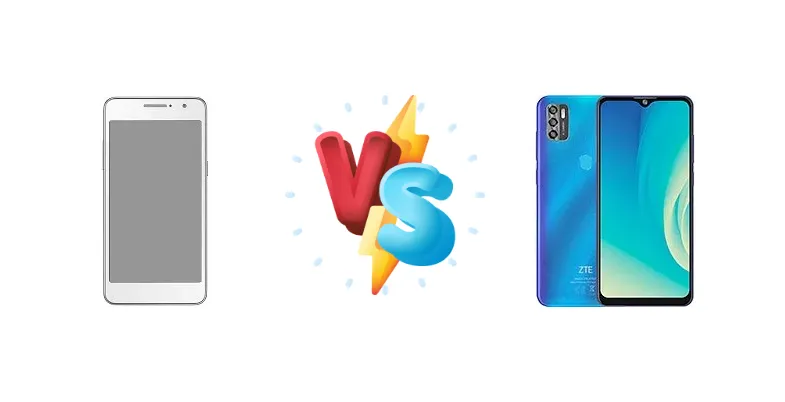
The ZTE Blade V20 and Blade A7s 2020 represent ZTE’s commitment to the affordable smartphone market. While both aim to deliver essential functionality at a low price point, they differ significantly in their internal hardware, particularly in processing power and efficiency. This comparison dissects these differences to help you determine which device best suits your needs.
🏆 Quick Verdict
For most users, the ZTE Blade V20 is the superior choice. Its octa-core 2.0 GHz CPU offers a substantial performance advantage over the Blade A7s 2020’s Unisoc SC9863A, translating to a smoother user experience and better app responsiveness. The 18W charging is also a welcome addition.
| Network |
|---|
| 2G bands | GSM 850 / 900 / 1800 / 1900 | GSM 850 / 900 / 1800 / 1900 |
| 3G bands | HSDPA 850 / 900 / 1900 / 2100 | HSDPA 850 / 900 / 1900 / 2100 |
| 4G bands | LTE | 1, 3, 7, 8, 28 |
| Speed | HSPA, LTE | HSPA 42.2/5.76 Mbps, LTE Cat4 150/50 Mbps |
| Technology | GSM / HSPA / LTE | GSM / HSPA / LTE |
| | - | HSDPA 850 / 2100 |
| Launch |
|---|
| Announced | Not announced yet | 2020, November 03. Released 2020, November 03 |
| Status | Cancelled | Discontinued |
| Body |
|---|
| Dimensions | - | 164.7 x 77.4 x 8.2 mm (6.48 x 3.05 x 0.32 in) |
| SIM | Nano-SIM + Nano-SIM | Nano-SIM + Nano-SIM |
| Weight | - | 182 g (6.42 oz) |
| Display |
|---|
| Resolution | 720 x 1560 pixels, 19.5:9 ratio (~282 ppi density) | 720 x 1560 pixels, 19.5:9 ratio (~264 ppi density) |
| Size | 6.1 inches, 91.3 cm2 | 6.5 inches, 103.7 cm2 (~81.4% screen-to-body ratio) |
| Type | IPS LCD | IPS LCD |
| Platform |
|---|
| CPU | Octa-core 2.0 GHz | Octa-core (4x1.6 GHz Cortex-A55 & 4x1.2 GHz Cortex-A55) |
| Chipset | - | Unisoc SC9863A (28 nm) |
| GPU | - | IMG8322 |
| OS | Android 9.0 (Pie), MiFavor 9.0 | Android 10 |
| Memory |
|---|
| Card slot | microSDXC | microSDXC |
| Internal | 64GB 4GB RAM | 64GB 3GB RAM |
| | - | eMMC 5.1 |
| Main Camera |
|---|
| Features | LED flash, HDR, panorama | LED flash, HDR, panorama |
| Triple | 16 MP, PDAF
8 MP, (ultrawide)
Auxiliary lens | 16 MP, (wide), AF
8 MP, f/2.2, 120˚, 16mm (ultrawide)
Auxiliary lens |
| Video | 1080p@30fps | 1080p@30fps |
| Selfie camera |
|---|
| Features | LED flash | - |
| Single | 5 MP | 8 MP |
| Video | - | 1080p@30fps |
| Sound |
|---|
| 3.5mm jack | Yes | Yes |
| 35mm jack | Yes | Yes |
| Loudspeaker | Yes | Yes |
| Comms |
|---|
| Bluetooth | 4.2, A2DP, LE | 4.2, A2DP |
| NFC | No | Yes |
| Positioning | GPS, GLONASS | GPS |
| Radio | FM radio | FM radio |
| USB | USB Type-C | Yes |
| WLAN | Wi-Fi 802.11 b/g/n/ac, Wi-Fi Direct | Wi-Fi 802.11 b/g/n, Wi-Fi Direct |
| Features |
|---|
| Sensors | Fingerprint (rear-mounted), accelerometer, proximity, compass | Fingerprint (rear-mounted), accelerometer, proximity |
| Battery |
|---|
| Charging | 18W wired | - |
| Type | Li-Po 5000 mAh, non-removable | Li-Ion 4000 mAh |
| Misc |
|---|
| Colors | Black, Blue | Black, Blue |
| Models | V1050 | A7020 |
| Price | - | About 120 EUR |
ZTE Blade V20
- Faster CPU for smoother performance
- 18W fast charging for quicker top-ups
- Potentially improved image processing
- Display specifications unknown
- Battery capacity not specified
ZTE Blade A7s 2020
- Lower price point (likely)
- Potentially better battery life due to less powerful CPU
- Functional for basic tasks
- Significantly slower CPU performance
- Slower charging speeds
- Less responsive user experience
Display Comparison
Unfortunately, display specifications are not provided for either device. However, given their market segment, it’s reasonable to expect both utilize LCD panels with 720p+ resolutions. The Blade V20, being a slightly newer model, *may* benefit from improved color calibration or slightly higher peak brightness, but this is speculative. Bezels are likely to be substantial on both devices, reflecting their budget nature.
Camera Comparison
Camera details are limited. Without sensor size or aperture information, a direct comparison is difficult. However, it’s safe to assume both phones feature basic camera setups geared towards casual photography. The presence of a 2MP macro camera on either device is largely a marketing tactic, as image quality will be limited. The Blade V20, being newer, *might* benefit from slightly improved image processing algorithms, but the difference will likely be marginal.
Performance
The core difference lies in the processing power. The ZTE Blade V20’s octa-core CPU clocked at 2.0 GHz represents a significant leap over the Unisoc SC9863A in the Blade A7s 2020. The A7s 2020’s chipset features a split core configuration (4x1.6 GHz Cortex-A55 & 4x1.2 GHz Cortex-A55), indicating a focus on power efficiency rather than raw performance. The 28nm process node of the Unisoc chip is also less efficient than more modern fabrication processes, potentially leading to more heat generation under load. This translates to noticeably slower app launch times and less fluid multitasking on the A7s 2020.
Battery Life
Battery capacity is not specified for either device. However, the Blade V20’s 18W wired charging is a clear advantage. While the A7s 2020 likely supports standard 5W or 10W charging, the 18W support on the V20 will significantly reduce charging times, offering greater convenience for users who rely heavily on their phones throughout the day. A larger battery on the A7s 2020 could offset the slower charging, but without capacity data, it’s impossible to determine.
Buying Guide
Buy the ZTE Blade V20 if you prioritize a responsive user experience, faster app loading times, and quicker charging. This phone is ideal for users who frequently multitask, browse the web, or enjoy casual gaming. Buy the ZTE Blade A7s 2020 if your primary needs are basic communication – calls, texts, and light social media – and you are on an extremely tight budget where every dollar counts. It’s a functional device for those who don’t demand high performance.
Frequently Asked Questions
❓ Will the Unisoc SC9863A in the Blade A7s 2020 struggle with modern apps?
Yes, the Unisoc SC9863A is a low-end chipset designed for basic tasks. While it can handle calls, texts, and light social media, you may experience noticeable lag and slowdowns when running more demanding apps or multitasking.
❓ How long will it take to fully charge the ZTE Blade V20 with the 18W charger?
Without knowing the battery capacity, it's difficult to provide an exact time. However, 18W charging will likely take between 1.5 to 2.5 hours for a full charge, significantly faster than the Blade A7s 2020's likely 5W or 10W charging.
❓ Is the ZTE Blade A7s 2020 suitable for playing mobile games?
The ZTE Blade A7s 2020 is not ideal for gaming. The Unisoc SC9863A lacks the graphical power to run most modern games smoothly, even at low settings. Expect significant frame rate drops and lag.