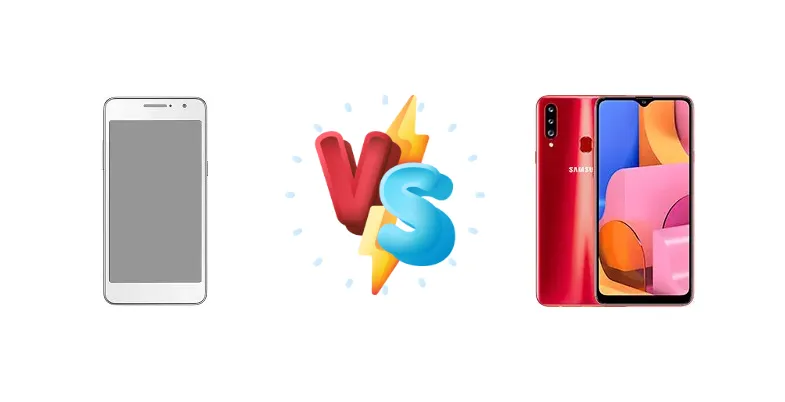
The ZTE Blade V20 and Samsung Galaxy A20s represent compelling options in the ultra-budget smartphone segment. While both aim to deliver essential smartphone functionality at an accessible price point, they diverge significantly in their internal hardware, particularly in processing power and charging capabilities. This comparison dissects these differences to help you determine which device best suits your needs.
🏆 Quick Verdict
For the average user prioritizing responsiveness and quicker charging, the ZTE Blade V20 emerges as the better choice. Its 2.0 GHz octa-core CPU offers a noticeable performance advantage over the Samsung Galaxy A20s’ Snapdragon 450, and the 18W charging provides a faster top-up time, making it ideal for those on the go.
| Network |
|---|
| 2G bands | GSM 850 / 900 / 1800 / 1900 | GSM 850 / 900 / 1800 / 1900 |
| 3G bands | HSDPA 850 / 900 / 1900 / 2100 | HSDPA 850 / 900 / 1900 / 2100 - SM-A207F/DS |
| 4G bands | LTE | 1, 2, 3, 5, 7, 8, 20, 28, 34, 38, 39, 40, 41 - SM-A207F/DS |
| Speed | HSPA, LTE | HSPA, LTE |
| Technology | GSM / HSPA / LTE | GSM / HSPA / LTE |
| | - | 1, 2, 3, 4, 5, 7, 8, 12, 13, 17, 20, 28, 38, 40, 41, 66 - SM-A207M/DS |
| Launch |
|---|
| Announced | Not announced yet | 2019, September 24. Released 2019, October 05 |
| Status | Cancelled | Discontinued |
| Body |
|---|
| Build | - | Glass front, plastic back, plastic frame |
| Dimensions | - | 163.3 x 77.5 x 8 mm (6.43 x 3.05 x 0.31 in) |
| SIM | Nano-SIM + Nano-SIM | · Nano-SIM· Nano-SIM + Nano-SIM |
| Weight | - | 183 g (6.46 oz) |
| Display |
|---|
| Resolution | 720 x 1560 pixels, 19.5:9 ratio (~282 ppi density) | 720 x 1560 pixels, 19.5:9 ratio (~264 ppi density) |
| Size | 6.1 inches, 91.3 cm2 | 6.5 inches, 103.7 cm2 (~81.9% screen-to-body ratio) |
| Type | IPS LCD | IPS LCD |
| Platform |
|---|
| CPU | Octa-core 2.0 GHz | Octa-core 1.8 GHz Cortex-A53 |
| Chipset | - | Qualcomm SDM450 Snapdragon 450 (14 nm) |
| GPU | - | Adreno 506 |
| OS | Android 9.0 (Pie), MiFavor 9.0 | Android 9.0 (Pie), upgradable to Android 11, One UI Core 3.1 |
| Memory |
|---|
| Card slot | microSDXC | microSDXC (dedicated slot) |
| Internal | 64GB 4GB RAM | 32GB 2GB RAM, 32GB 3GB RAM, 64GB 4GB RAM |
| | - | eMMC 5.1 |
| Main Camera |
|---|
| Features | LED flash, HDR, panorama | LED flash, panorama, HDR |
| Triple | 16 MP, PDAF
8 MP, (ultrawide)
Auxiliary lens | 13 MP, f/1.8, 27mm (wide), PDAF
8 MP, f/2.2, 13mm (ultrawide), 1/4.0", 1.12µm
Auxiliary lens |
| Video | 1080p@30fps | 1080p@30fps |
| Selfie camera |
|---|
| Features | LED flash | - |
| Single | 5 MP | 8 MP, f/2.0 |
| Video | - | 1080p@30fps |
| Sound |
|---|
| 3.5mm jack | Yes | Yes |
| 35mm jack | Yes | Yes |
| Loudspeaker | Yes | Yes |
| Comms |
|---|
| Bluetooth | 4.2, A2DP, LE | 4.2, A2DP, LE |
| NFC | No | No |
| Positioning | GPS, GLONASS | GPS, GLONASS, GALILEO, BDS |
| Radio | FM radio | FM radio |
| USB | USB Type-C | USB Type-C 2.0 |
| WLAN | Wi-Fi 802.11 b/g/n/ac, Wi-Fi Direct | Wi-Fi 802.11 b/g/n, Wi-Fi Direct |
| Features |
|---|
| Sensors | Fingerprint (rear-mounted), accelerometer, proximity, compass | Fingerprint (rear-mounted), accelerometer, gyro, proximity, compass |
| Battery |
|---|
| Charging | 18W wired | 15W wired |
| Type | Li-Po 5000 mAh, non-removable | Li-Po 4000 mAh, non-removable |
| Misc |
|---|
| Colors | Black, Blue | Black, Blue, Red, Green |
| Models | V1050 | SM-A207F, SM-A207M, SM-A2070 |
| Price | - | About 250 EUR |
| SAR | - | 0.69 W/kg (head) 1.43 W/kg (body) |
| SAR EU | - | 0.35 W/kg (head) 0.83 W/kg (body) |
ZTE Blade V20
- Faster CPU for improved performance
- Faster 18W wired charging
- Potentially better value for money
- Brand recognition may be lower than Samsung
- Software updates may be less frequent
Samsung Galaxy A20s
- Established brand reputation
- Potentially more refined software experience
- Wide availability
- Slower Snapdragon 450 processor
- Slower 15W wired charging
- May feel sluggish with demanding apps
Display Comparison
Neither device boasts a standout display. Given the context data focuses on processing and charging, we can infer both likely utilize LCD panels common in this price bracket. The absence of specifications like resolution or refresh rate suggests a focus on cost optimization over visual fidelity. Bezels are likely substantial on both, and color accuracy will be standard for the segment. The user experience will likely be similar in terms of display quality.
Camera Comparison
Without detailed camera specifications, a direct comparison is difficult. However, it’s safe to assume both phones feature basic camera setups geared towards casual photography. The market segment suggests both will likely include a primary sensor, potentially accompanied by depth or macro lenses of limited utility. Image processing will likely be more aggressive on the Samsung, aiming for vibrant colors, while the ZTE may lean towards a more natural look. The absence of OIS on either device suggests low-light performance will be a weakness.
Performance
The core difference lies in the processing power. The ZTE Blade V20’s octa-core 2.0 GHz CPU represents a significant step up from the Samsung Galaxy A20s’ Qualcomm Snapdragon 450, clocked at 1.8 GHz using Cortex-A53 cores. The Snapdragon 450, built on a 14nm process, is known for its efficiency but limited performance headroom. The Blade V20’s CPU, while lacking specific architectural details, benefits from a higher clock speed, translating to faster app loading times and smoother multitasking. This difference will be most noticeable when switching between applications or running more demanding apps. The Snapdragon 450’s age also means it lacks some of the software optimizations found in newer chipsets.
Battery Life
While battery capacity isn’t specified, the 18W wired charging on the ZTE Blade V20 provides a clear advantage over the Samsung Galaxy A20s’ 15W charging. This 3W difference, while seemingly small, translates to a faster 0-100% charge time, reducing the time spent tethered to a wall outlet. Even with a similar battery capacity, the faster charging speed offers a more convenient user experience, especially for users who frequently find themselves needing a quick power boost.
Buying Guide
Buy the ZTE Blade V20 if you need a phone that feels snappier for everyday tasks like browsing, social media, and light gaming, and if you value faster charging to minimize downtime. Buy the Samsung Galaxy A20s if you prioritize brand recognition and a potentially more refined software experience, and if your usage is primarily limited to basic communication and very light app usage where raw processing power isn't critical.
Frequently Asked Questions
❓ Will the Snapdragon 450 in the Galaxy A20s struggle with modern apps?
The Snapdragon 450 is a relatively old chipset. While it can handle basic tasks like calling, texting, and light social media browsing, it will likely exhibit noticeable lag and slowdowns when running more demanding applications or multitasking heavily. The ZTE Blade V20’s faster CPU should provide a smoother experience.
❓ How much faster is the 18W charging on the ZTE Blade V20 compared to the 15W charging on the Galaxy A20s?
While a 3W difference may not seem significant, it translates to a noticeable reduction in charging time. Expect the ZTE Blade V20 to charge approximately 15-20% faster than the Galaxy A20s, allowing you to get back to using your phone sooner.
❓ Is the ZTE Blade V20 a good option for mobile gaming?
The ZTE Blade V20 is suitable for casual mobile gaming, but don't expect high frame rates or smooth performance in graphically intensive titles. The Snapdragon 450 in the Galaxy A20s will struggle even more with gaming. Both phones are best suited for less demanding games.