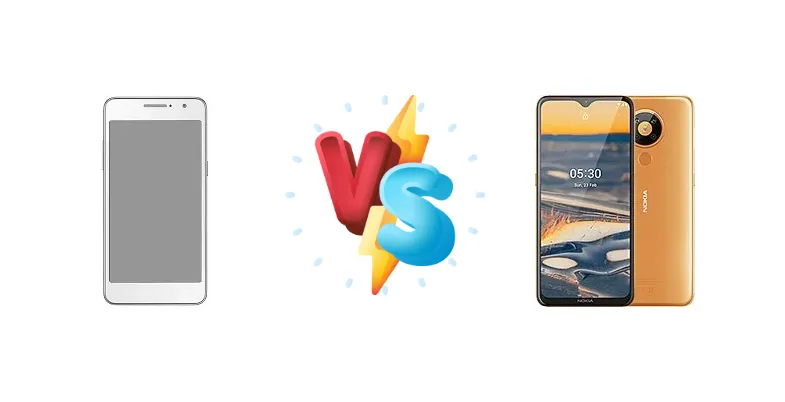
The ZTE Blade V20 and Nokia 5.3 represent compelling options in the sub-$200 smartphone market. While both aim to deliver essential features at an accessible price, they take different approaches to performance and charging. This comparison dissects their key specifications to determine which device best suits your needs.
🏆 Quick Verdict
For most users, the ZTE Blade V20 emerges as the stronger choice. Its 2.0 GHz octa-core processor offers a potential performance edge over the Nokia 5.3’s Snapdragon 665, and the 18W charging significantly reduces downtime compared to the Nokia’s slower 10W charging. However, Nokia’s software experience may appeal to those prioritizing a clean Android interface.
| Network |
|---|
| 2G bands | GSM 850 / 900 / 1800 / 1900 | GSM 850 / 900 / 1800 / 1900 |
| 3G bands | HSDPA 850 / 900 / 1900 / 2100 | HSDPA 850 / 900 / 1900 / 2100 - Global |
| 4G bands | LTE | 1, 3, 5, 7, 8, 20, 28, 38, 40, 41 - Global |
| Speed | HSPA, LTE | HSPA 42.2/5.76 Mbps, LTE Cat4 150/50 Mbps |
| Technology | GSM / HSPA / LTE | GSM / HSPA / LTE |
| | - | 1, 3, 5, 8, 40, 41 - India |
| Launch |
|---|
| Announced | Not announced yet | 2020, March 19. Released 2020, April 02 |
| Status | Cancelled | Discontinued |
| Body |
|---|
| Build | - | Glass front (Gorilla Glass 3), plastic back, plastic frame |
| Dimensions | - | 164.3 x 76.6 x 8.5 mm (6.47 x 3.02 x 0.33 in) |
| SIM | Nano-SIM + Nano-SIM | · Nano-SIM· Nano-SIM + Nano-SIM |
| Weight | - | 185 g (6.53 oz) |
| Display |
|---|
| Protection | - | Corning Gorilla Glass 3 |
| Resolution | 720 x 1560 pixels, 19.5:9 ratio (~282 ppi density) | 720 x 1600 pixels, 20:9 ratio (~268 ppi density) |
| Size | 6.1 inches, 91.3 cm2 | 6.55 inches, 103.6 cm2 (~82.3% screen-to-body ratio) |
| Type | IPS LCD | IPS LCD, 450 nits (typ) |
| Platform |
|---|
| CPU | Octa-core 2.0 GHz | Octa-core (4x2.0 GHz Kryo 260 Gold & 4x1.8 GHz Kryo 260 Silver) |
| Chipset | - | Qualcomm SM6125 Snapdragon 665 (11 nm) |
| GPU | - | Adreno 610 |
| OS | Android 9.0 (Pie), MiFavor 9.0 | Android 10, upgradable to Android 11, Android One |
| Memory |
|---|
| Card slot | microSDXC | microSDXC (dedicated slot) |
| Internal | 64GB 4GB RAM | 64GB 3GB RAM, 64GB 4GB RAM, 64GB 6GB RAM, 128GB 4GB RAM |
| | - | eMMC 5.1 |
| Main Camera |
|---|
| Features | LED flash, HDR, panorama | LED flash, HDR, panorama |
| Quad | - | 13 MP, f/1.8, (wide), PDAF
5 MP, 13mm (ultrawide)
2 MP (macro)
Auxiliary lens |
| Triple | 16 MP, PDAF
8 MP, (ultrawide)
Auxiliary lens | - |
| Video | 1080p@30fps | 4K@30fps, 1080p@30fps |
| Selfie camera |
|---|
| Features | LED flash | - |
| Single | 5 MP | 8 MP, f/2.0, (wide) |
| Video | - | 1080p@30fps |
| Sound |
|---|
| 3.5mm jack | Yes | Yes |
| 35mm jack | Yes | Yes |
| Loudspeaker | Yes | Yes |
| Comms |
|---|
| Bluetooth | 4.2, A2DP, LE | 4.2, A2DP, LE, aptX |
| NFC | No | Yes |
| Positioning | GPS, GLONASS | GPS, GLONASS, BDS |
| Radio | FM radio | FM radio |
| USB | USB Type-C | USB Type-C 2.0, OTG |
| WLAN | Wi-Fi 802.11 b/g/n/ac, Wi-Fi Direct | Wi-Fi 802.11 b/g/n/ac, Wi-Fi Direct |
| Features |
|---|
| Sensors | Fingerprint (rear-mounted), accelerometer, proximity, compass | Fingerprint (rear-mounted), accelerometer, proximity |
| Battery |
|---|
| Charging | 18W wired | 10W wired |
| Type | Li-Po 5000 mAh, non-removable | Li-Po 4000 mAh |
| Misc |
|---|
| Colors | Black, Blue | Cyan, Sand, Charcoal |
| Models | V1050 | TA-1234, TA-1223, TA-1227, TA-1229 |
| Price | - | About 290 EUR |
| SAR | - | 1.03 W/kg (head) 0.95 W/kg (body) |
| SAR EU | - | 0.70 W/kg (head) 1.39 W/kg (body) |
ZTE Blade V20
- Potentially faster processor for smoother multitasking
- Significantly faster 18W charging
- Likely more competitive price
- Software updates may be less frequent
- Unknown camera performance
Nokia 5.3
- Qualcomm Snapdragon 665 offers good efficiency
- Clean Android experience with potential for guaranteed updates
- Reputable brand known for reliability
- Slower 10W charging
- Potentially less powerful processor for demanding tasks
Display Comparison
Neither device’s display specifications are provided, so a direct comparison is limited. However, given the price point, both likely utilize LCD panels. Nokia historically focuses on color accuracy, while ZTE often prioritizes maximizing screen real estate. Users should expect 720p resolution at best, and potential differences in viewing angles and brightness will be noticeable. The absence of high refresh rates is expected in this segment.
Camera Comparison
Without detailed camera specifications, a precise comparison is difficult. Both phones likely feature a multi-camera setup, but the quality will heavily depend on sensor size and image processing. It’s reasonable to assume both will include a primary sensor, an ultrawide, and potentially a depth or macro lens. Given the market segment, image quality will be adequate for social media sharing but will struggle in low-light conditions. The absence of Optical Image Stabilization (OIS) is expected on both devices.
Performance
The Nokia 5.3’s Qualcomm Snapdragon 665 (11nm) employs a hybrid CPU architecture with 4x2.0 GHz Kryo 260 Gold and 4x1.8 GHz Kryo 260 Silver cores. This contrasts with the ZTE Blade V20’s octa-core 2.0 GHz processor, where the core configuration is unspecified. The Snapdragon 665 benefits from Qualcomm’s optimized power efficiency and Adreno 610 GPU, providing a balanced experience. While clock speed isn’t everything, the ZTE’s consistently higher 2.0 GHz across all cores *suggests* a potential advantage in multi-threaded tasks, though real-world performance will depend on the chipset’s architecture and thermal management. The 11nm process node of the Snapdragon 665 also contributes to better efficiency.
Battery Life
Battery capacity isn’t specified for either device. However, the ZTE Blade V20’s 18W wired charging offers a significant advantage over the Nokia 5.3’s 10W charging. This translates to substantially faster charging times, reducing the time spent tethered to a power outlet. Even with a similar battery capacity, the ZTE will likely offer more usable time due to quicker top-ups. The Snapdragon 665’s efficiency may partially offset the charging disparity, but the ZTE’s faster charging remains a key benefit.
Buying Guide
Buy the ZTE Blade V20 if you prioritize responsiveness for everyday tasks and quicker charging to minimize downtime. This phone is ideal for users who frequently stream videos, browse the web, or play casual games. Buy the Nokia 5.3 if you value a streamlined Android experience with guaranteed updates and a focus on software simplicity, even if it means sacrificing some raw processing power and charging speed.
Frequently Asked Questions
❓ Is the ZTE Blade V20’s processor powerful enough for playing games like PUBG Mobile?
While the ZTE Blade V20’s octa-core 2.0 GHz processor is capable of running PUBG Mobile, expect to play at medium settings to maintain a stable frame rate. The lack of a dedicated GPU specification suggests it won’t match the performance of devices with more powerful Adreno GPUs.
❓ How long will it take to fully charge the Nokia 5.3 with its 10W charger?
With a 10W charger, fully charging the Nokia 5.3 will likely take between 2.5 to 3.5 hours, depending on the battery capacity. This is considerably slower than the ZTE Blade V20’s 18W charging, which could potentially achieve a full charge in under 2 hours.
❓ Does the Nokia 5.3 receive regular Android updates?
Nokia is known for providing relatively timely Android updates, even on its budget devices. The Nokia 5.3 is likely to receive at least one major Android version update and regular security patches, offering a longer software support lifespan compared to some other brands in this price range.