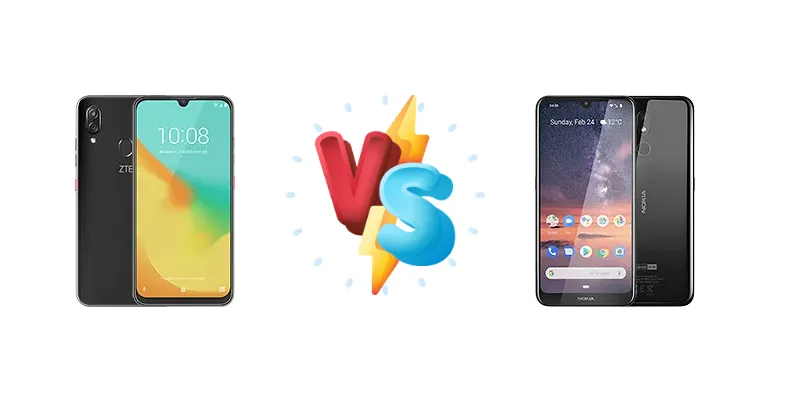
The ZTE Blade V10 Vita and Nokia 3.2 represent the lower end of the Android smartphone market, targeting users prioritizing affordability. However, they take different approaches to achieving that price point, particularly in their core processing power. This comparison dissects the key differences between the Unisoc-powered ZTE and the Qualcomm-equipped Nokia to determine which offers the best value.
🏆 Quick Verdict
For the average user, the Nokia 3.2 is the better choice. While the ZTE Blade V10 Vita boasts an octa-core CPU, the Nokia 3.2’s Snapdragon 429, built on a smaller 12nm process, delivers more consistent performance and better power efficiency, resulting in a smoother user experience and potentially longer battery life.
| Network |
|---|
| 2G bands | GSM 850 / 900 / 1800 / 1900 | GSM 850 / 900 / 1800 / 1900 |
| 3G bands | HSDPA 850 / 900 / 1900 / 2100 | HSDPA 850 / 900 / 2100 |
| 4G bands | 1, 3, 5, 7, 8, 20, 38 | 1, 3, 5, 7, 8, 20, 28, 38, 40 - EMEA, APAC, MENA |
| Speed | HSPA 42.2/5.76 Mbps, LTE Cat4 150/50 Mbps | HSPA 42.2/5.76 Mbps, LTE Cat4 150/50 Mbps |
| Technology | GSM / HSPA / LTE | GSM / HSPA / LTE |
| | - | 1, 3, 5, 8, 40, 41 - India |
| Launch |
|---|
| Announced | 2019, February. Released 2019, March | 2019, February 24. Released 2019, May 22 |
| Status | Discontinued | Discontinued |
| Body |
|---|
| Build | - | Glass front, plastic back, plastic frame |
| Dimensions | 157.1 x 75.8 x 8.1 mm (6.19 x 2.98 x 0.32 in) | 159.4 x 76.2 x 8.6 mm (6.28 x 3.00 x 0.34 in) |
| SIM | Nano-SIM + Nano-SIM | Nano-SIM + Nano-SIM |
| Weight | 150 g (5.29 oz) | 181 g (6.38 oz) |
| Display |
|---|
| Resolution | 720 x 1520 pixels, 19:9 ratio (~269 ppi density) | 720 x 1520 pixels, 19:9 ratio (~269 ppi density) |
| Size | 6.26 inches, 97.8 cm2 (~82.1% screen-to-body ratio) | 6.26 inches, 97.8 cm2 (~80.5% screen-to-body ratio) |
| Type | IPS LCD | IPS LCD |
| Platform |
|---|
| CPU | Octa-core (4x1.6 GHz Cortex-A55 & 4x1.2 GHz Cortex-A55) | Quad-core 1.8 GHz Cortex-A53 |
| Chipset | Unisoc SC9863A (28 nm) | Qualcomm SDM429 Snapdragon 429 (12 nm) |
| GPU | IMG8322 | Adreno 504 |
| OS | Android 9.0 (Pie) | Android 9.0 (Pie), upgradable to Android 11, Android One |
| Memory |
|---|
| Card slot | microSDXC (uses shared SIM slot) | microSDXC (dedicated slot) |
| Internal | 32GB 2GB RAM, 64GB 3GB RAM | 16GB 2GB RAM, 32GB 3GB RAM, 64GB 3GB RAM |
| | - | eMMC 5.1 |
| Main Camera |
|---|
| Dual | 13 MP, f/2.0, AF
Auxiliary lens | - |
| Features | LED flash, HDR | LED flash |
| Single | - | 13 MP, f/2.2, 1/3.1", 1.12µm, AF |
| Video | 1080p@30fps | 1080p@30fps |
| Selfie camera |
|---|
| Single | 8 MP, f/2.0 | 5 MP, f/2.2, 27mm (wide), 1/5.0", 1.12µm |
| Sound |
|---|
| 3.5mm jack | Yes | Yes |
| 35mm jack | Yes | Yes |
| Loudspeaker | Yes | Yes |
| Comms |
|---|
| Bluetooth | 4.2, A2DP, LE | 4.2, A2DP, LE, aptX |
| NFC | Yes (64/3GB model only) | No |
| Positioning | GPS, GLONASS | GPS, GLONASS, BDS |
| Radio | FM radio | FM radio |
| USB | microUSB 2.0, OTG | microUSB 2.0, OTG |
| WLAN | Wi-Fi 802.11 b/g/n, Wi-Fi Direct | Wi-Fi 802.11 b/g/n |
| Features |
|---|
| Sensors | Fingerprint (rear-mounted), accelerometer, gyro, proximity, compass | Fingerprint (rear-mounted, 32/3GB only), accelerometer, proximity |
| Battery |
|---|
| Charging | - | 10W wired |
| Type | Li-Ion 3200 mAh, non-removable | Li-Ion 4000 mAh, non-removable |
| Misc |
|---|
| Colors | Black, Green | Black, Steel |
| Models | - | TA-1156, TA-1159, TA-1164 |
| Price | - | About 140 EUR |
| SAR EU | - | 0.24 W/kg (head) 1.63 W/kg (body) |
ZTE Blade V10 Vita
- Octa-core processor (on paper)
- Potentially lower price (depending on retailer)
- May offer slightly more RAM in some configurations
- Less efficient 28nm chipset
- Likely slower real-world performance
- Potential for thermal throttling
Nokia 3.2
- More efficient 12nm Snapdragon 429
- Smoother user experience
- Better power management
- 10W wired charging
- Quad-core processor
- May be slightly more expensive
- Limited RAM options
Display Comparison
Neither device is expected to deliver a stunning visual experience. Details regarding display resolution and panel type are missing, but both likely utilize LCD panels common in this price bracket. The focus here is on the underlying processing power, as display performance is less impacted by the chipset. Bezels are likely substantial on both devices, contributing to a dated aesthetic.
Camera Comparison
Camera performance is unlikely to be a strong suit for either device. Details regarding sensor sizes and image processing capabilities are unavailable. However, given the price point, both likely feature basic camera setups focused on capturing acceptable images in good lighting conditions. The presence of a 2MP macro camera on either device is largely a marketing gimmick, offering minimal practical benefit due to the low resolution and lack of optical image stabilization (OIS).
Performance
The core difference lies in the chipsets. The ZTE Blade V10 Vita’s Unisoc SC9863A features an octa-core configuration, split between four Cortex-A55 cores at 1.6 GHz and four at 1.2 GHz. While eight cores sound impressive, the Unisoc chip is fabricated on a larger 28nm process. This older node results in higher power consumption and potentially more heat generation. Conversely, the Nokia 3.2 utilizes the Qualcomm Snapdragon 429, a quad-core processor with Cortex-A53 cores clocked at 1.8 GHz. Crucially, the Snapdragon 429 is built on a more efficient 12nm process. This smaller node translates to better thermal management and improved power efficiency, even with fewer cores. The Snapdragon 429’s architecture, while older, is generally more optimized for everyday tasks than the Unisoc SC9863A, leading to a snappier user experience.
Battery Life
Battery capacity details are missing for both devices. However, the Nokia 3.2 benefits from the Snapdragon 429’s superior power efficiency. While the ZTE Blade V10 Vita might have a slightly larger battery, the Unisoc chip’s higher power draw will likely negate any capacity advantage. The Nokia 3.2 also supports 10W wired charging, which, while slow by modern standards, will be sufficient for overnight charging and topping up throughout the day. The ZTE Blade V10 Vita’s charging speed is unknown, but likely comparable.
Buying Guide
Buy the ZTE Blade V10 Vita if you prioritize having a higher core count on paper and anticipate primarily using the phone for very light tasks like basic messaging and calls. Buy the Nokia 3.2 if you value a more responsive user interface, slightly better app loading times, and a more efficient chipset that won't struggle as much with multitasking or moderately demanding apps. The Nokia 3.2 is also a better choice for those who prefer a cleaner Android experience.
Frequently Asked Questions
❓ Will the ZTE Blade V10 Vita struggle with multitasking or running multiple apps simultaneously?
Yes, the Unisoc SC9863A’s less efficient architecture and larger process node mean it’s more likely to experience slowdowns and lag when multitasking compared to the Nokia 3.2’s Snapdragon 429. The Snapdragon 429, despite having fewer cores, is better optimized for handling multiple tasks concurrently.
❓ Is the 10W charging on the Nokia 3.2 significantly slow compared to other smartphones?
Yes, 10W charging is relatively slow by today’s standards. However, for a budget device like the Nokia 3.2, it’s adequate for overnight charging. Expect a full charge to take several hours. The focus with these devices is on maximizing battery life rather than rapid charging speeds.
❓ Does the ZTE Blade V10 Vita's octa-core processor actually translate to faster performance in real-world use?
Not necessarily. While an octa-core processor sounds impressive, the Unisoc SC9863A’s older 28nm process and less efficient architecture mean it often underperforms compared to the quad-core Snapdragon 429 in the Nokia 3.2. Core count isn't everything; architecture and process node play a crucial role.