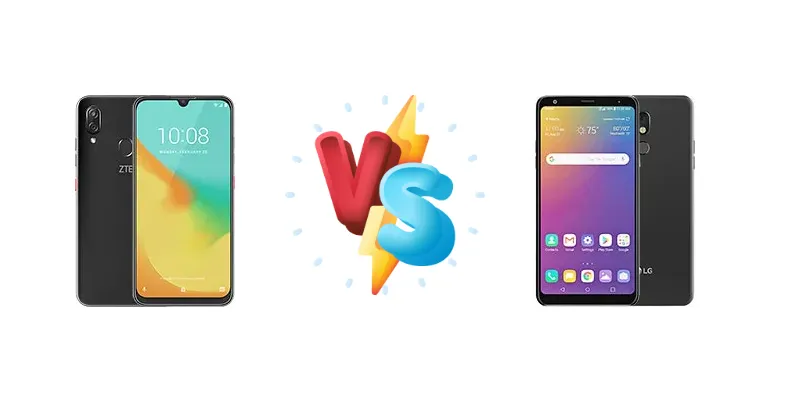
The ZTE Blade V10 Vita and LG Stylo 5 represent two compelling options in the ultra-budget smartphone space. While both aim to deliver essential smartphone functionality at a low price point, they take different approaches to achieving this, particularly in their core processing power and display characteristics. This comparison dissects these differences to help you determine which device best suits your needs.
🏆 Quick Verdict
For the average user prioritizing consistent performance and faster charging, the LG Stylo 5 emerges as the better choice. Its Snapdragon 450 chipset, despite being older, offers a more refined experience than the Unisoc SC9863A, and the 20W charging significantly reduces downtime. However, the V10 Vita may appeal to those seeking the absolute lowest price.
| Network |
|---|
| 2G bands | GSM 850 / 900 / 1800 / 1900 | GSM 850 / 900 / 1800 / 1900 |
| 3G bands | HSDPA 850 / 900 / 1900 / 2100 | HSDPA 850 / 1700(AWS) / 1900 |
| 4G bands | 1, 3, 5, 7, 8, 20, 38 | 2, 4, 5, 12, 14, 29, 30, 66 |
| Speed | HSPA 42.2/5.76 Mbps, LTE Cat4 150/50 Mbps | HSPA, LTE |
| Technology | GSM / HSPA / LTE | GSM / HSPA / LTE |
| Launch |
|---|
| Announced | 2019, February. Released 2019, March | 2019, June. Released 2019, June |
| Status | Discontinued | Discontinued |
| Body |
|---|
| Build | - | Glass front (Gorilla Glass 5), aluminum back, aluminum frame |
| Dimensions | 157.1 x 75.8 x 8.1 mm (6.19 x 2.98 x 0.32 in) | 160 x 77.7 x 8.4 mm (6.30 x 3.06 x 0.33 in) |
| SIM | Nano-SIM + Nano-SIM | Nano-SIM |
| Weight | 150 g (5.29 oz) | 179 g (6.31 oz) |
| | - | Stylus |
| Display |
|---|
| Protection | - | Corning Gorilla Glass 5 |
| Resolution | 720 x 1520 pixels, 19:9 ratio (~269 ppi density) | 1080 x 2160 pixels, 18:9 ratio (~390 ppi density) |
| Size | 6.26 inches, 97.8 cm2 (~82.1% screen-to-body ratio) | 6.2 inches, 99.2 cm2 (~79.8% screen-to-body ratio) |
| Type | IPS LCD | IPS LCD |
| Platform |
|---|
| CPU | Octa-core (4x1.6 GHz Cortex-A55 & 4x1.2 GHz Cortex-A55) | Octa-core 1.8 GHz Cortex-A53 |
| Chipset | Unisoc SC9863A (28 nm) | Qualcomm SDM450 Snapdragon 450 (14 nm) |
| GPU | IMG8322 | Adreno 506 |
| OS | Android 9.0 (Pie) | Android 9.0 (Pie) |
| Memory |
|---|
| Card slot | microSDXC (uses shared SIM slot) | microSDXC (dedicated slot) |
| Internal | 32GB 2GB RAM, 64GB 3GB RAM | 32GB 3GB RAM |
| | - | eMMC 5.1 |
| Main Camera |
|---|
| Dual | 13 MP, f/2.0, AF
Auxiliary lens | - |
| Features | LED flash, HDR | LED flash, panorama, HDR |
| Single | - | 13 MP, PDAF |
| Video | 1080p@30fps | 1080p@30fps |
| Selfie camera |
|---|
| Dual | - | 16 MP, f/2.0, 26mm (wide), 1/3.06", 1.0µm
8 MP |
| Single | 8 MP, f/2.0 | 5 MP |
| Video | - | 1080p@30fps |
| Sound |
|---|
| 3.5mm jack | Yes | Yes |
| 35mm jack | Yes | Yes |
| Loudspeaker | Yes | Yes |
| Comms |
|---|
| Bluetooth | 4.2, A2DP, LE | 4.2, A2DP, LE |
| NFC | Yes (64/3GB model only) | No |
| Positioning | GPS, GLONASS | GPS |
| Radio | FM radio | No |
| USB | microUSB 2.0, OTG | USB Type-C 2.0 |
| WLAN | Wi-Fi 802.11 b/g/n, Wi-Fi Direct | Wi-Fi 802.11 a/b/g/n/ac, dual-band, Wi-Fi Direct |
| Features |
|---|
| Sensors | Fingerprint (rear-mounted), accelerometer, gyro, proximity, compass | Fingerprint (rear-mounted), accelerometer, proximity |
| Battery |
|---|
| Charging | - | 20W wired |
| Type | Li-Ion 3200 mAh, non-removable | Li-Ion 3500 mAh, non-removable |
| Misc |
|---|
| Colors | Black, Green | Blonde Rose, Platinum Gray |
| Models | - | LM-Q720 |
| Price | - | About 200 EUR |
| Tests |
|---|
| Audio quality | - |
Noise-93.5dB / Crosstalk -92.0dB |
| Battery life | - |
Endurance rating 79h
|
| Camera | - |
Photo / Video |
| Display | - |
Contrast ratio: 1485 (nominal), 3.218 (sunlight) |
| Loudspeaker | - |
Voice 62dB / Noise 69dB / Ring 70dB
|
| Performance | - |
GeekBench: 4695 (v4.4)
GFXBench: 6fps (ES 3.1 onscreen) |
ZTE Blade V10 Vita
- Potentially lower price point
- Functional for basic smartphone tasks
- Acceptable for light usage
- Less efficient Unisoc chipset
- Likely slower performance
- Limited display information suggests lower quality
LG Stylo 5
- More efficient Snapdragon 450 processor
- Faster 20W charging
- Better display contrast ratio for outdoor visibility
- Slightly higher price
- Older chipset architecture
- Camera performance likely average
Display Comparison
The LG Stylo 5 boasts a contrast ratio of 1485 (nominal) and 3.218 (sunlight), suggesting superior visibility in bright outdoor conditions compared to the ZTE Blade V10 Vita, which lacks detailed display specifications. While both likely utilize IPS LCD panels, the Stylo 5’s higher contrast ratio indicates better black levels and a more vibrant image. The absence of detailed display specs for the V10 Vita suggests a more basic panel, potentially impacting color accuracy and viewing angles. This makes the Stylo 5 the better option for media consumption.
Camera Comparison
Both devices likely feature modest camera setups geared towards casual photography. Without detailed sensor information for either phone, it’s difficult to make a definitive judgment. However, the LG Stylo 5’s brand reputation suggests a more refined image processing pipeline. The inclusion of photo/video capabilities on both is standard for this segment, but users shouldn't expect flagship-level image quality. The absence of details regarding OIS or large sensors on either device indicates a focus on affordability over photographic prowess.
Performance
The LG Stylo 5’s Qualcomm Snapdragon 450, fabricated on a 14nm process, offers a clear architectural advantage over the ZTE Blade V10 Vita’s Unisoc SC9863A (28nm). The 14nm process is more efficient, leading to better thermal management and potentially sustained performance. While both are octa-core CPUs, the Stylo 5 utilizes Cortex-A53 cores clocked at 1.8 GHz, while the V10 Vita mixes Cortex-A55 cores at 1.6 GHz and 1.2 GHz. The A53 cores, despite being an older generation, generally outperform the A55 cores at similar clock speeds, resulting in snappier app launches and smoother multitasking on the LG Stylo 5.
Battery Life
The LG Stylo 5’s 79-hour endurance rating is a significant advantage, indicating excellent battery life under typical usage. Coupled with its 20W wired charging, the Stylo 5 minimizes downtime. The ZTE Blade V10 Vita’s battery capacity is unknown, but given its less efficient chipset, it likely requires more frequent charging. The 20W charging on the Stylo 5 translates to a significantly faster 0-100% charge time compared to what we’d expect from the V10 Vita, making it ideal for users who prioritize minimizing charging interruptions.
Buying Guide
Buy the ZTE Blade V10 Vita if you need a functional smartphone for basic tasks like calls, texts, and light social media, and your budget is extremely limited. Buy the LG Stylo 5 if you prefer a smoother user experience, faster app loading times, and the convenience of quicker charging, even if it means spending a bit more upfront.
Frequently Asked Questions
❓ Is the Snapdragon 450 in the LG Stylo 5 powerful enough for modern apps?
While not a high-end processor, the Snapdragon 450 is capable of running most common apps and social media platforms smoothly. It may struggle with graphically intensive games at higher settings, but it provides a more responsive experience than the Unisoc SC9863A in the ZTE Blade V10 Vita for everyday tasks.
❓ How long will it take to fully charge the LG Stylo 5 with the 20W charger?
With 20W charging, the LG Stylo 5 should fully charge from 0% to 100% in approximately 1 hour and 45 minutes to 2 hours, depending on usage during charging. This is significantly faster than the expected charging time for the ZTE Blade V10 Vita, which lacks fast charging capabilities.
❓ Does the ZTE Blade V10 Vita support common video streaming services like Netflix and YouTube?
Yes, the ZTE Blade V10 Vita will support common video streaming services like Netflix and YouTube. However, the lower display quality and less powerful processor may result in a less optimal viewing experience compared to the LG Stylo 5, potentially with lower resolution or occasional buffering.
❓ What type of storage does the LG Stylo 5 use, and is it expandable?
While the exact storage type isn't specified, the LG Stylo 5 typically utilizes eMMC storage, common in this price range. It also supports microSD card expansion, allowing you to increase storage capacity for photos, videos, and other files.