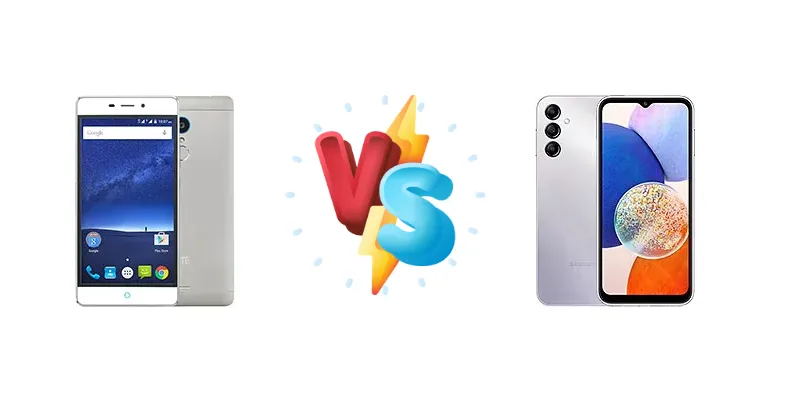
The budget smartphone market is fiercely competitive, offering incredible value for money. Today, we're pitting two contenders against each other: the ZTE Blade V Plus and the Samsung Galaxy A14 5G. Both promise affordability, but which one delivers the better overall experience?
🏆 Quick Verdict
The Samsung Galaxy A14 5G is the clear winner. Its modern chipset, 5G connectivity, brighter display, and longer software support significantly outweigh the ZTE Blade V Plus's strengths. While the Blade V Plus might be cheaper, the A14 5G offers a more future-proof and enjoyable user experience.
| Network |
|---|
| 2G bands | GSM 900 / 1800 - SIM 1 & SIM 2 | GSM 850 / 900 / 1800 / 1900 |
| 3G bands | HSDPA 850 / 900 / 2100 | HSDPA 850 / 900 / 1700(AWS) / 1900 / 2100 |
| 4G bands | 1, 3, 7, 28 | 1, 2, 3, 4, 5, 7, 8, 12, 17, 20, 26, 28, 38, 40, 41, 66 - International |
| 5G bands | - | 2, 5, 66, 77 Sub6/mmWave - USA |
| Speed | HSPA 42.2/11.5 Mbps, LTE Cat4 150/50 Mbps | HSPA, LTE, 5G |
| Technology | GSM / HSPA / LTE | GSM / HSPA / LTE / 5G |
| | 1, 3, 7, 38, 39, 40, 41 | 1, 3, 5, 7, 8, 20, 28, 40, 41, 78 SA/NSA/Sub6 - India |
| Launch |
|---|
| Announced | 2016, January. Released 2016, February | 2023, January 04 |
| Status | Discontinued | Available. Released 2023, January 12 |
| Body |
|---|
| Build | - | Glass front, plastic back, plastic frame |
| Dimensions | 155.3 x 77.2 x 8.6 mm (6.11 x 3.04 x 0.34 in) | 167.7 x 78 x 9.1 mm (6.60 x 3.07 x 0.36 in) |
| SIM | Nano-SIM + Nano-SIM | · Nano-SIM· Nano-SIM + Nano-SIM |
| Weight | 164 g (5.78 oz) | 202 g (7.13 oz) |
| Display |
|---|
| Resolution | 1080 x 1920 pixels, 16:9 ratio (~401 ppi density) | 1080 x 2408 pixels, 20:9 ratio (~400 ppi density) |
| Size | 5.5 inches, 83.4 cm2 (~69.6% screen-to-body ratio) | 6.6 inches, 104.9 cm2 (~80.2% screen-to-body ratio) |
| Type | IPS LCD | PLS LCD, 90Hz |
| Platform |
|---|
| CPU | Octa-core 1.3 GHz Cortex-A53Octa-core (4x1.5 GHz Cortex-A53 & 4x1.0 GHz Cortex-A53) | Octa-core (2x2.4 GHz Cortex-A78 & 6x2.0 GHz Cortex-A55) - SM-A146BOcta-core (2x2.2 GHz Cortex-A76 & 6x2.0 GHz Cortex-A55) - SM-A146P |
| Chipset | Mediatek MT6753Qualcomm MSM8939 Snapdragon 615 (28 nm) | Exynos 1330 (5 nm) - SM-A146BMediatek Dimensity 700 (7 nm) - SM-A146P |
| GPU | Mali-T720MP3Adreno 405 | Mali-G68 MP2 - SM-A146BMali-G57 MC2 - SM-A146P |
| OS | Android 5.1.1 (Lollipop) | Android 13, upgradable to Android 15, One UI Core 7 |
| Memory |
|---|
| Card slot | microSDHC (uses shared SIM slot) - mediatek modelmicroSDXC (uses shared SIM slot) - snapdragon model | microSDXC (uses shared SIM slot) - USA onlymicroSDXC (dedicated slot) - International |
| Internal | 16GB 2GB RAM | 64GB 4GB RAM, 128GB 4GB RAM, 128GB 6GB RAM, 128GB 8GB RAM |
| | eMMC 4.5 | - |
| Main Camera |
|---|
| Features | LED flash, HDR, panorama | LED flash, panorama, HDR |
| Single | 13 MP, AF | 13 MP, f/2.0, (wide) |
| Triple | - | 50 MP, f/1.8, 26mm (wide), 1/2.76", 0.64µm, PDAF
2 MP (macro)
Auxiliary lens |
| Video | 1080p@30fps | 1080p@30fps |
| Selfie camera |
|---|
| Single | 5 MP | 13 MP, f/2.0, 26mm (wide), 1.12µm |
| Video | - | 1080p@30fps |
| Sound |
|---|
| 3.5mm jack | Yes | Yes |
| 35mm jack | Yes | Yes |
| Loudspeaker | Yes | Yes |
| Comms |
|---|
| Bluetooth | 4.1, A2DP, LE | 5.2, A2DP, LE |
| NFC | No | Yes |
| Positioning | GPS | GPS, GLONASS, GALILEO |
| Radio | FM radio | FM radio (Exynos 1330 chipset only), recording |
| USB | microUSB 2.0, OTG | USB Type-C 2.0 |
| WLAN | Wi-Fi 802.11 b/g/n, Wi-Fi Direct, hotspot | Wi-Fi 802.11 a/b/g/n/ac, dual-band, Wi-Fi Direct |
| Features |
|---|
| Sensors | Fingerprint (rear-mounted), accelerometer, gyro, proximity, compass | Fingerprint (side-mounted), accelerometer, gyro, proximity, compass, barometer (USA only) |
| Battery |
|---|
| Charging | - | 15W wired |
| Stand-by | Up to 220 h | - |
| Talk time | Up to 9 h | - |
| Type | Li-Ion 3000 mAh, non-removable | Li-Po 5000 mAh |
| Misc |
|---|
| Colors | Silver | Black, Light Green, Dark Red, Silver |
| Models | N939Sc, V580, Blade V580 | SM-A146B, SM-A146B/DS, SM-A146P, SM-A146P/DS, SM-A146U, SM-A146U1, SM-A146U1/DS, SM-A146W, SM-A146P/N, SM-A146P/DSN, SM-S146VL, SM-A146M |
| Price | About 200 EUR | $ 77.63 / C$ 151.00 / £ 97.00 / € 159.79 / ₹ 14,990 |
| SAR | - | 1.00 W/kg (head) 1.00 W/kg (body) |
| SAR EU | - | 0.56 W/kg (head) 1.28 W/kg (body) |
| Tests |
|---|
| Battery life | - |
Endurance rating 130h
|
| Camera | - |
Photo / Video |
| Display | - |
Contrast ratio: 1334:1 (nominal) |
| Loudspeaker | - |
-26.8 LUFS (Good)
|
| Performance | - |
AnTuTu: 307886 (v9)
GeekBench: 1727 (v5.1)
GFXBench: 12fps (ES 3.1 onscreen) |
ZTE Blade V Plus
- Potentially lower price
- Decent for basic tasks
- Outdated chipset
- Lower display brightness
- Limited camera capabilities
- No 5G connectivity
- Likely shorter software support
Samsung Galaxy A14 5G
- Modern chipset (Exynos 1330 or Dimensity 700)
- 5G connectivity
- Brighter display
- Better camera
- Longer software support
- Good battery life
- Slightly higher price than Blade V Plus
- 15W charging is relatively slow
Display Comparison
The Samsung Galaxy A14 5G boasts a significantly brighter display (519 nits vs. likely lower on the Blade V Plus) and a more modern panel. While both have a nominal contrast ratio of 1334:1, the A14 5G's higher brightness makes it easier to view in sunlight. The Blade V Plus likely uses an older LCD panel, while the A14 5G probably uses a more advanced LCD or potentially an AMOLED panel depending on the specific variant.
Camera Comparison
The Galaxy A14 5G generally offers a superior camera experience. While specific megapixel counts aren't provided for the Blade V Plus, the A14 5G's newer sensor and image processing capabilities will likely result in better image quality, especially in low light. The A14 5G also likely offers more advanced camera features.
Performance
Here's where the A14 5G truly shines. The Exynos 1330 (or Dimensity 700) is a much more powerful chipset than the Mediatek MT6753/Snapdragon 615 in the Blade V Plus. Expect smoother multitasking, faster app loading times, and better gaming performance on the A14 5G. The A14 5G's CPU architecture is also more efficient, contributing to better battery life.
Battery Life
Both phones offer impressive battery life with an endurance rating of 130h. However, the A14 5G's more efficient chipset and potentially larger battery capacity (though not explicitly stated) could give it a slight edge in real-world usage.
Buying Guide
Who should buy the ZTE Blade V Plus? Those on an extremely tight budget who prioritize a basic smartphone experience and don't need 5G. Who should buy the Samsung Galaxy A14 5G? Anyone looking for a reliable, affordable 5G smartphone with a decent camera, good battery life, and a modern processor.
Frequently Asked Questions
❓ Is the ZTE Blade V Plus still worth buying in 2024?
Only if you're on an extremely tight budget and don't need 5G or modern features. Otherwise, the Samsung Galaxy A14 5G offers significantly better value.
❓ Which phone has better software support?
The Samsung Galaxy A14 5G will receive longer software updates and security patches compared to the ZTE Blade V Plus.