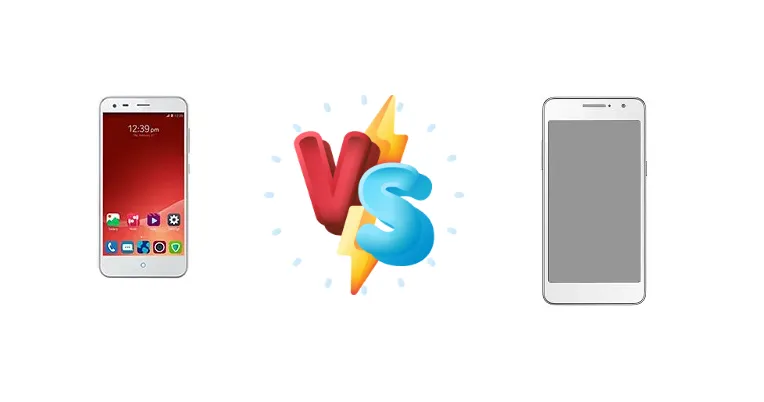
The ZTE Blade S6 Plus and Samsung Galaxy S6 Plus both aimed to offer compelling features, but at different price points. The Blade S6 Plus targeted the budget-conscious, while the S6 Plus represented Samsung's premium offering. Let's dive into a head-to-head comparison to see which phone holds up best today.
🏆 Quick Verdict
The Samsung Galaxy S6 Plus is the clear winner. While the ZTE Blade S6 Plus offered decent value for its time, the S6 Plus boasts a significantly faster processor, superior camera, and a more refined design. The S6 Plus's premium features justify its higher price, even in retrospect.
| Network |
|---|
| 2G bands | GSM 850 / 900 / 1800 / 1900 - SIM 1 & SIM 2 | GSM 850 / 900 / 1800 / 1900 |
| 3G bands | HSDPA 900 / 2100 | HSDPA 850 / 900 / 1900 / 2100 |
| 4G bands | 3, 7, 8, 20 | LTE |
| Speed | HSPA, LTE Cat4 150/50 Mbps | HSPA 42.2/5.76 Mbps, LTE Cat4 150/50 Mbps |
| Technology | GSM / HSPA / LTE | GSM / HSPA / LTE |
| Launch |
|---|
| Announced | 2015, April. Released 2015, April | Exp. announcement 2015, Q3 |
| Status | Discontinued | Cancelled |
| Body |
|---|
| Dimensions | 155 x 78 x 7.7 mm (6.10 x 3.07 x 0.30 in) | - |
| SIM | Dual SIM (Micro-SIM, dual stand-by) | Nano-SIM |
| Weight | 139.3 g (4.90 oz) | - |
| Display |
|---|
| Protection | - | To be confirmed |
| Resolution | 720 x 1280 pixels, 16:9 ratio (~267 ppi density) | 1080 x 1920 pixels, 16:9 ratio (~401 ppi density) |
| Size | 5.5 inches, 83.4 cm2 (~69.0% screen-to-body ratio) | 5.5 inches, 83.4 cm2 |
| Type | IPS LCD | Super AMOLED |
| Platform |
|---|
| CPU | Octa-core (4x1.7 GHz Cortex-A53 & 4x1.0 GHz Cortex-A53) | Octa-core (4x2.1 GHz Cortex-A57 & 4x1.5 GHz Cortex-A53) |
| Chipset | Qualcomm MSM8939 Snapdragon 615 (28 nm) | Exynos 7420 Octa (14 nm) |
| GPU | Adreno 405 | Mali-T760MP8 |
| OS | Android 5.2 (Lollipop), MiFavor 3 | Android 5.0.2 (Lollipop), TouchWiz UI |
| Memory |
|---|
| Card slot | microSDXC (dedicated slot) | To be confirmed |
| Internal | 16GB 2GB RAM | 32GB 4GB RAM |
| | eMMC 4.5 | UFS 2.0 |
| Main Camera |
|---|
| Features | LED flash | LED flash, auto-HDR, panorama |
| Single | 13 MP, AF | 16 MP, f/1.9, 28mm (wide), 1/2.6", 1.12µm, AF, OIS |
| Video | 1080p@30fps | 4K@30fps, 1080p@30/60fps, 720p@120fps, HDR, stereo sound rec., OIS, gyro-EIS |
| Selfie camera |
|---|
| Features | - | HDR |
| Single | 5 MP | 5 MP, f/1.9, 22mm (wide) |
| Video | - | 1440p@30fps |
| Sound |
|---|
| 3.5mm jack | Yes | Yes |
| 35mm jack | Yes | Yes |
| Loudspeaker | Yes | Yes |
| | - | 24-bit/192kHz audio
|
| Comms |
|---|
| Bluetooth | 4.0, A2DP | 4.1, A2DP, LE, aptX |
| NFC | No | Yes |
| Positioning | GPS | GPS, GLONASS, BDS |
| Radio | FM radio | No |
| USB | microUSB 2.0 | microUSB 2.0, OTG |
| WLAN | Wi-Fi 802.11 b/g/n, hotspot | Wi-Fi 802.11 a/b/g/n/ac, dual-band, Wi-Fi Direct, hotspot |
| Features |
|---|
| Sensors | Accelerometer, proximity, compass | Fingerprint (front-mounted), accelerometer, gyro, proximity, compass, barometer |
| | - | ANT+
S-Voice natural language commands and dictation
Samsung Pay (Visa, MasterCard certified) |
| Battery |
|---|
| Charging | - | 15W wired
Wireless (Qi) (market dependent) |
| Type | Li-Ion 3000 mAh, non-removable | Li-Po 3000 mAh, non-removable |
| Misc |
|---|
| Colors | Silver | White Pearl, Black Sapphire |
| Price | About 280 EUR | - |
ZTE Blade S6 Plus
- Affordable
- Decent display
- Slim design
- Lower performance
- Less impressive camera
- Smaller battery
- Outdated software
Samsung Galaxy S6 Plus
- Excellent display
- Powerful processor
- Superior camera
- Premium design
- Wireless charging (market dependent)
- Older device
- Battery life could be better
- Limited software updates
Display Comparison
The Samsung Galaxy S6 Plus features a 5.7-inch Super AMOLED display with QHD resolution (2560 x 1440), offering vibrant colors, deep blacks, and excellent sharpness. The ZTE Blade S6 Plus has a 5.5-inch IPS LCD display with Full HD resolution (1920 x 1080). While the Blade S6 Plus display is adequate, the S6 Plus's AMOLED screen provides a noticeably superior viewing experience.
Camera Comparison
The Samsung Galaxy S6 Plus boasts a 16MP rear camera with optical image stabilization (OIS) and a 5MP front camera. The ZTE Blade S6 Plus has a 13MP rear camera and a 5MP front camera. The S6 Plus's camera captures significantly better images, particularly in low-light conditions, thanks to its superior sensor and OIS. Image processing is also noticeably better on the S6 Plus.
Performance
The Exynos 7420 in the Samsung Galaxy S6 Plus is a substantial upgrade over the Snapdragon 615 in the ZTE Blade S6 Plus. The S6 Plus's Cortex-A57 cores provide significantly faster processing speeds, resulting in smoother multitasking, faster app loading times, and better overall responsiveness. The Blade S6 Plus can feel sluggish by comparison, especially with demanding applications.
Battery Life
The Samsung Galaxy S6 Plus has a 3000mAh battery with 15W wired charging and potentially Qi wireless charging (market dependent). The ZTE Blade S6 Plus has a 2400mAh battery. While battery life on both devices is decent, the S6 Plus's larger battery and more efficient processor generally provide longer usage times.
Buying Guide
Who should buy the ZTE Blade S6 Plus? Primarily those seeking a very affordable Android phone and are willing to compromise on performance and camera quality. Who should buy the Samsung Galaxy S6 Plus? Users prioritizing performance, camera quality, and a premium design, and who are comfortable with a slightly older device.
Frequently Asked Questions
❓ Is the Samsung Galaxy S6 Plus still worth buying in 2024?
If you're looking for a powerful and well-featured Android phone on a budget, the Galaxy S6 Plus can still be a viable option. However, be aware that it's an older device with limited software updates.
❓ What is the main difference between the ZTE Blade S6 Plus and the Samsung Galaxy S6 Plus?
The primary difference lies in performance and display quality. The Galaxy S6 Plus has a significantly faster processor and a superior Super AMOLED display compared to the Blade S6 Plus's IPS LCD screen and slower Snapdragon 615 chipset.