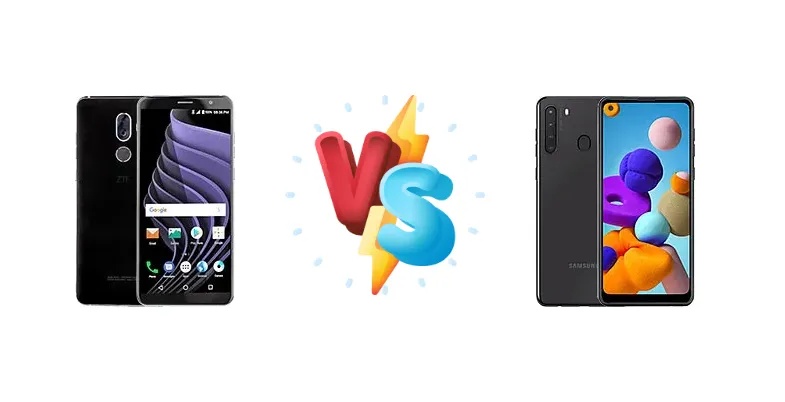
The Samsung Galaxy A21 and ZTE Blade Max View represent two approaches to the ultra-budget smartphone market. The A21 aims for a more modern feature set, while the Blade Max View focuses on a streamlined experience. This comparison dissects their core components to determine which device offers the best value for users prioritizing affordability.
🏆 Quick Verdict
For the average user, the Samsung Galaxy A21 emerges as the better choice. Its newer Mediatek Helio P35 chipset, fabricated on a 12nm process, provides a noticeable performance advantage over the ZTE Blade Max View’s older Snapdragon 435, despite both utilizing Cortex-A53 cores. The inclusion of 15W charging is also a significant benefit.
| Network |
|---|
| 2G bands | GSM 850 / 900 / 1800 / 1900 | GSM 850 / 900 / 1800 / 1900 |
| 3G bands | HSDPA 850 / 1700(AWS) / 1900 | HSDPA 850 / 900 / 1700(AWS) / 1900 / 2100 - USA |
| 4G bands | 2, 4, 5, 12, 13, 66 | 1, 2, 3, 4, 5, 7, 8, 12, 13, 17, 20, 25, 26, 28, 38, 39, 40, 41, 66, 71 - USA |
| Speed | HSPA 42.2/5.76 Mbps, LTE (2CA) Cat6 300/50 Mbps | HSPA 42.2/5.76 Mbps, LTE Cat4 150/50 Mbps |
| Technology | GSM / CDMA / HSPA / EVDO / LTE | GSM / CDMA / HSPA / EVDO / LTE |
| | CDMA2000 1xEV-DO | CDMA2000 1xEV-DO |
| Launch |
|---|
| Announced | 2019. Released 2019 | 2020, April 08. Released 2020, June 26 |
| Status | Discontinued | Discontinued |
| Body |
|---|
| Build | Glass front, plastic back, plastic frame | Glass front, plastic back, plastic frame |
| Dimensions | 163.1 x 74.9 x 8.1 mm (6.42 x 2.95 x 0.32 in) | 167.8 x 76.7 x 8.1 mm (6.61 x 3.02 x 0.32 in) |
| SIM | Nano-SIM | · Nano-SIM· Nano-SIM + Nano-SIM |
| Weight | 160 g (5.64 oz) | 193 g (6.81 oz) |
| Display |
|---|
| Resolution | 1080 x 2160 pixels, 18:9 ratio (~402 ppi density) | 720 x 1600 pixels, 20:9 ratio (~270 ppi density) |
| Size | 6.0 inches, 92.9 cm2 (~76.0% screen-to-body ratio) | 6.5 inches, 102.0 cm2 (~79.3% screen-to-body ratio) |
| Type | IPS LCD | IPS LCD |
| Platform |
|---|
| CPU | Octa-core 1.4 GHz Cortex-A53 | Octa-core (4x2.35 GHz Cortex-A53 & 4x1.8 GHz Cortex-A53) |
| Chipset | Qualcomm MSM8940 Snapdragon 435 (28 nm) | Mediatek MT6765 Helio P35 (12 nm) |
| GPU | Adreno 505 | PowerVR GE8320 |
| OS | Android 7.1.1 (Nougat), upgradable to Android 8.1 (Oreo) | Android 10, One UI 2.0 |
| Memory |
|---|
| Card slot | microSDXC | microSDXC (dedicated slot) |
| Internal | 32GB 3GB RAM | 32GB 3GB RAM |
| | eMMC 5.1 | eMMC 5.1 |
| Main Camera |
|---|
| Dual | 16 MP, f/2.0, 25mm (wide), 1/3.1", 1.0µm, PDAF
Auxiliary lens | - |
| Features | LED flash, HDR, panorama | LED flash, panorama, HDR |
| Quad | - | 16 MP, f/1.8, (wide), 1/3.06", 1.0µm, PDAF
8 MP, f/2.2, (ultrawide), 1/4.0", 1.12µm
2 MP (macro)
Auxiliary lens |
| Video | 1080p@30fps | 1080p@30fps |
| Selfie camera |
|---|
| Single | 8 MP | 13 MP, f/2.0, (wide), 1/3.1", 1.12µm |
| Video | - | 1080p@30fps |
| Sound |
|---|
| 3.5mm jack | Yes | Yes |
| 35mm jack | Yes | Yes |
| Loudspeaker | Yes | Yes |
| Comms |
|---|
| Bluetooth | 4.2, A2DP, LE | 5.0, A2DP, LE |
| NFC | No | Yes (market/region dependent) |
| Positioning | GPS | GPS, GLONASS, BDS |
| Radio | Unspecified | FM radio |
| USB | USB Type-C 2.0 | USB Type-C 2.0 |
| WLAN | Wi-Fi 802.11 b/g/n/ac, dual-band, Wi-Fi Direct | Wi-Fi 802.11 a/b/g/n/ac, dual-band, Wi-Fi Direct |
| Features |
|---|
| Sensors | Fingerprint (rear-mounted), accelerometer, proximity | Fingerprint (rear-mounted), accelerometer, gyro, proximity, compass |
| Battery |
|---|
| Charging | - | 15W wired |
| Type | Li-Po 4000 mAh | Li-Po 4000 mAh |
| Misc |
|---|
| Colors | Black | Black |
| Models | Z610DL | SM-A215U, SM-A215U1, SM-S215DL, SM-A215W |
| Price | About 90 EUR | $ 69.88 / C$ 155.00 / £ 54.99 / € 73.89 |
| SAR | - | 1.27 W/kg (head) 0.60 W/kg (body) |
ZTE Blade Max View
- More powerful Helio P35 chipset
- Faster 15W charging
- Potentially better image processing
- Potentially shorter software support
- Display specs are unknown
Samsung Galaxy A21
- Simpler user experience
- Potentially longer software support from ZTE
- Lower price point (likely)
- Older, less efficient Snapdragon 435
- Slower charging speeds
- Less responsive performance
Display Comparison
Neither device boasts a standout display. Both likely utilize IPS LCD panels, common in this price bracket. However, the lack of detailed display specs (resolution, brightness) necessitates focusing on the chipset impact on UI smoothness. The A21’s more powerful processor will contribute to a more fluid scrolling experience, even if the panels themselves are similar.
Camera Comparison
Without detailed camera specs beyond the presence of cameras, a direct comparison is difficult. It’s safe to assume both devices feature basic camera systems geared towards casual photography. The A21 likely benefits from Mediatek’s image signal processor (ISP), which may offer slightly better image processing capabilities than the Snapdragon 435’s ISP. However, the quality will largely depend on sensor size and lens aperture, data not provided.
Performance
The core difference lies in the chipsets. The Samsung Galaxy A21’s Mediatek Helio P35 (12nm) is a clear upgrade over the ZTE Blade Max View’s Qualcomm Snapdragon 435 (28nm). The 12nm fabrication process inherently offers better power efficiency and thermal characteristics. While both CPUs feature Cortex-A53 cores, the A21’s configuration – a cluster of four cores clocked at 2.35 GHz and another four at 1.8 GHz – provides a significant boost in peak performance compared to the Blade Max View’s uniform 1.4 GHz octa-core setup. This translates to faster app loading times and smoother multitasking on the A21.
Battery Life
Battery capacity is not specified for either device. However, the Samsung Galaxy A21’s inclusion of 15W wired charging is a substantial advantage. The Blade Max View likely relies on slower charging speeds, meaning a significantly longer time to reach a full charge. While a larger battery capacity on the Blade Max View *could* offset this, the more efficient Helio P35 in the A21 will likely result in comparable real-world battery life with faster replenishment.
Buying Guide
Buy the ZTE Blade Max View if you need a simple, functional device for basic tasks like calls, texts, and light web browsing, and prioritize a potentially longer software support lifecycle from ZTE. Buy the Samsung Galaxy A21 if you prefer a more responsive user experience for social media, streaming, and casual gaming, and value the convenience of faster charging, even if it means potentially shorter software updates.
Frequently Asked Questions
❓ Does the Mediatek Helio P35 in the Galaxy A21 get noticeably hot during extended use, like gaming?
While the Helio P35 isn't a high-end gaming chip, its 12nm fabrication process helps manage thermals better than the Snapdragon 435's 28nm process. Expect some warmth during prolonged gaming, but it's unlikely to reach uncomfortable levels or cause significant performance throttling.
❓ Is the performance difference between the Snapdragon 435 and Helio P35 significant for everyday tasks like browsing and social media?
Yes, the difference is noticeable. The Helio P35’s faster clock speeds and more efficient architecture result in snappier app loading times, smoother scrolling, and a more responsive overall user experience, even with everyday tasks. The Snapdragon 435 may feel sluggish in comparison.
❓ Given the price range, should I expect frequent software updates on either device?
Software update support is often limited on phones in this price bracket. While Samsung generally provides better software support than ZTE, don't expect major Android version updates for an extended period. Security patches may be more frequent, but long-term support is not guaranteed for either device.