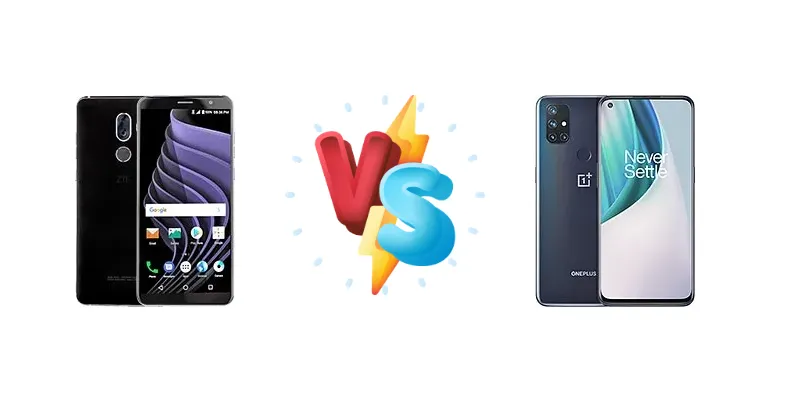
The OnePlus Nord N10 5G and ZTE Blade Max View represent different approaches to the budget smartphone market. The N10 5G aims to deliver 5G connectivity and a modern experience, while the Blade Max View focuses on providing a functional device at an extremely competitive price point. This comparison dissects their key differences to determine which phone best suits your needs.
🏆 Quick Verdict
For the average user, the OnePlus Nord N10 5G is the clear winner. Its Snapdragon 690 chipset provides a substantially faster and more responsive experience than the ZTE Blade Max View’s Snapdragon 435. While both phones offer similar battery endurance ratings, the N10 5G’s faster 30W charging is a significant advantage.
| Network |
|---|
| 2G bands | GSM 850 / 900 / 1800 / 1900 | GSM 850 / 900 / 1800 / 1900 |
| 3G bands | HSDPA 850 / 1700(AWS) / 1900 | HSDPA 850 / 900 / 1700(AWS) / 1900 / 2100 |
| 4G bands | 2, 4, 5, 12, 13, 66 | 1, 2, 3, 4, 5, 7, 8, 12, 17, 20, 28, 38, 39, 40, 41, 66 - International |
| 5G bands | - | 1, 3, 7, 28, 41, 66, 78 SA/NSA - International |
| Speed | HSPA 42.2/5.76 Mbps, LTE (2CA) Cat6 300/50 Mbps | HSPA 42.2/5.76 Mbps, LTE Cat18 1024/150 Mbps, 5G |
| Technology | GSM / CDMA / HSPA / EVDO / LTE | GSM / CDMA / HSPA / LTE / 5G |
| | CDMA2000 1xEV-DO | 2, 5, 25, 41, 66, 71 SA/NSA - USA |
| Launch |
|---|
| Announced | 2019. Released 2019 | 2020, October 26 |
| Status | Discontinued | Available. Released 2020, November 21 |
| Body |
|---|
| Build | Glass front, plastic back, plastic frame | Glass front (Gorilla Glass 3), plastic back, plastic frame |
| Dimensions | 163.1 x 74.9 x 8.1 mm (6.42 x 2.95 x 0.32 in) | 163 x 74.7 x 9 mm (6.42 x 2.94 x 0.35 in) |
| SIM | Nano-SIM | Nano-SIM + Nano-SIM |
| Weight | 160 g (5.64 oz) | 190 g (6.70 oz) |
| Display |
|---|
| Protection | - | Corning Gorilla Glass 3 |
| Resolution | 1080 x 2160 pixels, 18:9 ratio (~402 ppi density) | 1080 x 2400 pixels, 20:9 ratio (~406 ppi density) |
| Size | 6.0 inches, 92.9 cm2 (~76.0% screen-to-body ratio) | 6.49 inches, 101.7 cm2 (~83.5% screen-to-body ratio) |
| Type | IPS LCD | IPS LCD, 90Hz |
| Platform |
|---|
| CPU | Octa-core 1.4 GHz Cortex-A53 | Octa-core (2x2.0 GHz Kryo 560 Gold & 6x1.7 GHz Kryo 560 Silver) |
| Chipset | Qualcomm MSM8940 Snapdragon 435 (28 nm) | Qualcomm SM6350 Snapdragon 690 5G (8 nm) |
| GPU | Adreno 505 | Adreno 619L |
| OS | Android 7.1.1 (Nougat), upgradable to Android 8.1 (Oreo) | Android 10, OxygenOS 10.5 |
| Memory |
|---|
| Card slot | microSDXC | microSDXC |
| Internal | 32GB 3GB RAM | 128GB 6GB RAM |
| | eMMC 5.1 | UFS 2.1 |
| Main Camera |
|---|
| Dual | 16 MP, f/2.0, 25mm (wide), 1/3.1", 1.0µm, PDAF
Auxiliary lens | - |
| Features | LED flash, HDR, panorama | LED flash, HDR, panorama |
| Quad | - | 64 MP, f/1.8, (wide), 1/1.72", 0.8µm, PDAF
8 MP, f/2.3, 119˚ (ultrawide)
2 MP (macro)
Auxiliary lens |
| Video | 1080p@30fps | 4K@30fps, 1080p@30/60/120fps; gyro-EIS |
| Selfie camera |
|---|
| Features | - | HDR |
| Single | 8 MP | 16 MP, f/2.1 |
| Video | - | 1080p@30/60fps, gyro-EIS |
| Sound |
|---|
| 3.5mm jack | Yes | Yes |
| 35mm jack | Yes | Yes |
| Loudspeaker | Yes | Yes, with dual speakers |
| Comms |
|---|
| Bluetooth | 4.2, A2DP, LE | 5.1, A2DP, LE |
| NFC | No | Yes |
| Positioning | GPS | GPS (L1+L5), GLONASS, GALILEO, BDS |
| Radio | Unspecified | No |
| USB | USB Type-C 2.0 | USB Type-C 2.0, OTG |
| WLAN | Wi-Fi 802.11 b/g/n/ac, dual-band, Wi-Fi Direct | Wi-Fi 802.11 a/b/g/n/ac, dual-band, Wi-Fi Direct |
| Features |
|---|
| Sensors | Fingerprint (rear-mounted), accelerometer, proximity | Fingerprint (rear-mounted), accelerometer, gyro, proximity, compass |
| Battery |
|---|
| Charging | - | 30W wired |
| Type | Li-Po 4000 mAh | Li-Po 4300 mAh |
| Misc |
|---|
| Colors | Black | Midnight Ice |
| Models | Z610DL | BE2029, BE2025, BE2026, BE2028 |
| Price | About 90 EUR | About 250 EUR |
| Tests |
|---|
| Battery life | - |
Endurance rating 99h
|
| Camera | - |
Photo / Video |
| Loudspeaker | - |
-25.8 LUFS (Very good)
|
| Performance | - |
AnTuTu: 279579 (v8)
GeekBench: 1848 (v5.1)
GFXBench: 13fps (ES 3.1 onscreen) |
ZTE Blade Max View
- Extremely affordable price point
- Decent battery endurance
- Functional for basic smartphone tasks
- Outdated Snapdragon 435 chipset
- Limited performance for demanding apps
- Display specifications are basic
OnePlus Nord N10 5G
- 5G connectivity
- Faster Snapdragon 690 chipset
- 30W fast charging
- Brighter display with higher contrast
- Higher price than the ZTE Blade Max View
- May not be the best choice for extremely budget-conscious users
Display Comparison
The OnePlus Nord N10 5G boasts a brighter display, measured at 440 nits, compared to the ZTE Blade Max View (brightness unspecified). This difference is noticeable in outdoor visibility. While both display technologies are not specified, the N10 5G’s 1447:1 contrast ratio suggests a more vibrant image. The Blade Max View’s display specifications are limited, making a direct comparison difficult, but it likely utilizes a less advanced panel technology given its lower price point.
Camera Comparison
Both phones feature photo and video capabilities, but detailed camera specifications are lacking for both. Without sensor size, aperture, or image processing details, a direct comparison is challenging. However, given the N10 5G’s overall positioning, it likely incorporates a more advanced camera system with better image quality and features. The Blade Max View likely relies on more basic camera hardware, suitable for casual snapshots.
Performance
The performance gap between these two devices is substantial. The OnePlus Nord N10 5G’s Qualcomm Snapdragon 690 5G (8nm) is a significant upgrade over the ZTE Blade Max View’s Snapdragon 435 (28nm). The 690 features Kryo 560 Gold and Silver cores clocked at 2.0 GHz and 1.7 GHz respectively, offering a much more capable CPU for multitasking and demanding applications. The Snapdragon 435’s Cortex-A53 cores at 1.4 GHz are considerably less powerful. The 8nm process node of the 690 also translates to better power efficiency and reduced thermal throttling compared to the older 28nm process of the 435.
Battery Life
Interestingly, both the ZTE Blade Max View and the OnePlus Nord N10 5G achieve an endurance rating of 99 hours. This suggests similar real-world battery life despite the more power-hungry chipset in the N10 5G. However, the N10 5G’s 30W wired charging is a game-changer, allowing for significantly faster top-ups compared to the Blade Max View, which likely supports slower charging speeds. This faster charging capability mitigates any potential battery life disadvantage.
Buying Guide
Buy the ZTE Blade Max View if you prioritize absolute affordability and only need a smartphone for basic tasks like calls, texts, and light web browsing. Its older chipset is sufficient for these use cases. Buy the OnePlus Nord N10 5G if you want a smoother, more future-proof experience with 5G connectivity, faster charging, and better performance for gaming and multitasking. The N10 5G is ideal for users who want a device that can handle more demanding applications.
Frequently Asked Questions
❓ Is the Snapdragon 690 in the OnePlus Nord N10 5G powerful enough for modern mobile games?
Yes, the Snapdragon 690 is capable of running most modern mobile games at medium to high settings. While it won't match the performance of flagship chipsets, it provides a significantly smoother gaming experience than the Snapdragon 435 in the ZTE Blade Max View.
❓ How much faster is the 30W charging on the OnePlus Nord N10 5G compared to the ZTE Blade Max View?
While the Blade Max View's charging speed isn't officially specified, it's likely to be around 10W or 15W. The N10 5G's 30W charging will significantly reduce charging times, potentially taking the phone from 0% to 100% in around an hour, compared to potentially 3+ hours for the Blade Max View.
❓ Will the ZTE Blade Max View receive software updates?
Historically, ZTE's budget devices receive limited software updates. Expect minimal security patches and potentially no major Android version upgrades. The OnePlus Nord N10 5G is likely to receive more consistent updates, though its update support is also limited compared to flagship OnePlus devices.