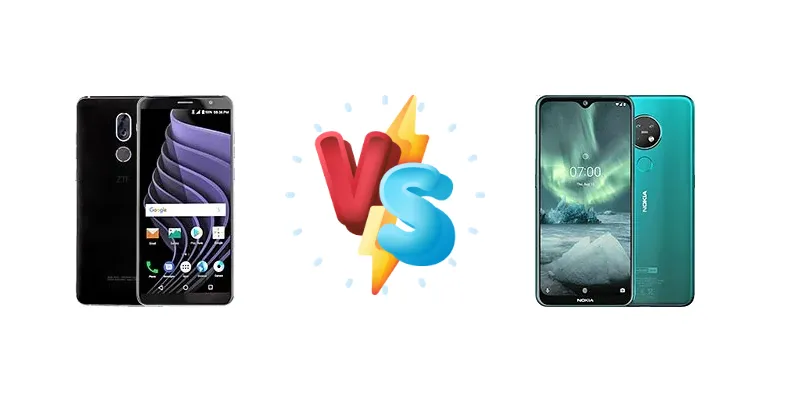
Both the ZTE Blade Max View and Nokia 7.2 represent attempts to deliver a functional smartphone experience at an accessible price point. However, a closer look reveals a substantial difference in processing power and display quality, making the Nokia 7.2 the clear frontrunner for users prioritizing performance and visual fidelity. This comparison will dissect the key differences between these two devices, helping you determine which best suits your needs.
🏆 Quick Verdict
For the average user, the Nokia 7.2 is the superior choice. Its Snapdragon 660 chipset delivers significantly faster performance than the ZTE Blade Max View’s Snapdragon 435, and its brighter display enhances the overall user experience. While both phones offer comparable battery life, the Nokia 7.2 provides a more responsive and enjoyable daily experience.
| Network |
|---|
| 2G bands | GSM 850 / 900 / 1800 / 1900 | GSM 850 / 900 / 1800 / 1900 |
| 3G bands | HSDPA 850 / 1700(AWS) / 1900 | HSDPA 850 / 900 / 2100 - ROW |
| 4G bands | 2, 4, 5, 12, 13, 66 | 1, 3, 5, 7, 8, 20, 28, 38, 40, 41 - ROW |
| Speed | HSPA 42.2/5.76 Mbps, LTE (2CA) Cat6 300/50 Mbps | HSPA 42.2/5.76 Mbps, LTE (2CA) Cat6 300/50 Mbps or LTE Cat4 150/50 Mbps |
| Technology | GSM / CDMA / HSPA / EVDO / LTE | GSM / HSPA / LTE |
| | CDMA2000 1xEV-DO | 1, 3, 5, 8, 40, 41 - IN |
| Launch |
|---|
| Announced | 2019. Released 2019 | 2019, September 05. Released 2019, September 23 |
| Status | Discontinued | Discontinued |
| Body |
|---|
| Build | Glass front, plastic back, plastic frame | Glass front (Gorilla Glass 3), glass back (Gorilla Glass 3), plastic frame |
| Dimensions | 163.1 x 74.9 x 8.1 mm (6.42 x 2.95 x 0.32 in) | 159.9 x 75.2 x 8.3 mm (6.30 x 2.96 x 0.33 in) |
| SIM | Nano-SIM | · Nano-SIM· Nano-SIM + Nano-SIM |
| Weight | 160 g (5.64 oz) | 180 g (6.35 oz) |
| Display |
|---|
| Protection | - | Corning Gorilla Glass 3 |
| Resolution | 1080 x 2160 pixels, 18:9 ratio (~402 ppi density) | 1080 x 2280 pixels, 19:9 ratio (~400 ppi density) |
| Size | 6.0 inches, 92.9 cm2 (~76.0% screen-to-body ratio) | 6.3 inches, 99.1 cm2 (~82.4% screen-to-body ratio) |
| Type | IPS LCD | IPS LCD, HDR10 |
| Platform |
|---|
| CPU | Octa-core 1.4 GHz Cortex-A53 | Octa-core (4x2.2 GHz Kryo 260 Gold & 4x1.8 GHz Kryo 260 Silver) |
| Chipset | Qualcomm MSM8940 Snapdragon 435 (28 nm) | Qualcomm SDM660 Snapdragon 660 (14 nm) |
| GPU | Adreno 505 | Adreno 512 |
| OS | Android 7.1.1 (Nougat), upgradable to Android 8.1 (Oreo) | Android 9.0 (Pie), upgradable to Android 11, Android One |
| Memory |
|---|
| Card slot | microSDXC | microSDXC (dedicated slot) |
| Internal | 32GB 3GB RAM | 64GB 4GB RAM, 64GB 6GB RAM, 128GB 4GB RAM, 128GB 6GB RAM |
| | eMMC 5.1 | eMMC 5.1 |
| Main Camera |
|---|
| Dual | 16 MP, f/2.0, 25mm (wide), 1/3.1", 1.0µm, PDAF
Auxiliary lens | - |
| Features | LED flash, HDR, panorama | Zeiss optics, LED flash, panorama, HDR |
| Triple | - | 48 MP, f/1.8, (wide), 1/2.0", 0.8µm, PDAF
8 MP, f/2.2, 13mm (ultrawide), 1/4.0", 1.12µm
Auxiliary lens |
| Video | 1080p@30fps | 4K@30fps, 1080p@30fps (gyro-EIS) |
| Selfie camera |
|---|
| Features | - | Zeiss optics, HDR |
| Single | 8 MP | 20 MP, f/2.0, (wide), 1/3", 0.9µm |
| Video | - | 1080p@30fps |
| Sound |
|---|
| 3.5mm jack | Yes | Yes |
| 35mm jack | Yes | Yes |
| Loudspeaker | Yes | Yes |
| Comms |
|---|
| Bluetooth | 4.2, A2DP, LE | 5.0, A2DP, EDR, LE, aptX |
| NFC | No | Yes (excl. India) |
| Positioning | GPS | GPS, GLONASS, GALILEO, BDS |
| Radio | Unspecified | FM radio |
| USB | USB Type-C 2.0 | USB Type-C 2.0, OTG |
| WLAN | Wi-Fi 802.11 b/g/n/ac, dual-band, Wi-Fi Direct | Wi-Fi 802.11 b/g/n/ac, dual-band, Wi-Fi Direct |
| Features |
|---|
| Sensors | Fingerprint (rear-mounted), accelerometer, proximity | Fingerprint (rear-mounted), accelerometer, gyro, proximity, compass |
| Battery |
|---|
| Charging | - | 10W wired |
| Type | Li-Po 4000 mAh | Li-Po 3500 mAh, non-removable |
| Misc |
|---|
| Colors | Black | Cyan Green, Charcoal, Ice |
| Models | Z610DL | TA-1193, TA-1178, TA-1196, TA-1181 |
| Price | About 90 EUR | About 240 EUR |
| SAR | - | 1.15 W/kg (head) 0.90 W/kg (body) |
| SAR EU | - | 0.99 W/kg (head) 1.44 W/kg (body) |
| Tests |
|---|
| Audio quality | - |
Noise -93.0dB / Crosstalk -93.4dB |
| Battery life | - |
Endurance rating 69h
|
| Camera | - |
Photo / Video |
| Display | - |
Contrast ratio: 1342:1 (nominal) |
| Loudspeaker | - |
-29.6 LUFS (Average)
|
| Performance | - |
AnTuTu: 139495 (v7), 164484 (v8)
GeekBench: 5440 (v4.4), 1398 (v5.1)
GFXBench: 8.1fps (ES 3.1 onscreen) |
ZTE Blade Max View
- Extremely affordable price point
- Acceptable battery life
- Functional for basic smartphone tasks
- Weak processor performance
- Likely low-quality display
- Slow charging speed
Nokia 7.2
- Significantly faster processor
- Brighter and more vibrant display
- More responsive user experience
- Slightly higher price
- Slow charging speed
- May not be available in all regions
Display Comparison
The Nokia 7.2 boasts a significantly more appealing display experience. While both phones share a 1342:1 contrast ratio, the Nokia 7.2’s measured peak brightness of 585 nits far exceeds what we’d expect from the Blade Max View, which lacks published brightness data. This translates to better visibility outdoors and a more vibrant image. The lack of detailed display specifications for the Blade Max View suggests a lower-quality panel, likely with lower color accuracy and viewing angles. The Nokia 7.2’s display is a clear advantage for media consumption and general usability.
Camera Comparison
Both devices are listed as having Photo/Video capabilities, but without specific sensor details, a meaningful comparison is difficult. However, given the Nokia 7.2’s positioning as a more premium device, it’s reasonable to assume a more capable camera system. The Blade Max View, targeting the ultra-budget segment, likely features a simpler camera setup. The absence of information regarding Optical Image Stabilization (OIS) on either device suggests neither prioritizes advanced image stabilization. We can expect the Nokia 7.2 to deliver better image quality, particularly in low-light conditions, due to its more powerful image signal processor (ISP) integrated within the Snapdragon 660.
Performance
The performance gap between these two devices is substantial. The Nokia 7.2’s Qualcomm SDM660 Snapdragon 660, built on a 14nm process, features an octa-core CPU configuration (4x2.2 GHz Kryo 260 Gold & 4x1.8 GHz Kryo 260 Silver) that significantly outperforms the ZTE Blade Max View’s Snapdragon 435 (28nm) and its octa-core 1.4 GHz Cortex-A53 CPU. The smaller manufacturing node of the Snapdragon 660 also contributes to better power efficiency and reduced thermal throttling. This means the Nokia 7.2 will handle multitasking, demanding apps, and even light gaming with greater ease and responsiveness. The Snapdragon 435 in the Blade Max View is geared towards basic functionality and will struggle with more intensive tasks.
Battery Life
Both the ZTE Blade Max View and Nokia 7.2 achieve an endurance rating of 69 hours, indicating comparable battery life under similar usage conditions. However, the Nokia 7.2’s more efficient Snapdragon 660 chipset, built on a 14nm process, likely contributes to this longevity. The Blade Max View’s older 28nm Snapdragon 435 is less power-efficient. Both phones feature 10W wired charging, which is relatively slow by today’s standards, meaning a full charge will take a considerable amount of time. The similar endurance ratings suggest that real-world battery performance will be comparable, despite the chipset differences.
Buying Guide
Buy the ZTE Blade Max View if you need a basic smartphone for essential tasks like calls, texts, and light social media browsing, and your budget is extremely limited. Buy the Nokia 7.2 if you prefer a smoother, more responsive experience for multitasking, gaming, and content consumption, and value a brighter, more vibrant display. The Nokia 7.2 is ideal for users who want a phone that feels more modern and capable.
Frequently Asked Questions
❓ Is the Snapdragon 435 in the ZTE Blade Max View sufficient for playing modern mobile games?
The Snapdragon 435 is a low-end chipset and will struggle with most modern mobile games. While it may be able to run less demanding titles at low settings, expect significant frame rate drops and lag in more graphically intensive games. The Nokia 7.2’s Snapdragon 660 offers a much smoother gaming experience.
❓ Does the Nokia 7.2 support fast charging, and how long does it take to fully charge?
Unfortunately, the Nokia 7.2 only supports 10W wired charging, which is relatively slow. A full charge from 0% to 100% will likely take around 2.5 to 3 hours. This is a drawback compared to many modern smartphones that offer significantly faster charging speeds.
❓ What kind of storage options are available on each device, and can the storage be expanded?
Specific storage configurations weren't provided. However, given the market segment, the ZTE Blade Max View likely offers limited internal storage (32GB or 64GB) with microSD card expansion. The Nokia 7.2 likely offers similar options, potentially with a larger base storage configuration and microSD card support. Checking retailer listings is crucial for confirming exact storage options.