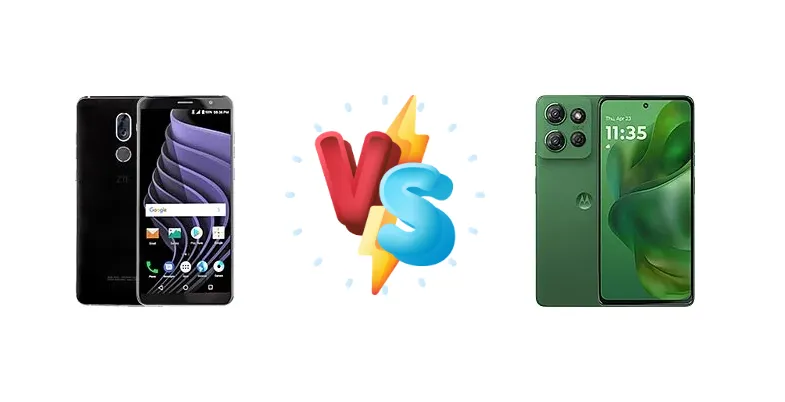
The ZTE Blade Max View represents a generation of budget smartphones focused on affordability, while the Motorola Moto G Power (2025) aims to redefine what's possible in the sub-$300 segment. This comparison dissects the core differences between these two devices, focusing on how their hardware choices impact real-world performance and user experience.
🏆 Quick Verdict
For the average user prioritizing responsiveness and longevity, the Motorola Moto G Power (2025) is the clear winner. Its Mediatek Dimensity 6300 chipset and impressive 11:56h battery life offer a substantial upgrade over the ZTE Blade Max View’s aging Snapdragon 435, despite a likely higher price point.
| Network |
|---|
| 2G bands | GSM 850 / 900 / 1800 / 1900 | GSM 850 / 900 / 1800 / 1900 |
| 3G bands | HSDPA 850 / 1700(AWS) / 1900 | HSDPA 850 / 900 / 1700(AWS) / 1900 / 2100 |
| 4G bands | 2, 4, 5, 12, 13, 66 | 1, 2, 3, 4, 5, 7, 8, 12, 13, 14, 17, 18, 20, 25, 26, 28, 29, 30, 38, 39, 40, 41, 48, 66, 71 |
| 5G bands | - | 2, 5, 7, 12, 14, 25, 26, 29, 30, 41, 48, 66, 70, 71, 77, 78 SA/NSA/Sub6 |
| Speed | HSPA 42.2/5.76 Mbps, LTE (2CA) Cat6 300/50 Mbps | HSPA, LTE, 5G |
| Technology | GSM / CDMA / HSPA / EVDO / LTE | GSM / HSPA / LTE / 5G |
| | CDMA2000 1xEV-DO | - |
| Launch |
|---|
| Announced | 2019. Released 2019 | 2025, January 14 |
| Status | Discontinued | Available. Released 2025, February 06 |
| Body |
|---|
| Build | Glass front, plastic back, plastic frame | Glass front (Gorilla Glass 5), silicone polymer (eco leather) back, plastic frame |
| Dimensions | 163.1 x 74.9 x 8.1 mm (6.42 x 2.95 x 0.32 in) | 166.6 x 77.1 x 8.7 mm (6.56 x 3.04 x 0.34 in) |
| SIM | Nano-SIM | Nano-SIM + eSIM |
| Weight | 160 g (5.64 oz) | 208 g (7.34 oz) |
| Display |
|---|
| Protection | - | Corning Gorilla Glass 5 |
| Resolution | 1080 x 2160 pixels, 18:9 ratio (~402 ppi density) | 1080 x 2388 pixels (~385 ppi density) |
| Size | 6.0 inches, 92.9 cm2 (~76.0% screen-to-body ratio) | 6.8 inches, 112.0 cm2 (~87.2% screen-to-body ratio) |
| Type | IPS LCD | IPS LCD, 120Hz |
| Platform |
|---|
| CPU | Octa-core 1.4 GHz Cortex-A53 | Octa-core (2x2.4 GHz Cortex-A76 & 6x2.0 GHz Cortex-A55) |
| Chipset | Qualcomm MSM8940 Snapdragon 435 (28 nm) | Mediatek Dimensity 6300 (6 nm) |
| GPU | Adreno 505 | Mali-G57 MC2 |
| OS | Android 7.1.1 (Nougat), upgradable to Android 8.1 (Oreo) | Android 15, up to 2 major Android upgrades |
| Memory |
|---|
| Card slot | microSDXC | microSDXC (dedicated slot) |
| Internal | 32GB 3GB RAM | 128GB 8GB RAM |
| | eMMC 5.1 | - |
| Main Camera |
|---|
| Dual | 16 MP, f/2.0, 25mm (wide), 1/3.1", 1.0µm, PDAF
Auxiliary lens | 50 MP, f/1.8, (wide), 1/2.88", 0.61µm, PDAF, OIS
8 MP, f/2.2, 119˚ 13mm (ultrawide), 1.12µm, AF |
| Features | LED flash, HDR, panorama | LED flash, HDR, panorama |
| Video | 1080p@30fps | 1080p@30fps |
| Selfie camera |
|---|
| Single | 8 MP | 16 MP, f/2.4, 24mm (wide), 1/3.0", 1.0µm |
| Video | - | 1080p@30fps |
| Sound |
|---|
| 3.5mm jack | Yes | - |
| 35mm jack | Yes | Yes |
| Loudspeaker | Yes | Yes, with stereo speakers (with Dolby Atmos) |
| Comms |
|---|
| Bluetooth | 4.2, A2DP, LE | Yes |
| NFC | No | Yes |
| Positioning | GPS | GPS, GALILEO, GLONASS |
| Radio | Unspecified | FM radio |
| USB | USB Type-C 2.0 | USB Type-C 2.0 |
| WLAN | Wi-Fi 802.11 b/g/n/ac, dual-band, Wi-Fi Direct | Wi-Fi 802.11 a/b/g/n/ac, dual-band |
| Features |
|---|
| Sensors | Fingerprint (rear-mounted), accelerometer, proximity | Fingerprint (side-mounted), accelerometer, gyro, proximity, compass, barometer |
| Battery |
|---|
| Charging | - | 30W wired
15W wireless |
| Type | Li-Po 4000 mAh | 5000 mAh |
| Misc |
|---|
| Colors | Black | Slate Gray, Leaf Green |
| Models | Z610DL | XT2515-1 |
| Price | About 90 EUR | $ 199.99 |
ZTE Blade Max View
- Extremely affordable
- Functional for basic tasks
- Potentially lightweight design
- Outdated chipset
- Likely poor performance
- Inferior display quality
- Limited battery life
Motorola Moto G Power (2025)
- Excellent battery life (11:56h)
- Fast charging (30W wired, 15W wireless)
- Modern and efficient chipset (Dimensity 6300)
- Superior display brightness and contrast
- Smoother user experience
- Likely higher price point
- May be slightly heavier than the ZTE Blade Max View
Display Comparison
The Motorola Moto G Power (2025) boasts a significantly more advanced display, achieving a measured peak brightness of 993 nits and a 1358:1 contrast ratio. This translates to excellent visibility outdoors and richer, more vibrant colors. The ZTE Blade Max View’s display specifications are not provided, but given its market positioning, it likely features a lower brightness and contrast ratio, resulting in a less immersive viewing experience. The Moto G Power’s superior display is a key benefit for media consumption and gaming.
Camera Comparison
Without detailed camera specifications for the ZTE Blade Max View, a direct comparison is difficult. However, given its price point, it likely features a basic camera setup. The Motorola Moto G Power (2025) is expected to have a more capable camera system, though details are currently unavailable. The focus should be on the main sensor's size and aperture, as these are the primary determinants of image quality in low-light conditions. The presence of Optical Image Stabilization (OIS) would also be a significant advantage for the Moto G Power.
Performance
The performance gap between these two devices is substantial. The ZTE Blade Max View utilizes the Qualcomm MSM8940 Snapdragon 435, a 28nm chipset with an octa-core 1.4 GHz Cortex-A53 CPU. This is a relatively old architecture. In contrast, the Motorola Moto G Power (2025) is powered by the Mediatek Dimensity 6300, built on a more efficient 6nm process, and features a more modern CPU configuration: two 2.4 GHz Cortex-A76 cores and six 2.0 GHz Cortex-A55 cores. The Dimensity 6300’s architecture provides a significant boost in both single-core and multi-core performance, resulting in faster app loading times, smoother multitasking, and improved gaming capabilities. The 6nm process also contributes to better thermal management, reducing the likelihood of performance throttling under sustained load.
Battery Life
Battery life is a major differentiator. The Motorola Moto G Power (2025) achieves an impressive active use score of 11:56h, indicating exceptional endurance. This is coupled with 30W wired charging and 15W wireless charging, allowing for quick top-ups. The ZTE Blade Max View’s battery capacity is unknown, but given its older chipset and likely less efficient display, it’s unlikely to match the Moto G Power’s longevity. The addition of wireless charging on the Moto G Power is a convenience feature absent on the Blade Max View.
Buying Guide
Buy the ZTE Blade Max View if you need a functional smartphone for basic tasks like calls, texts, and light social media, and your budget is extremely limited. It's a viable option for first-time smartphone users or as a temporary device. Buy the Motorola Moto G Power (2025) if you prioritize a smooth user experience, extended battery life for all-day use, and faster charging capabilities, even if it means spending a bit more upfront.
Frequently Asked Questions
❓ Is the Mediatek Dimensity 6300 in the Moto G Power (2025) prone to overheating during extended gaming sessions?
The Dimensity 6300's 6nm process and improved thermal design are expected to mitigate overheating issues. While sustained gaming will generate heat, the chipset is designed to manage it effectively, preventing significant performance throttling. The ZTE Blade Max View's older Snapdragon 435 is more likely to throttle under load due to its less efficient architecture.
❓ How does the 30W charging on the Moto G Power (2025) translate to real-world charging times?
30W charging on the Moto G Power (2025) should allow for a 0-50% charge in approximately 30 minutes, and a full charge in around 1 hour and 15 minutes, assuming optimal conditions. This is a significant improvement over the slower charging speeds typically found in devices in the ZTE Blade Max View’s price range.
❓ Will the Motorola Moto G Power (2025) receive regular software updates and security patches?
Motorola has improved its software update commitment in recent years. While not on par with Google or Samsung, the Moto G Power (2025) is likely to receive at least one major Android version update and several years of security patches, offering better long-term software support than the ZTE Blade Max View, which may receive limited or no updates.